



In the 2012 movie The Amazing Spider-Man, a key character regrows his missing arm by imbibing reptilian DNA — but then turns into a monster lizard that Spider-Man must foil. While humans outside the Marvel Cinematic Universe can’t regrow limbs, a new study has uncovered a shared genetic and cellular toolkit for regenerating appendages in fish and salamanders. The work, reported January 22 in Nature Communications, reveals clues about how far back in evolutionary time regeneration appeared in vertebrates.
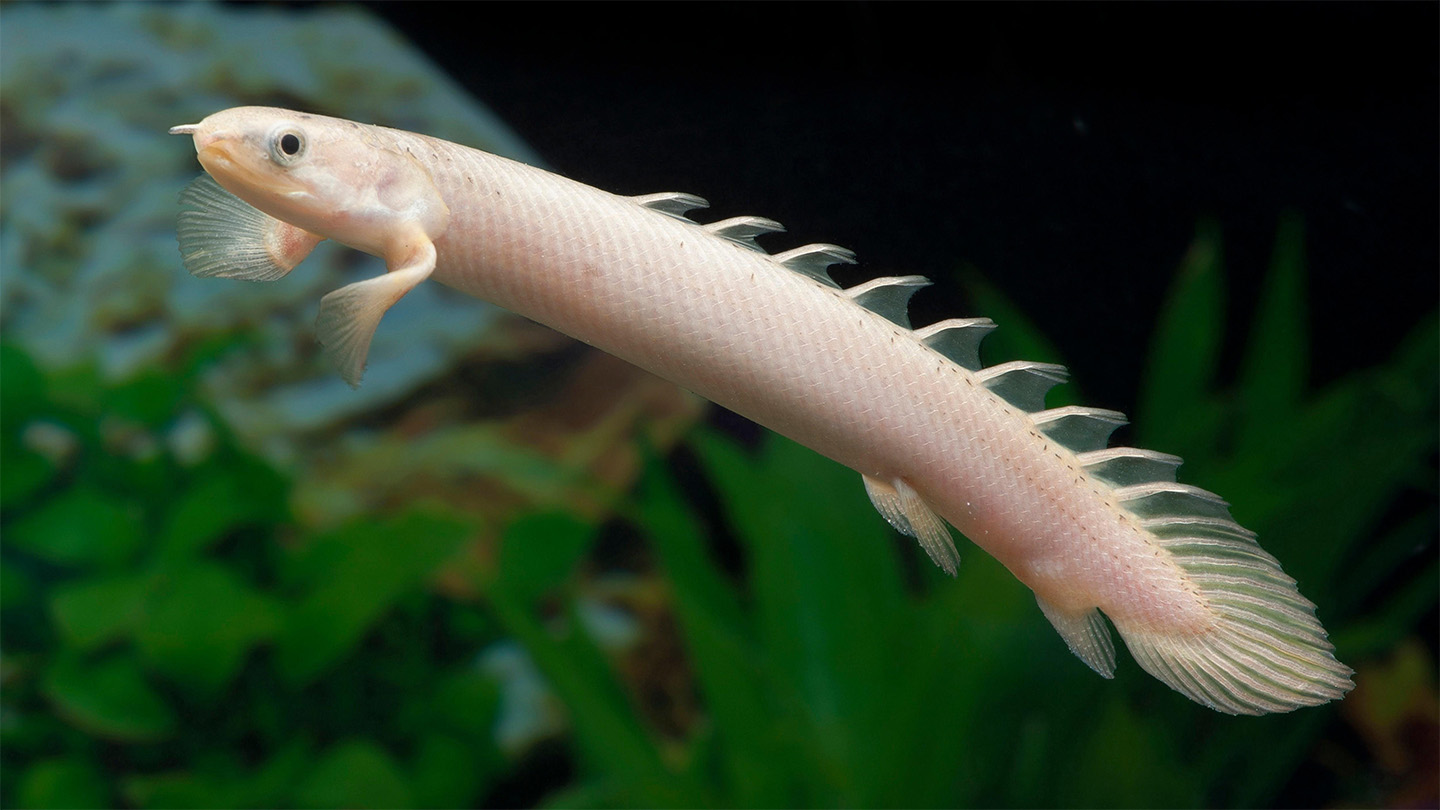
Interested in how vertebrates evolved — and often lost — the ability to regrow body parts, evolutionary developmental biologist Igor Schneider of Louisiana State University in Baton Rouge has focused on understanding regeneration in the Senegal bichir (Polypterus senegalus). This fish can regrow an entire lost fin. And because it sits at the base of the family tree of modern bony fish, the bichir is considered a living fossil.
Studying this fish “helps fill a big gap in the story of how regeneration evolved,” says developmental biologist Ji-Feng Fei of the Guangdong Academy of Medical Sciences in Guangzhou, China, who was not involved with the work.
For the new study, Schneider’s team cut fins off bichirs and tracked gene activity at the wound site after one, three and seven days, which revealed the types of cells present and their activity. The team compared those data to similar new and existing data about the axolotl, a salamander that regrows limbs, and the zebrafish, a modern bony fish that can regrow the bony tips of its fins.
In all three species, the team found that immune cells rushed to the scene. There, they first fended off bacteria, a typical response to wounding found even in humans. But in the bichir and axolotl, the immune system quickly switched tactics, dampening any further inflammatory response that would otherwise cause scar tissue to form.
Typically, blood supply — and consequently oxygen flow — is disrupted in wounds. The new data clarified how these three animals compensated: Many types of cells in the wound began producing energy using a chemical pathway that did not require oxygen. This energy fueled the production of more cells and of proteins and other materials needed for regeneration.
In the two fish species, myoglobin, which muscles depend on for oxygen storage, appeared in skin cells covering the wounds. Unexpectedly, red blood cells also rushed to the amputation site in the bichir and axolotl, eventually making up to 20 percent of all the cells at the wound site. Typically, red blood cells represent less than 2 percent of the cells in that part of a fin or limb. “The red blood cell thing blew my mind,” Fei says.
In humans, red blood cells lose their nuclei as they mature, but in both the bichir and axolotl these cells retain nuclei. Inside these nuclei, genes for controlling immune responses and for monitoring oxygen levels revved up their activity after the amputation, the team found. “It’s enticing to think [the red blood cells] are giving instructive signals” to other cells, Schneider says.
Genes for limb building and DNA repair also turned on, and two sets of repair cells developed, one forming near the base of the regenerating limb and one forming near the tip. All told, the work “is a big step in understanding how regeneration is coordinated,” Fei says.
The fact that many aspects of regeneration are shared in these animals, even though they evolutionarily diverged about 400 million years ago, indicates this ability is indeed ancient, Schneider says.
He hopes to learn more about regeneration by doing similar studies in lizards, which can regenerate tails but not limbs. One thing is certain, however: Spider-Man’s foil, Schneider says, “might have been more successful with salamander DNA, unless he wanted to regrow a tail.”
Read the full article here