

The “Resist and Unsubscribe” boycott is encouraging consumers to avoid supporting major tech companies and those that have been “enablers” of U.S. Customs and Immigration Enforcement (ICE) amid President Donald Trump’s ramped-up immigration enforcement.
Newsweek reached out to Scott Galloway, who is organizing the boycott, as well as companies targeted by the protest, for comment.
Why It Matters
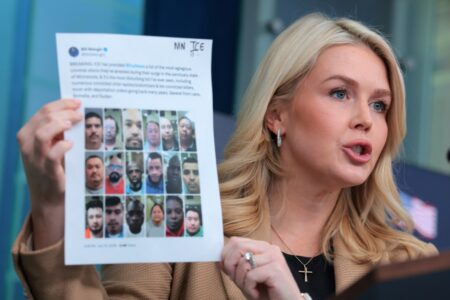
The Trump administration is facing growing scrutiny over its handling of immigration. While Trump campaigned on implementing mass deportations against undocumented immigrants, the administration’s efforts at doing so have been met with criticism. The fatal shooting of two U.S. citizens by federal immigration agents in Minneapolis, as well as reports of ICE tactics such as allegedly using a 5-year-old as bait, last month became a flashpoint in criticism toward immigration operations.
The boycott is the latest attempt by critics to put pressure on companies that may be able to influence government officials to bring change.
What Is the Resist and Unsubscribe Boycott?
Galloway, a New York University professor and critic of the Trump administration, is behind the protest. He wrote in a message explaining the boycott that it uses a “powerful weapon that has been hiding in plain sight,” as many Americans feel “powerless” to stand up to the administration.
“First, we must recognize that the president is unfazed by citizen outrage, the courts, or the media. He responds to one thing: the market,” he wrote. “The most potent weapon to resist the administration is a targeted, month-long national economic strike — a coordinated campaign that attacks tech companies and firms enabling ICE — to inflict maximum damage with minimal impact on consumers.”
He described the protest, which is “targeted at the companies driving the markets and enabling our president,” as “the shortest path to change without hurting consumers.”
Here is a look at the companies included in the protest.
ICE Boycott Company List
The protest focuses on two types of companies. The first is listed as “ground zero,” referring to subscription-based companies identified as having “outsized influence over the national economy and our president.” These companies are included in that protest.
- Amazon
- Apple
- Microsoft
- Paramount+
- Meta
- Uber
- Netflix
- OpenAI
- X
The protest also lays out the “blast zone,” or companies identified as “active enablers of ICE.” Those companies include the following:
- AT&T
- Comcast
- Charter
- Dell
- FedEx
- Lowe’s
- Marriott
- UPS
Amazon Boycott
Amazon, founded by billionaire Jeff Bezos, is among the companies that have faced several boycotts during the second Trump administration. It was also included in the “We Ain’t Buying It” protest campaign during Black Friday and Cyber Monday in November 2025. That campaign said Amazon “holds a monopolistic position in the market, contributes to dangerous working conditions for its employees and drivers, and CEO Jeff Bezos has donated over $1 million to this administration.”
The Resist and Unsubscribe boycott urges consumers to unsubscribe from Amazon’s myriad subscription programs, such as Amazon Prime, Audible and Amazon Music.
ICE and U.S. Customs and Border Patrol (CBP) have spent $140 million on cloud services from both Amazon and Microsoft under the Trump administration, Forbes reported.
Target Boycott
Target has also faced notable boycotts during the second Trump administration. Those were launched after the retailer announced changes to its diversity, equity, and inclusion (DEI) programs upon Trump’s return to office. The company experienced sales declines last year amid the protests, and executives acknowledged that the boycott played a role.
“We faced several additional headwinds this quarter including five consecutive months of declining consumer confidence, uncertainty regarding the impact of potential tariffs and the reaction to the updates we shared on belonging in January. While we believe each of these factors played a role in our first quarter performance, we can’t reliably estimate the impact of each one separately,” Target CEO Brian Cornell said in an earnings call last spring.
What People Are Saying
Boycott organizer Scott Galloway said in a YouTube video about the protest: “The Trump administration doesn’t respond to outrage. It responds to economic signals. It’s not about ideology. It’s about mechanics. When stock prices fall, when GDP looks threatened, when interest rates increase, all of the sudden we see a very crisp walking back of the president’s plans, whether that’s to annex Greenland or to reduce tariffs.”
Apple CEO Tim Cook wrote in a memo to staff last month: “This is a time for de-escalation. I believe America is strongest when we live up to our highest ideals, when we treat everyone with dignity and respect no matter who they are or where they’re from, and when we embrace our shared humanity. This is something Apple has always advocated for. I had a good conversation with the president this week where I shared my views, and I appreciate his openness to engaging on issues that matter to us all.”
What Happens Next
Protests and boycotts of companies supporting Trump and ICE are likely to continue over the coming months. The administration has taken steps to pull agents from Minneapolis, which has become the epicenter of the administration’s enforcement, but operations and deportations continue across the country.
In a polarized era, the center is dismissed as bland. At Newsweek, ours is different: The Courageous Center—it’s not “both sides,” it’s sharp, challenging and alive with ideas. We follow facts, not factions. If that sounds like the kind of journalism you want to see thrive, we need you.
When you become a Newsweek Member, you support a mission to keep the center strong and vibrant. Members enjoy: Ad-free browsing, exclusive content and editor conversations. Help keep the center courageous. Join today.
Read the full article here