



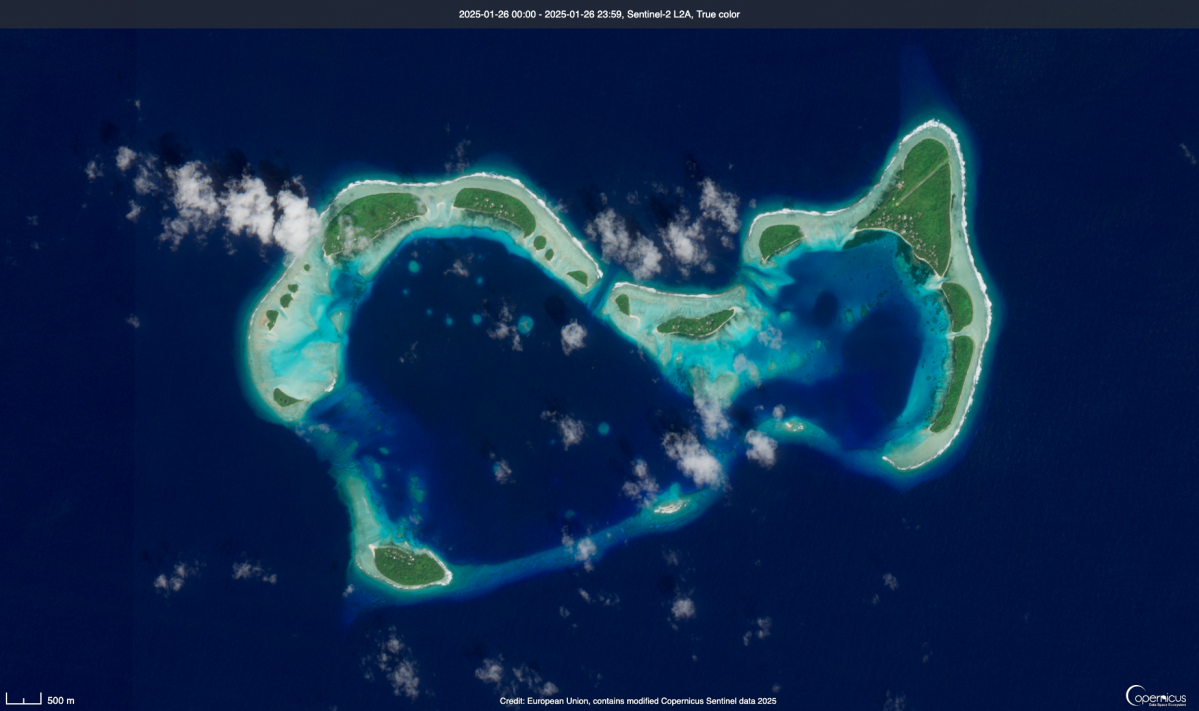
Satellite imagery reviewed by Newsweek this week showed Chinese-led work to revive a World War II-era runway was nearing completion in the remote South Pacific atoll of Wolaei, just a few hundred miles from Guam.
Why It Matters
Wolaei island is in the Federated States of Micronesia (FSM), which along with the Marshall Islands and Palau is a member of the Freely Associated States, countries that depend on the United States for security and economic aid in exchange for American military access to their territory.
Micronesia’s vast archipelago sits along the so-called second island chain, one of three strategic lines the U.S. Defense Department considers key to containing China’s military in the event of a conflict. Western analysts say growing Chinese investment in the South Pacific could erode the U.S.’s political influence and military advantage.
Newsweek reached out to China’s embassy in Palikir, Micronesia’s capital, with an emailed request for comment.
What To Know
Imagery captured by the European Space Agency’s Sentinel-2 satellites between January and December this year showed marked progress on the runway at Woleai airport in Micronesia’s Yap State, where work to restore the old airfield began in May.
The Woleai civilian airfield is being redeveloped by China’s state-run Shandong Hengyue Municipal Engineering Co. and is slated for completion by the end of the month, according to Cleo Paskal, a nonresident senior fellow at the Foundation for Defense of Democracies, a Washington think tank.
The airport is expected to serve as a major boost for the atoll’s 1,000 residents, who currently rely on an infrequent, multi-day transport ship—also provided through Chinese assistance—to reach the nearest runway and access flights to other parts of the state and beyond.
The Woleai runway was originally built by Imperial Japanese forces in late 1942 or early 1943, according to the South Carolina-based nonprofit the Habel Institute, but was virtually destroyed by American bombers during the Pacific War.
The U.S. Navy rehabilitated the strip in the 1970s, making it one of three airstrips on Yap’s outer islands. However, it was prone to flooding and eventually became unusable due to damage.
What People Are Saying
Wu Wei, China’s ambassador to Micronesia, wrote in a December 3 op-ed in The Kaselehlie Press, a Pohnpei state newspaper: “We are willing to join hands with the FSM to further expand cooperation in various fields such as infrastructure and climate change response, continue to deepen exchanges in education, youth, and subnational cooperation so as to advance the China-FSM Comprehensive Strategic Partnership, jointly build a closer community with a shared future between China and the Pacific Island countries, and work together to promote peace, development, and prosperity in the Pacific Islands region.”
What Happens Next
Following the renovation, Shandong Hengyue is set to begin work on a bridge project in Micronesia on the state’s main island Yap Proper, according to Paskal.
Recognizing the region’s strategic value, the U.S. has increased its infrastructure investments in Micronesia, pledging $2 billion to support projects aimed at enhancing military mobility—including $400 million for upgrades to Yap International Airport. However, outer islands like Woleai remain underserved, Paskal said.
Read the full article here