



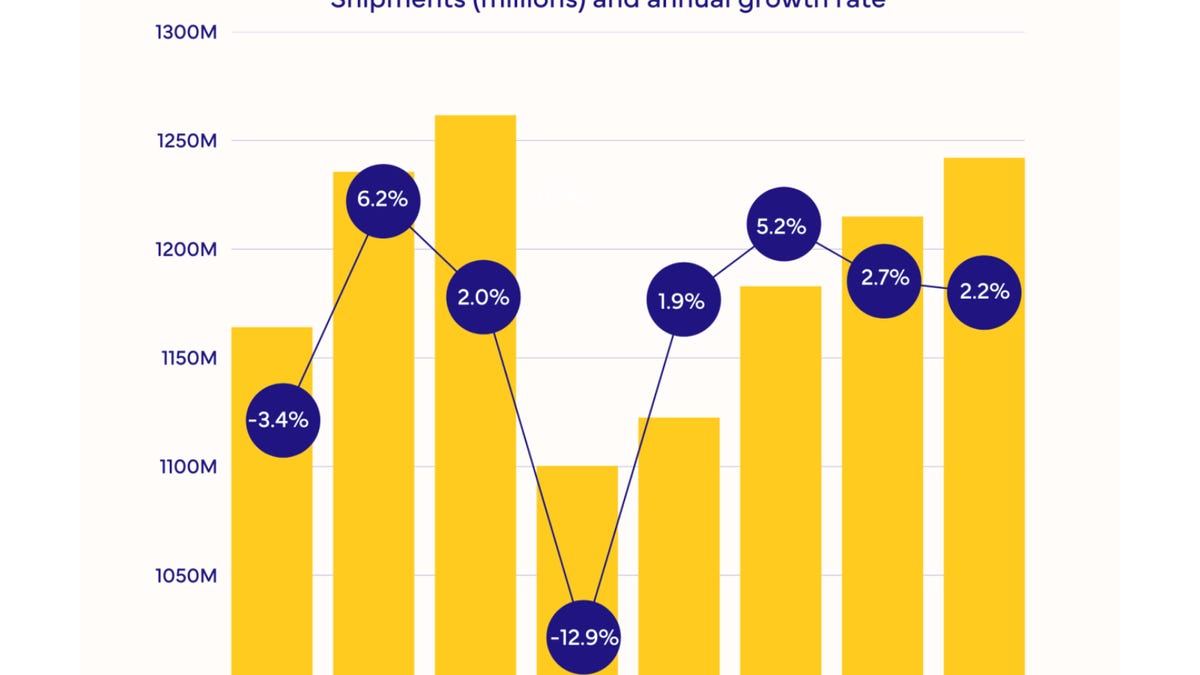
The projected shortage of memory chips worldwide will have a more serious impact on smartphone sales in 2026 than previously projected, according to new data from International Data Corporation Worldwide. Whereas the company just in November had estimated a drop of between 0.9% and 5.2% (the latter being its “pessimistic scenario”), now it sees a 12.9% decline this year, based on its Worldwide Quarterly Mobile Phone Tracker.
“What we are witnessing is not a temporary squeeze, but a tsunami-like shock originating in the memory supply chain, with ripple effects spreading across the entire consumer electronics industry,” Francisco Jeronimo, vice president for Worldwide Client Devices at IDC, said in a statement.
The hardest-hit companies are expected to be those selling to the lower end of the market, which can’t absorb the higher component costs while maintaining profitable margins. As a result, Jeronimo says, many of those players will pass the added costs on to consumers.
That also includes regional markets like the Middle East and Africa that sell mostly inexpensive smartphones, which could see a steep 20.6% drop year-over-year.
IDC predicts a steep drop in smartphone sales for 2026.
By contrast, IDC expects Apple and Samsung to be better able to withstand the crisis. “As smaller and low-end-positioned Android vendors struggle with rising costs, Apple and Samsung could not only weather the storm but potentially expand market share as the competitive landscape tightens,” said Jeronimo.
Memory has become scarce due to the insatiable demand to feed generative AI. Essentially all of the memory set to be manufactured this year is already earmarked. What started as a demand for graphics processors has expanded to other components. For example, hard drive manufacturer Western Digital announced in early February that it had already sold out of its supply for 2026.
“We expect consolidation as smaller players exit, and low-end vendors face sharp shipment declines amid supply constraints and lower demand at higher price points,” said Nabila Popal, senior research director at IDC, projecting a 14% rise in the average selling price of smartphones to $523.
Popal expects memory prices to stabilize by the middle of 2027, but doesn’t see them coming down to earlier levels. The sub-$100 segment, made up of approximately 171 million devices, will be “permanently uneconomical,” she said. “In short, there is no return to business as usual for vendors and consumers.”
Read the full article here