



Hearing difficulties aren’t just an issue for older adults. Roughly 48 million Americans have some kind of hearing issue in one or both ears, according to a CDC report. What’s to be blamed? From listening to music at dangerously loud volumes to regular exposure to unhealthy ambient sound levels at concerts or sporting events, hearing difficulties are a silent epidemic plaguing young Americans.
That got us thinking — just how good was our own hearing health? Moreover, what can we do to safeguard it? CNET’s wellness experts put Apple’s Hearing Test through its paces using the AirPods Pro 2. We also tapped experts for professional opinions and to better understand the results. Here’s what we found.
What is the Apple Hearing Test?
In the fall of 2024, Apple announced its clinically validated Hearing Test with its Hearing Aid and Protection features. To turn your AirPods into hearing aids, you must first take the Hearing Test, which is based on pure-tone audiometry.
The hearing test built into the AirPods Pro is more scientifically backed than what you would expect from a consumer device. Using the Health app on your iPhone or iPad, you’ll be taken through a series of tones at different volumes (similar to what’s used in a clinical setting), and you will be given a result based on your answers in one of these five categories: slight, mild, moderate or severe hearing loss or normal hearing.
Apple received FDA authorization for this hearing test as an over-the-counter hearing aid and screener. It’s important to note that it doesn’t provide a diagnosis, but it’s a great screening tool that can flag something worth discussing with your doctor.
Apple’s hearing test also integrates seamlessly into the brand’s broader hearing health ecosystem, including real-time monitoring of environmental noise levels, a hearing aid mode that can amplify ambient sound and headphone audio exposure tracking.
How to take Apple’s Hearing Test
To take Apple’s Hearing Test, you need the AirPods Pro 2 or AirPods Pro 3 and a compatible iPhone or iPad. The test takes about five minutes to complete. First, connect your AirPods to your iPhone or iPad. Go to Settings, click your AirPods, then under Hearing Health, click Take a Hearing Test.
“The idea that they can test their hearing before they have significant concerns is a great way for many people to get baseline hearing testing done,” Tricia Ashby-Scabis, senior director of audiology practices at the American Speech-Language-Hearing Association, tells CNET. “When I was working clinically, I could not tell patients if their hearing had changed unless I had tested them previously. Most people don’t undergo baseline hearing testing and don’t seek services from an audiologist until they suspect they have hearing loss. If they are curious and test their hearing with their AirPods, we now have a baseline audiogram to work from for monitoring potential changes in hearing.”
Lachelle Lazarus, AuD, an audiologist at the University of Maryland Medical Center, adds that the Apple Hearing Test is “particularly useful in reaching those of a younger generation who tend to be more tech-savvy.” With the test raising awareness of the importance of hearing health, younger adults and teens can realize they are also susceptible to hearing loss.
Anna’s experience: I had no issues the first time I took the test. The second time, however, before I could take the test, I was asked to adjust my AirPods or use different Ear Tips. I kept moving them around in my ear and eventually went into my bathroom, shut the door and turned off the light for complete quiet. Then, it worked.
Ashby-Scabis reported a similar experience after purchasing AirPods Pro 2 for her mom. “Her AirPods Pro 2 kept telling us to reposition the AirPods,” she explained. “I used an otoscope and looked at her ear canals, revealing she has a very steep slope upward and significant narrowing of stiff ear canal walls. Once I had a better idea of her ear canal rise, I refit the AirPods Pro 2 and she was ready for her hearing test.”
I found the test simple and straightforward, but it was hard for me to concentrate solely on the tones I was hearing. I ended up having to close my eyes to really focus (and so I wouldn’t get distracted by the sound of my own blinking). Even though my bathroom is the quietest place in my apartment, I could still hear some outside noises, so if you do take the test, I would recommend doing so in the quietest environment possible.
I also like that the results are saved in the Health app so you can look back at them. There, you can also find information about environmental sound levels, headphone audio levels, noise and headphone notifications and articles on hearing.
Nasha’s experience: I also found the hearing test process easy to follow, with clear instructions guiding me through each step. One of the biggest challenges I encountered (similar to Anna) was finding a truly quiet environment. I attempted the test at my office, and despite it being a relatively quiet space, the app repeatedly prompted me to move to a quieter location. I think this highlights a potential limitation, as many people may struggle to find a place that meets the app’s noise-level requirements, especially in workplaces or busy households.
Once I found a moment of quiet, I could focus on the test itself. A few moments into the test, I realized I needed to close my eyes to concentrate on the sounds. The test involves listening for faint beeps at different frequencies, and while I was sure I heard them at times, there were also moments of doubt. Was that a beep or just my mind playing tricks on me? This experience underscored how subjective hearing perception can be.
Overall, Apple’s hearing test is a useful tool for raising awareness about hearing health, but the need for a silent environment could be a barrier for some users. It’s a good reminder that while at-home screenings are helpful, they’re not a replacement for professional hearing evaluations.
What we learned
According to Apple, “Hearing test results (audiograms) are the result of an audiometry test and show your hearing ability at different frequencies of sound measured in decibels (dBHL). The higher the decibels, the louder a sound needs to be for you to hear it.”
The American Speech-Language-Hearing Association states, “Decibels, or dB, describe loudness. The term dB HL describes your hearing loss in decibels.”
With Apple’s Hearing Test, the average hearing for both the right and left ears is based on the four frequencies most important for speech: 500Hz, 1kHz, 2kHz and 4kHz.
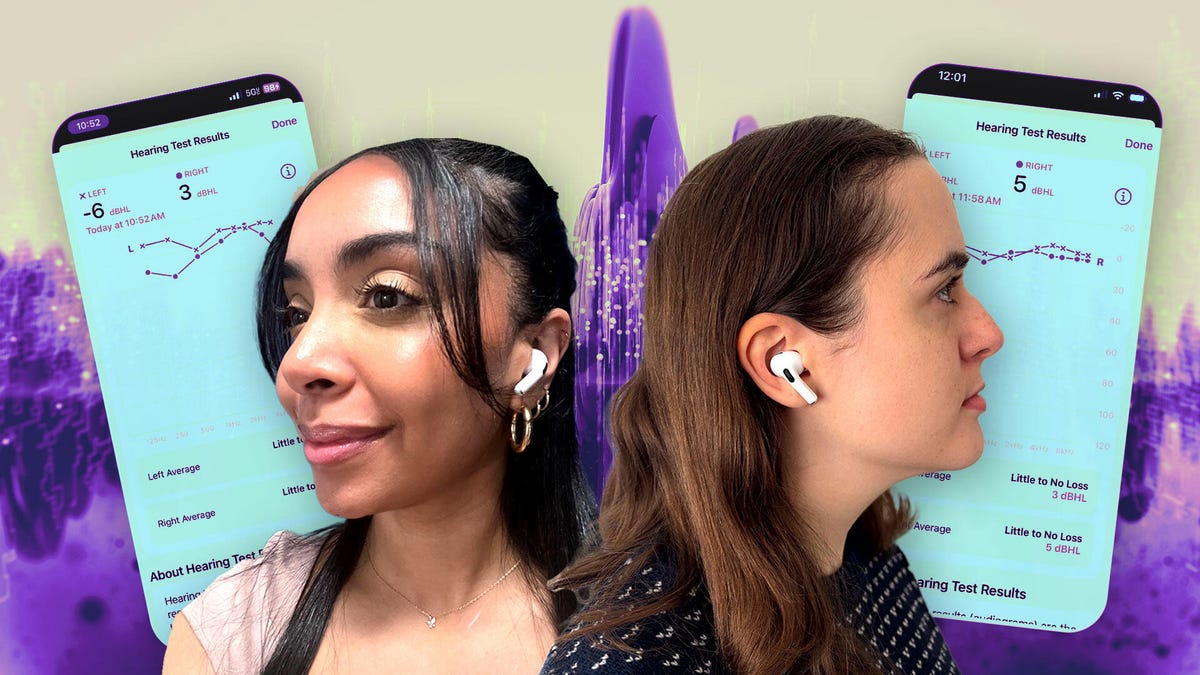
Anna’s results: Lately, I’ve been concerned about my hearing, so I was pleasantly surprised that Apple’s Hearing Test indicated that I have “little to no hearing loss.” It specifically revealed that my left ear is 3 dBHL while my right ear is 5 dBHL. When I took the test a second time, my left ear was 2 dBHL and my right ear was 4 dBHL.
In other words, the degree of hearing loss in my right ear is greater than that in my left ear. I always thought my hearing was worse in my left ear, especially because I tend to have more sinus issues on my left side, so this was interesting.
It was cool to get this information right on my phone instead of taking the time (and money) to do it in an audiologist’s office. (However, note that Apple isn’t providing a full diagnostic audiogram.) Though Hampden Hearing Center states that most insurance plans will cover a hearing test if it’s medically necessary, that depends on the plan. I also wouldn’t classify my curiosity about my hearing as medically necessary.
Nasha’s results: My hearing test showed little to no hearing loss, which was reassuring. The results of the first test I took said my left ear is 3 dBHL and my right ear is 5 dBHL (same as Anna!). I took the test a second time because the first time I was at my office, and there was a little noise from the air conditioner. The second time around, my results were even better than the first. (This time, I took it in a quiet room in my home.) My left ear is -6 dBHL, and my right ear is 3 dBHL.
The writer, Nasha, wearing the Loop Switch 2 on the subway.
Given that I live in New York City, where noise pollution is a constant factor — whether it’s from the subway, construction sites or traffic — I’ve become more aware of it recently. This test was a good reminder of how important it is to be proactive about your hearing health. One key takeaway for me is that while my hearing is currently in good shape, long-term exposure to high decibel levels could change that. I’ve learned that everyday city sounds can contribute to gradual hearing damage. Since taking Apple’s hearing test, I now carry my Loop earplugs with me at all times to wear on the train or when in noisy environments.
Regarding results, Ashby-Scabis mentioned that a friend who experienced sudden-onset hearing loss found that, while monitoring her treatment, an Apple audiogram matched the hearing test she had obtained from an audiologist. “It was a very interesting way to track her hearing without going into the doctor’s office,” says Ashby-Scabis. “She bought the AirPods Pro 2 for the hearing aid feature but discovered the benefit was the hearing testing for keeping her informed during her treatment.”
If you receive results that concern you, Dr. Lazarus advises scheduling a comprehensive hearing test with a local audiologist. “As mentioned in this article, the environment of administering the test is crucial,” she says. “If there is background noise or a lack of mental focus from the tester, the reliability of the test decreases.”
How we protect our hearing health now
After you’re done taking your hearing test, through the app you can read articles about how to protect your hearing and why it’s important. In general, that’s one of the great things about Apple’s hearing features — they remind you of how important hearing health is and that you should focus on protecting it.
Using earplugs on a regular basis
I started wearing earplugs regularly after taking the hearing test. I wear them on the subway, at concerts and even when I go dancing. It’s become such an integral part of my daily life, similar to wearing sunscreen or a seatbelt. It’s something I do because I understand the risk.
My favorite pair of earplugs has become the Loop Switch 2, which, unlike foam plugs that muffle surrounding noise, uses a manual dial to move between modes: 20dB maximum noise reduction (ideal for conversation in loud spaces), 23dB (preserves sound quality at events like concerts) and 26dB (maximum noise reduction for commutes or deep focus). And for all of the Formula 1 fans, Loop partnered with McLaren to offer a limited color in papaya orange and anthracite. My partner uses these daily and gets so many compliments.
Use noise monitoring
“My Apple Watch and phone let me know when I am exposed to loud sounds,” says Ashby-Scabis, referring to a feature in the Noise app on the Apple Watch. “I like that there is a way to identify when my environment is too loud. Once we are exposed to noise, especially when it is persistent/consistent, we can experience ear damage and hearing loss. Once that damage occurs, there is no way to undo it.” That is why Apple’s noise monitoring is a great way for people to know precisely when they may be exposing their ears to damaging noise levels.
Being conscious of loud noises
If you’re around loud noises, such as at a concert or in a restaurant with blaring music, make sure you give your ears a break afterward. Or wear earplugs. The same goes for listening to music through your headphones. Now, whenever I’m listening to music, I ask myself: Does it need to be this loud?
The writer, Nasha, wearing the Loop Experience at a concert.
“For the preservation of hearing, use of earplugs in noisy environments is key!” says Dr. Lazarus. “These environments include but are not limited to concerts, movies and sporting events. Musician earplugs are also a great way to protect your hearing while enjoying certain environments, as they dampen the noise instead of providing full blockage of the noise.”
Take hearing loss seriously
Long-term exposure to loud sounds can lead to permanent hearing loss. If I’m ever concerned about this to the point where it feels medically necessary, I will consult an audiologist. This is also important because I want to make sure no other medical conditions are at play.
Be aware of other things that can cause hearing loss
Loud noises aren’t the only things that can cause hearing loss. Infections, head trauma, high blood pressure, diabetes and dental problems are just a few of the unexpected conditions that can lead to hearing loss.
Read the full article here