




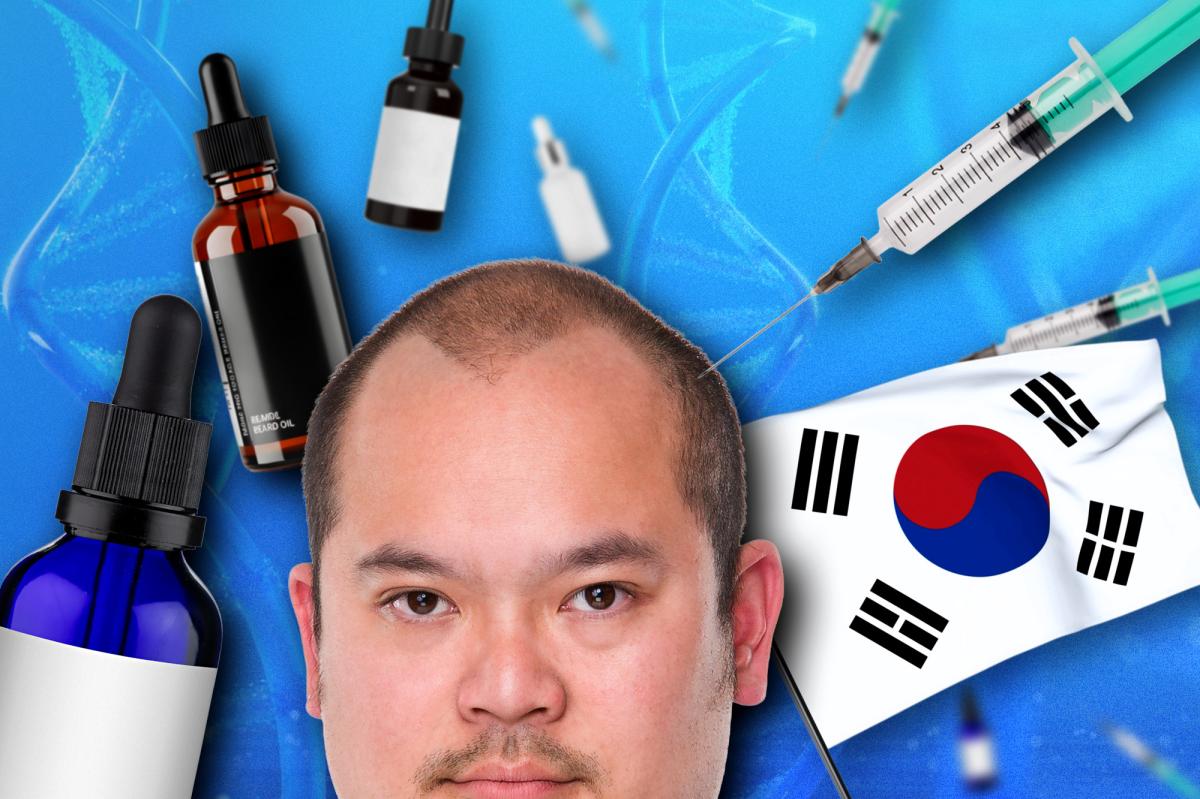
Hair loss is stressful. In South Korea, it’s now being treated like a national crisis.
President Lee Jae Myung recently called hair loss a “matter of survival” and going so far as to call for treatments to be covered by national health insurance.
With the global hair-thinning market expected to nearly double from about $1.5 billion in 2024 to roughly $2.75 billion by 2030, demand for new solutions is booming worldwide.
And Korea’s on the cutting edge of innovation, creating new treatments that are only just being popularized in the US — or haven’t even made their way over here yet.
Why hair loss is such a problem in Korea — and why they’re ahead on addressing it
The idea of “lookism” — judging people based on appearance — exists everywhere. But in South Korea, it’s a defining cultural force.
“Korea is a small, highly collective society, and people are extremely sensitive to others’ perceptions,” Dr. Jae-Hyun Park, a plastic surgeon and hair restoration specialist at Dana Plastic Surgery Clinic in Seoul, told The Post. In a culture shaped by K-pop idols, he added, appearance has become a form of competitiveness.
That social pressure has helped turn Korea into one of the world’s most aggressive testing grounds for cosmetic and medical innovation.
“Korea has very fast clinical adoption,” said Dr. Hee Jin Kim, medical director of PureenMD Skin, who notes it often takes years for similar treatments to reach the US.
The result is a hair-loss industry that is consistently developing and optimizing the next generation of solutions, from gene-silencing serums and regenerative cell therapies to enhanced delivery systems.
The gene-silencing approach
One of the most innovative ideas in hair loss right now is CosmeRNA, an easily applied topical treatment developed in South Korea that uses small interfering RNA technology.
It works by blocking the follicle’s androgen receptor — the signal that tells hair to thin and fall out — rather than suppressing the hormone systemically.
The brand claims that after 16 weeks of weekly use, users saw an 86% visible improvement in their hair.
“I find RNA-based therapies compelling because they go directly after the genetic signaling that drives pattern hair loss,” said Dr. Ross Kopelman, a hair transplant surgeon in New York City.
CosmeRNA is used in many Korean clinics and can also be purchased online in the United States, where it’s registered as a cosmetic rather than a drug.
“CosmeRNA is one of the more talked-about newer approaches because it’s scalable and easy to apply,” said Dr. Hee Jin Kim. “But it’s still best viewed as an early-stage treatment rather than a proven therapy.”
Exosomes
Exosomes have become one of the biggest buzzwords in aesthetics.
These microscopic signaling particles regulate inflammation and tissue repair. In hair restoration, they’re being explored for their ability to help keep follicles in the growth phase. A 2023 study found that patients treated over 12 weeks showed significant improvements in hair density and thickness.
In Korea, exosomes are most often applied topically with microneedling to boost penetration. In the US, injected exosomes are not FDA-approved, but topical use is in a gray area and increasingly common.
While exosomes show promise, inconsistent sourcing and contamination are risks, warned Dr. Jane Yoo, a dermatologist at the Clinical Research Center of New York. “Many of the ‘exosome hair’ offerings are marketed ahead of evidence and ahead of regulatory clarity.”
Regeneration: stem cells and dermal papilla cells
If gene silencing and exosomes are about repairing damaged or dormant follicles, the real innovation lies in regeneration, which can regrow new hair altogether.
In Korea, stem-cell-based hair treatments are already used in clinics, typically using regenerative components from a patient’s own tissue — often blood or fat — and injecting them into the scalp to stimulate dormant follicles.
“This is the future of administering products into the scalp.”
Dr. Eunice Park on microneedling
Dr. Daewoo Kim, medical director of Monara Dermatology Clinic in Seoul, said these are “one of the most biologically promising options.” Still, he stresses they should be viewed as supportive therapies, not cures. In the US, injected stem cells for hair loss are not FDA-approved.
A more ambitious, and still investigational, approach is something called autologous dermal papilla cell therapy. Dermal papilla cells are the command center of the hair follicle, influencing growth and even pigmentation. The idea is to harvest these cells from healthy follicles and reintroduce them to weakened ones to restart growth.
But even in Korea, this is still a niche. “While the science is exciting, reproducibility, cost and scalability remain major obstacles,” said Kim.
The delivery revolution: microneedling without the needles
Even the most promising treatments depend on how well they’re delivered.
“Simple topical application has clear limitations,” said Kim. Microneedling, which uses tiny needles to create microchannels in the skin, has become one of the most practical and evidence-backed ways to improve product absorption in the scalp.
“In Korea, microneedle-based delivery systems are no longer viewed as optional — they are considered essential to successful treatment protocols,” he added.
While microneedling is also used in the US, Korean clinics are pushing the technology further with more precise depth control and needle-free, jet-powered devices like CureJet.
“It’s similar to a pressure-based system that disperses product under the skin without needles,” said Dr. Eunice Park, a facial plastic surgeon at AIREM in New York.
Studies show microneedling alone can improve blood flow and encourage growth — though it can be uncomfortable. “This is the future of administering products into the scalp,” Park said.
What else is different between Korea and the US
Most of what’s popular in Korea already exists in some form in the US, but the difference is what gets tried first. Treatments like Botox, already widely used in Korean hair clinics to improve scalp blood flow, remain relatively niche in the US.
“In Korea, there is also always a push for noninvasive methods,” said Dr. Christina Han, a dermatologist and medical director at XYON Health. “That pushes physicians and the industry to think more outside the box.”
Still, the hype comes with caveats. “That doesn’t mean everything coming out of Korea is proven, but it often shows us where the field is heading before it reaches the US,” said Dr. Kopelman.
Read the full article here