




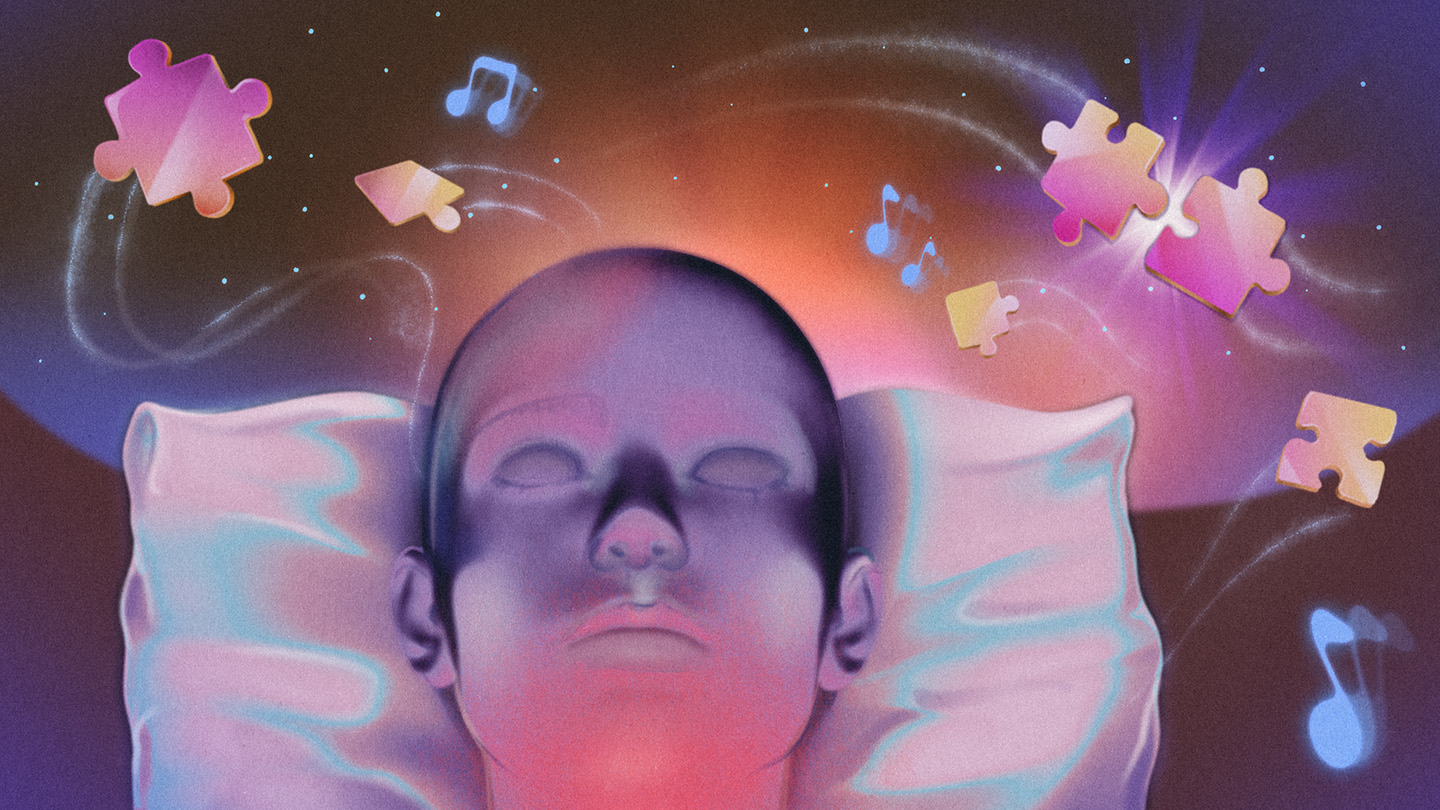
When solving a puzzle, the answer could lie in your dreams.
In a study of lucid dreamers, playing soundtracks linked with unsolved puzzles helped the sleepers solve the problems the next day, researchers report February 5 in Neuroscience of Consciousness.
Stories of brilliant insights after a nap or daydream abound, but scientists have struggled to successfully influence people’s dreams and rigorously test the idea. “This study provides one of the first experimentally grounded demonstrations of such a link,” says Giulio Bernardi, a cognitive neuroscientist at IMT School for Advanced Studies Lucca, in Italy, who was not involved with the work.
Whether we remember our dreams or not, we have countless dreams in our sleep, according to Karen Konkoly, a cognitive neuroscientist who performed the study at Northwestern University in Evanston, Ill. “Your dreams are such a big part of your inner life,” she says.
And in the right circumstances, manipulating those dreams could help people think of problems in new ways.
While some scientists have shown that sleeping on a problem increases the odds of solving it the next day, others have shown no benefit. Of course, it might help only if you actually think about the problem in your sleep.
Konkoly and her colleagues were especially interested in helping sleepers think about specific topics using targeted memory reactivation, or TMR. “It’s this research technique where you have a sensory stimuli that’s associated with a memory,” Konkoly says. “It could be a very soft sound or a smell that’s presented to a sleeper, and it functions to remind the sleeping brain of the full memory.” While people dream in every stage of sleep, the effects of TMR have been strongest in deep, slow-wave sleep, she says. Konkoly wanted to look at the effects of TMR at a different sleep stage — rapid eye movement sleep, which could be helpful for creative thinking.
She and her colleagues recruited 20 volunteers who could lucid dream — where someone realizes they are dreaming, and can even potentially change the dream as they dream it.
The participants were given sets of brain-teasing puzzles to solve, some they could — and some they couldn’t. Each was accompanied by a specific soundtrack unrelated to the task itself, such as a brief clip of instrumental music. The scientists next hooked the participants up to electrodes to monitor their sleep and put them to bed.
At 4 a.m., the participants were woken up and encouraged to lucid dream as they returned to sleep. Then, the scientists started playing sounds associated with the puzzles the participants couldn’t solve, asking them to sniff to indicate they were working on the puzzles in their sleep. The next morning, 75 percent of sleepers reported dreaming about the unsolved puzzles, though participants were only able to lucidly dream of the problems nine times.
Sleepers who heard the sound cues in their sleep and dreamed about the puzzles —even if they weren’t lucid dreaming — solved the puzzles they dreamed about 42 percent of the time, while those who didn’t dream about the cued puzzles only solved them 17 percent of the time.
While the effects were modest, the idea of hacking your dreams to increase productivity and problem-solving could tempt some people. But that’s not why Konkoly does this research. “I don’t think that all our dreams should be corrupted for creative problem-solving,” she says. “I want people to value dreams more,” for their own sake, as what can be disjointed reflections of our inner lives and experiences.
Read the full article here