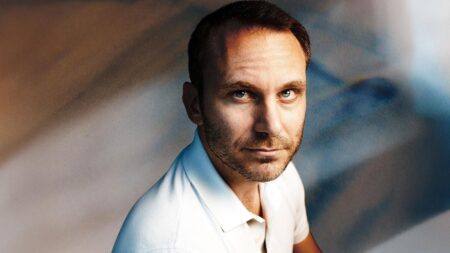




Jyoti Bansal sold his first company to Cisco in 2017 and then hit the road. He was on his second African safari, eyeing the now-familiar Savanna, when it dawned on him that over the past several months he had already hiked Machu Picchu, marveled at Norwegian fjords and trekked across the Himalayas. He was only 39 and there was nothing left on his bucket list.
“I tried to retire,” says Bansal, now 47, from his home office in San Francisco, where he lives with his family. “People say, ‘Once I retire, I’m going to do what I enjoy.’ I asked myself, ‘Do I enjoy playing golf all the time or being on the beach all the time?’ I don’t really. I realized why not just go back to what I enjoy, building a company.”
So he launched Harness, an AI-based software delivery platform that announced on Thursday that it has raised a $240 million Series E round from Goldman Sachs Alternatives, Institutional Venture Partners and Menlo Ventures at a $5.5 billion valuation—enough to make Bansal a new billionaire. Forbes estimates his net worth is $2.3 billion, thanks to an estimated 30% stake in Harness and plenty of cash from selling his first company, AppDynamics (which diagnoses and troubleshoots software anomalies), to Cisco in 2017, mere days before it was set to IPO.
Bansal’s first venture inspired his second. “The problem I was fascinated with at AppDynamics was when you ship software and a glitch happens or an outage happens, [our software] helps them fix it,” he says. “People don’t often realize writing code is just the first 30% of the job. Then you have the next 70% of the job to make sure you test that code properly.”
Harness uses AI agents to automate the manual labor of making sure code is secure and compliant with different regulations. Harness does this by breaking up the different tasks involved in shipping code, such testing, optimizing and securing that code, by using AI to automate each of those steps. Bansal compares the technology to a physical safety harness; it sells its delivery software to companies ranging from United Airlines to Citi to reduce an engineer’s toil of testing and deploying code. “If you bring a trillion dollars of efficiency to the world, people will gladly pay you at least 10% of what you save them,” says Bansal. He’s not quite at a trillion, the company generates closer to a quarter of a billion so far, but generative AI is making the service that much more mission critical. Says Bansal: “If AI is helping write, the volume of code is going up something like 10 times and now people are struggling to test it all.”
While most of its revenue comes from the continuous delivery business, Harness runs 16 other related products under its business, such as cybersecurity company Traceable, a separate company that Bansal founded and later merged with Harness that prevents hackers from attacking a company’s code through its interface systems.
“That’s what he calls a startup within a startup,” says Steve Harrick, a partner at Menlo Park, California-based Institutional Venture Partners, which has funded all three of Bansal’s businesses in addition to companies like Discord, Klarna and Slack. “When he came to pitch Harness [in 2017], he didn’t only pitch continuous [software] delivery, he laid out a roadmap for the next five to seven modules they were going to do.”
“It’s a very ambitious way to build a company,” Harrick continues. “But in our first meeting, [Bansal] showed me a 10-year progression to a billion dollars in revenue. And he said, ‘That’s what we’re going to do.’…I’m really pleased to say that he’s on track.”
Bansal grew up helping his dad with his farming machinery business in a small town in India’s Rajasthan state, before testing into Delhi’s Indian Institute of Technology for computer engineering. There he says he became enamored with entrepreneurship, recalling a campus visit from Bill Gates and reading about an alumnus “legend” Sabeer Bhatia, cofounder of Hotmail. “That’s what brought me to Silicon Valley,” Bansal says.
At 21 years old, he hopped on a plane to California with a few hundred dollars and dreams of getting a green card and starting his own company. But first he had to work. He spent seven years as an engineer at three small enterprise tech companies, which sponsored his H1-B visa.
“The challenge unfortunately is if you’re on an H1-B visa, you’re not allowed to start a company and create more jobs, which I find very ironic,” says Bansal, who became an American citizen in 2016. “I had to wait for some time until I got a green card.”
“I do think our superpower in America is that we can attract the best talent from all over the world,” he elaborates. “Anything that removes that advantage to me is short-term thinking and is not good for us as a country.”
Have a tip? Contact Simone Melvin at smelvin@forbes.com
Green card in hand, Bansal founded AppDynamics in 2008 to supply a sophisticated troubleshooting platform for complex platforms like Netflix and Priceline–effectively helping engineers at those companies reduce downtime and issues on their websites or services. After several initial rejections, he secured his first venture capital checks, raising a $5.5 million Series A round for AppDynamics that same year.
“Netflix was just starting their streaming business and moving everything online,” Bansal remembers. “Imagine you’re a consumer on Netflix who gets frustrated because video is buffering. So some of our initial customers were companies like [Netflix], where we help their engineers to make sure no glitches happen or if glitches happen, they can fix them very fast.”
Bansal scaled AppDynamics for more than a decade over six funding rounds, and the company was bringing in more than $200 million in revenue when Bansal decided to take it public. “We were about to list on Nasdaq and ring the bell on a Thursday in January of 2017,” says Bansal, but tech giant Cisco came knocking. Bansal negotiated to scrap the IPO and instead sold AppDynamics for $3.7 billion. Forbes estimates that Bansal walked away with hundreds of millions of dollars. AppDynamics now generates more than $1 billion in revenue for Cisco, according to IVP’s Harrick.
Bansal left AppDynamics soon after the acquisition, and following his brief attempt at an early retirement, he quickly came back to attack a list of problems he wanted to solve. “I strongly believe to build a company, you have to spend a lot of time on it,” he says. “Ten years at least.”
After traveling for around half a year after the AppDynamics sale, he founded Harness with the goal of allowing computer engineers to spend less time on the “unnecessary work that no one wanted to do” involved in testing and shipping code.
“The whole world is running on code, whether banking or transactions or airlines or everything–and that code needs a safety harness,” he says. “It frees up the developers to do interesting things and we can make sure everything is tested and deployed properly.”
Since its founding, Harness has been using AI to automate tasks. “Our first AI technology was to figure out if you make a change in the code, would it break something or not?” Bansal says. “In the last couple of years, agentic AI has become a very powerful part of the Harness platform…there might be a complex task that could take weeks of work to do. Now you go to these AI assistants to do most of this work for you.”
Altogether San Francisco-based Harness has raised $570 million to expand its market presence and accelerate innovation. The company, which has more than 1,200 employees in a hybrid work model, is growing 50% year-over-year. Bansal hopes it will one day allow him to knock a new item off his bucket list: “We want to IPO,” he says. “We didn’t get to do it last time.”
Read the full article here