

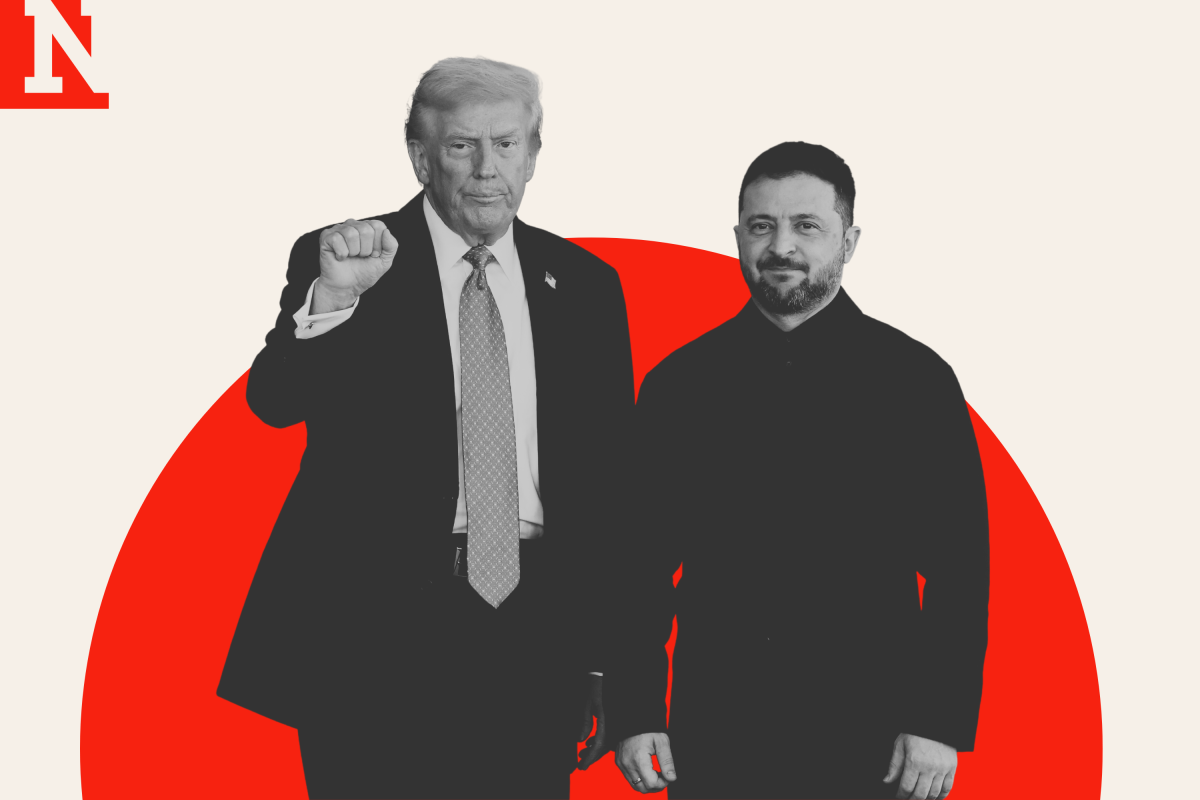
President Donald Trump spent Saturday night at the Kennedy Center Honors in Washington, having complained to reporters outside that Ukrainian President Volodymyr Zelensky hadn’t even read the latest U.S. peace proposal to end the Russia-Ukraine war. The image is pure 2025: America’s culture elite inside celebrating, America’s president outside berating a wartime ally for dragging his feet.
After a Saturday call with Trump’s special envoy Steve Witkoff and son-in-law Jared Kushner, Zelensky described recent Ukrainian-U.S. negotiations as “constructive, though not easy” and headed to London for talks with European leaders. As Russian missiles and drones again slammed into Ukrainian cities over the weekend, the choreography is looking uncomfortably familiar: a White House eager to declare “peace,” a Kremlin signaling just enough optimism to keep talks alive, and a Ukrainian leader trying not to be sold out by the people underwriting his survival.
The question hanging over all of it is simple and brutal: is Trump’s plan a path to end Europe’s bloodiest war since 1945, or a Russian wish list in White House wrapping paper?
Why is this happening?
The war is nearing its fourth year, with tens of thousands dead and entire Ukrainian cities leveled since Russia’s full-scale invasion in February 2022. Trump came back to office promising to end it “within 24 hours,” and his team has spent months trying to convert that campaign line into an actual deal.
The core of the current drama is a 28-point peace framework emerging from talks between Witkoff and Kremlin-linked figures, then circulated to Kyiv and European capitals. Leaks of the document show it asks Ukraine to surrender the Donbas, accept Russian control of Crimea, and abandon any attempt to join NATO—conditions that track closely with Vladimir Putin’s maximal demands.
That’s why a group of U.S. senators say Secretary of State Marco Rubio told them the text was not really an American plan at all but a “wish list” drawn up by the Russians and passed along by Washington. The State Department denies this, but the label has stuck, especially in Kyiv and European capitals already suspicious that Trump is too eager to give Moscow what it wants.
Over the last week, the process has accelerated. Putin hosted Witkoff in Moscow for five hours of talks, after which the Kremlin said it was “encouraged” and ready to keep working with the current U.S. team. Trump officials then met Ukrainian negotiators in Florida for three days, focusing on security guarantees and the status of Russian-occupied territories, while Russia simultaneously launched one of the largest drone-and-missile barrages of the war against Ukrainian cities and energy infrastructure.
Publicly, Trump is blaming Zelensky for the lack of breakthrough. He has said the Ukrainian leader “hasn’t read” the latest draft and “isn’t ready” to sign, while insisting Russia is broadly fine with the proposal. Zelensky counters that Ukraine’s “core positions” are understood in Washington but that no one in Kyiv can accept a deal that legitimizes Russian land grabs or leaves Ukraine without hard security guarantees.
Europe, which would live with any new security architecture, is deeply split. Some leaders are open to a revised plan that drops the most egregious military restrictions on Ukraine, but key figures in London, Paris and Berlin warn privately against any agreement that rewards aggression or leaves Kyiv unable to defend itself. British and EU officials have already bristled at learning that much of the original plan was drafted with Russian input and only later shown to allies.
In other words: the shooting war is grinding on, the diplomatic war is speeding up, and Trump is trying to force an endgame before either Ukraine or Europe is convinced it’s safe.
What is the Right saying?
On the populist right, Trump’s gambit is framed as overdue realism. At the Kennedy Center, he complained the Ukrainian president was holding up peace that Russia is ready to accept. Pro-Trump Republicans echo that line. One White House-friendly lawmaker, North Carolina Representative Mark Harris, praised Trump and Vice President J.D. Vance for “boldly defending America’s interests.” Another, North Carolina Representative Pat Harrigan, argued: “We’ve spent hundreds of billions with no accountability… It’s time to put America first and end this war..”
More traditional conservatives are cautiously supportive. A Wall Street Journal editorial said a “lasting peace with honor” in Ukraine would be “a laudable achievement,” while urging Trump to ensure any deal preserves Ukrainian sovereignty and deters future Russian aggression.
But the right is also at war with itself. Representative Don Bacon, a Republican from Nebraska, has blasted the original plan as a “surrender document” that lacks “moral clarity” about Putin, warning it risks rewarding a dictator who “has murdered all of his opponents.” Other GOP hawks have dismissed the plan as “Russia’s wish list,” accusing Trump of giving Putin too much leverage at the expense of a democratic ally.
What is the Left saying?
Ukrainian and Western commentators on the center-left see something darker: appeasement with better branding. David French in The New York Times argued that the 28-point peace plan risked being both a “national shame” and a “strategic disaster” if it left Ukraine as essentially a vulnerable rump state stripped of territory and barred from NATO. The Kyiv Independent notes how politically toxic the plan is in Ukraine; it’s hard to see how Zelensky could sell such a deal to his own public, given that it formalizes Russian annexations without delivering credible security guarantees.
Think-tank experts at Chatham House describe Trump’s pressure on Kyiv as an attempt to force through a settlement on Moscow’s terms, arguing that any plan drawn up primarily between Washington and the Kremlin risks sidelining Ukraine and fracturing the Western coalition. At the more radical end of the spectrum, figures like British MP Zarah Sultana cast both Trump and European leaders as servants of the arms industry, accusing them of prolonging the war for profit rather than principle.
What happens next?
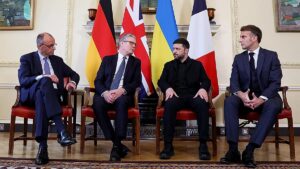
Zelensky on Monday briefed UK, French and German leaders in London, before heading across the English Channel to Brussels, to meet NATO officials and European Commission President Ursula von der Leyen. He is trying to turn their skepticism into a united front before Trump presents his plan as a take-it-or-leave-it offer. On the other side, the Kremlin says it is “encouraged” by talks with U.S. envoys and is clearly happy to let Washington carry the diplomatic load while Russian forces keep pounding Ukrainian cities.
The immediate pivot point is whether Trump formally puts a deadline on acceptance—and whether he follows through on his team’s threats to “move on” if Zelensky refuses to sign. If he does, Ukraine could suddenly find itself facing a choice between continuing the war without U.S. military aid, or accepting a deal many of its own citizens and soldiers will regard as defeat.
What’s clear already is that the battle lines have shifted. The front is still in eastern Ukraine, but the real fight this week is over who gets to define “peace”: the man in Kyiv whose country is being dismantled, or the man in Washington who wants to be able to say he ended a war.
Once a core feature of Newsweek’s print edition, Perspectives distilled the week’s news into a chorus of standout quotes. Today, we’re relaunching Perspectives in a different format, but with the same mission of keeping our members informed by showcasing the views that shape the conversation.
Read the full article here