

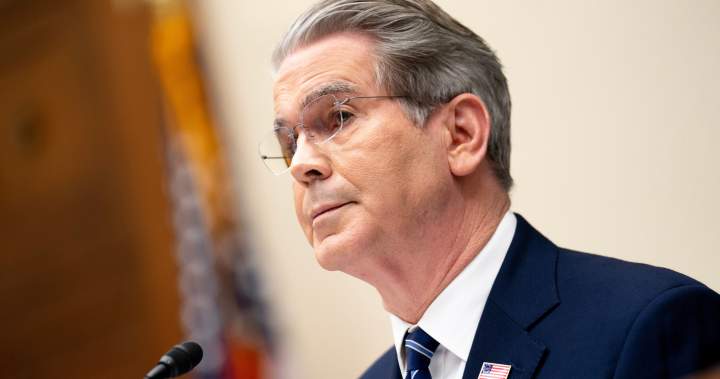
The Trump administration would “absolutely not” eliminate all of its tariffs on Canada if Ottawa did the same for American goods, U.S. Treasury Secretary Scott Bessent said Thursday, citing Canada’s recent trade agreement with China and the threat of Chinese electric vehicles.
During testimony in front of the U.S. Senate banking committee, Republican Sen. John Kennedy of Louisiana asked Bessent to explain the rationale behind the administration’s tariff strategy.
Kennedy said his understanding is that the “foremost reason” for the tariffs is trying to “stop other countries from taking advantage of us” through their own trade barriers.
“If Canada, for example, came to the United States and said, ‘We’re going to zero tariffs on the United States, all of them are off on our end,’ would you [and the] president go to zero tariffs and let Canadian companies and American companies compete on a level playing field?” Kennedy asked.
“Absolutely not,” Bessent replied.
“We saw two weeks ago when Prime Minister Carney went to China, he lowered tariffs on Chinese EVs from 100 per cent to six per cent. The U.S. has 100 per cent tariffs on Chinese EVs. We couldn’t let our northern border be used as a way for Chinese EVs to come into the U.S.”
Carney announced last month that Ottawa will drop its tariffs to six per cent on up to 49,000 Chinese-made electric vehicles that will be allowed to be sold in Canada.

Get daily National news
Get the day’s top news, political, economic, and current affairs headlines, delivered to your inbox once a day.
The deal, which was struck in return for Beijing lifting some of its tariffs on Canadian agricultural goods, has caused concern within the Trump administration about China gaining access to the North American auto market.
U.S. President Donald Trump, who initially called the prospect of a Canada-China trade deal “a good thing,” has since soured on the agreement and warned that China “will eat Canada alive.”
He has also threatened 100 per cent tariffs on Canada if it pursues free trade with China, something Carney has said is not happening.
While Ottawa argues a vast majority of Canadian goods sold to the U.S. are exempt from Trump’s tariffs due to the Canada-U.S.-Mexico Agreement on free trade (CUSMA), sectors like autos, steel and lumber are facing heavy additional duties.
U.S. Ambassador to Canada Pete Hoekstra has said Canada should expect some tariffs to remain in place even if CUSMA is renewed after this summer’s scheduled review. Trump has also floated the possibility of letting the trade pact expire or withdrawing the U.S. from it, which would significantly increase U.S. tariffs on Canada.
Bessent faced skepticism over the administration’s tariff strategy from both Republican and Democratic members of the U.S. Senate committee, who brought up higher prices for American consumers and impacts to states’ tourism and service industries due to international travellers avoiding the U.S.
Democratic Sen. Catherine Cortez Masto of Nevada pointed to the 12 straight months of declining travel from Canada to the U.S. last year, which she said was a 20 per cent decrease for her state alone, where Las Vegas is a top destination for Canadian tourists.
“Will you apologize for driving away visitors and hurting our working families?” she asked.
Bessent responded by claiming Canadian tourism is down because “the Canadian economy is doing poorly” and that tariffs weren’t tied to tourism declines.
“Do you think that we should pull down all of our trade barriers with China so that 1.4 billion people can fill up the hotel rooms in Las Vegas?” he asked.
Cortez Masto noted “it’s not just Canada” that is shunning U.S. travel but several other countries that Trump has attacked with tariffs and divisive rhetoric, and that the U.S. Travel Association has forecast a nearly US$70-billion deficit for 2025.
Bessent suggested Americans themselves were filling the void left by international tourism.
“It is a trillion-dollar industry, and you don’t seem to think it’s important,” Cortez Masto shot back.
The secretary faced tough questioning on Wednesday as well during an often-heated hearing at the U.S. House of Representatives financial services committee.
In one notable exchange, Democratic Rep. Sean Casten pressed him on a letter he sent in 2024 to partners of his Key Square investment firm — before Bessent was in government — in which he wrote that “tariffs are inflationary.”
Asked if he wanted to correct his remarks, Bessent said he did and that he was wrong.
“If I was mistaken, I want to correct it. And I was also mistaken when I said the tariffs could be inflationary,” he told the lawmakers, claiming the U.S. economy is growing and inflation is falling despite Trump’s tariffs.
“So tariff inflation was the dog that didn’t bark,” Bessent added.
© 2026 Global News, a division of Corus Entertainment Inc.
Read the full article here