



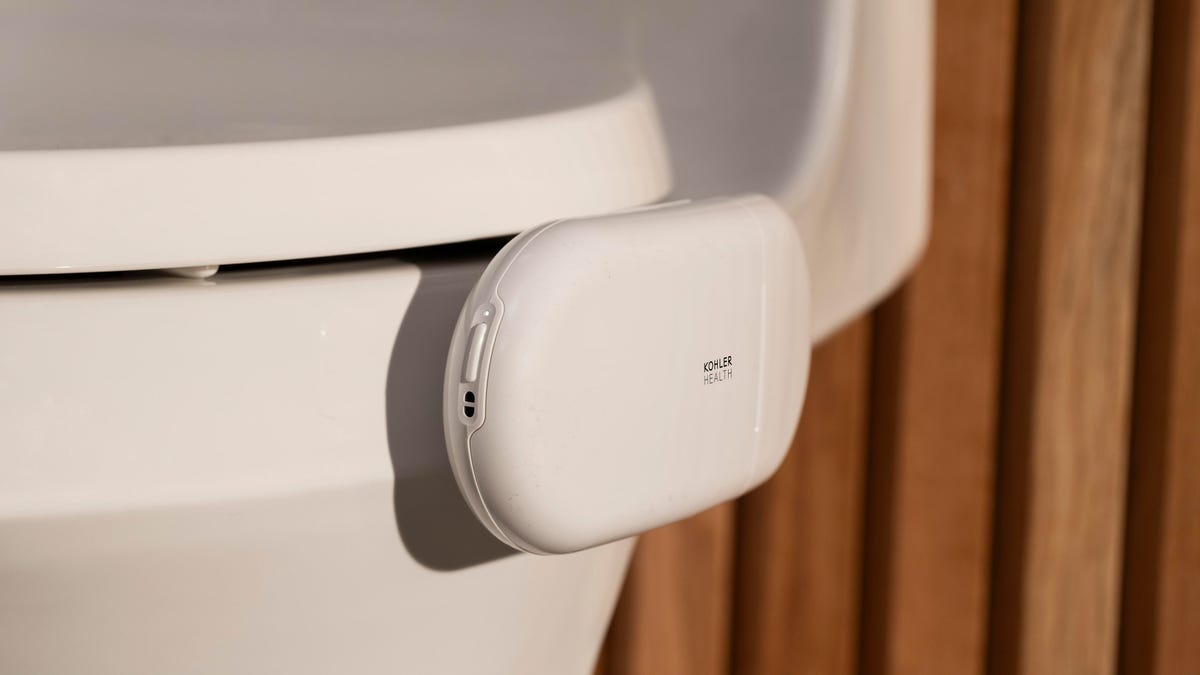
In October, Kohler launched Dekoda, a camera that attaches to a toilet and uses AI to examine your poop. Some say you can’t put a price on good gut health, but the Dekoda costs $599 for the device, plus a subscription fee that ranges from $70 to $156 per year.
But after a blog post published this week raised questions about Kohler’s data practices for its new toilet gadget, the company was forced to explained what it means by “encrypted” data for customers, and what its policy is for training its algorithms on their… uh… waste information. And it’s not as straightforward as it initially appeared to be.
Don’t miss any of our unbiased tech content and lab-based reviews. Add CNET as a preferred Google source.
On its website, Kohler says Dekoda “analyzes gut health and hydration and detects the presence of blood in the toilet bowl, providing data for building healthy habits.”
On the same webpage, Kohler touts privacy features for the gadget. It says that the camera only ever points down into the toilet bowl, that it offers fingerprint authentication optionally via the Dekoda remote and that, “our technology is designed to keep your personal data personal. It is end to end encrypted.”
The blog post published by security researcher Simon Fondrie-Teitler raised questions about what that encryption entails and pointed out that Kohler would likely have access to the data and images collected by Dekoda.
“Responses from the company make it clear that—contrary to common understanding of the term—Kohler is able to access data collected by the device and associated application,” he wrote.
Kohler responds to privacy concerns
Kohler itself appeared to confirm this notion in a statement it shared with CNET. It wrote: “The term end-to-end encryption is often used in the context of products that enable a user (sender) to communicate with another user (recipient), such as a messaging application. Kohler Health is not a messaging application. In this case, we used the term with respect to the encryption of data between our users (sender) and Kohler Health (recipient).”
The company went on to say: “We encrypt data end-to-end in transit, as it travels between users’ devices and our systems, where it is decrypted and processed to provide and improve our service. We also encrypt sensitive user data at rest, when it’s stored on a user’s mobile phone, toilet attachment, and on our systems.”
In other words, the data Dekoda collects is encrypted in transit, but can be decrypted by the company on its end.
In regards to how the company uses the data for AI systems learning, Kohler said in the same statement: “If a user consents (which is optional), Kohler Health may de-identify the data and use the de-identified data to train the AI that drives our product. This consent check-box is displayed in the Kohler Health app, is optional, and is not pre-checked.”
Based on Kohler’s statement, it will remove information that pairs a user’s identity with the data before it’s used for optional AI model training.
The meaning of ‘encrypted’
This may cause confusion for people who are familiar with the kind of end-to-end encryption offered by services such as Signal or even Apple. Here, the expectation that companies wouldn’t have access, or even a technological way, to decrypt data that people are transmitting through their services.
What Kohler is doing sounds different from that expectation, as Fondrie-Teitler points out in his post: “What Kohler is referring to as E2EE here is simply HTTPS encryption between the app and the server, something that has been basic security practice for two decades now, plus encryption at rest.”
Kohler did not respond directly to questions about Fondrie-Teitler’s post to CNET beyond the statement it shared.
Read the full article here