



In the third part of a monthlong series, Pete Wells and experts say a healthier diet begins with understanding what drives your eating, and slowing down.
Reset Your Appetite This is the third of four articles by Pete Wells, appearing each Monday in January, about how he developed healthier eating habits. The first focused on reducing sugar consumption, and the second on stocking the home with the right foods.
Once I resolved to eat better, I got curious about using behavioral psychology to help change my habits. It wasn’t long before I heard about mindful eating, an approach rooted in Buddhist practice that tries to repair the imbalances in our diets through calm attentiveness.
And when you study mindful eating, sooner or later you find out about the Raisin Meditation. It has been taught at Harvard, Brown, Duke and other schools. Diet books recommend it. A number of YouTube videos demonstrate it.
In the Raisin Meditation, you eat a single raisin more slowly and deliberately than you might have thought possible. First, you look at the raisin — really look, taking in its shape, its size, its color and its creases. Then, you hold the raisin to your nose and notice how it smells. Now, you put the raisin in your mouth to investigate how it feels, exploring it with your tongue and palate.
When your mouth is thoroughly acquainted with the raisin, you may take a single bite. Stop and assess how this has changed things. At this point, you can chew the raisin and eventually swallow it, paying close attention to all the accompanying sensations and aftertastes, even the shreds of raisin skin that cling to your teeth.
After 12 years as a restaurant critic at The Times, I thought I was an old hand at methodical sensory analysis. But there is more to the Raisin Meditation than stop-motion chewing. In the version of the exercise in the book “Mindful Eating” by Dr. Jan Chozen Bays, you are asked to tune in to one of seven varieties of hunger: “eye hunger” when you look at the raisin, “stomach hunger” when you’re finally allowed to swallow it, “cellular hunger,” that message your body sometimes sends when it needs you to eat differently — say, by packing in more calories when the weather turns cold.
Reading this for the first time, I thought: Hunger? What’s hunger got to do with it?
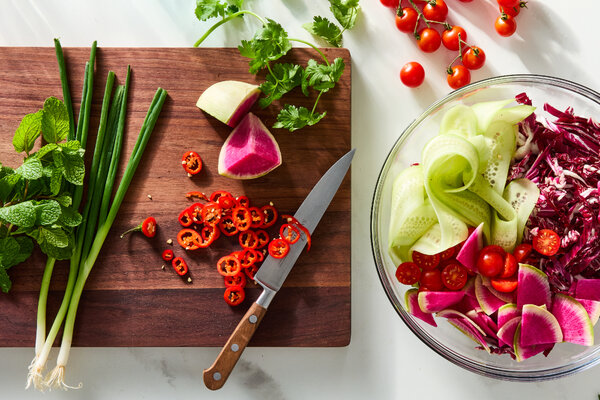
A composed salad of chicken, vegetables, herbs, shrimp and eggs, inspired by Thai yum yai.Credit…Julia Gartland for The New York Times. Food Stylist: Barrett Washburne.
When I reviewed restaurants, I never considered how much food my body needed. All that mattered was that I was ready when another mealtime swung around. When I gave my appetite any thought, I suppose I saw it as a useful workplace tool, like an office espresso maker: It made the work easier and more pleasant, but I could get along without it if I had to. I wasn’t going to let something as basic as my own body tell me what to eat, or where or when, let alone how much.
My encounters with mindful eating helped me listen to my appetite again. I’d ignored it for so long that I’d reached a state of being hungry all the time. But my true appetite never stopped talking to me, and it had useful information to convey.
Turn Down the Volume
Entire industries are devoted to drowning out the signals our bodies send to tell us what we need to eat.
Chip packages are designed in screaming colors we can see from across the supermarket. Chicken nuggets are engineered for craveability. TikTok and other forms of food media seed our brains with thoughts of life-changing Dubai chocolate strawberries. I completely understand why so many people rely on GLP-1 medications to quiet food noise; the ambient chatter from all these sources can be maddening.
The noise is especially good at confusing us because our body’s signals come in different forms. There is physical hunger, the solid sense that it’s time for a substantial meal. But there are impostors, too, feelings dressed up as needs. There is bored hunger, sad hunger, anxious hunger and (my specialty) hunger in the service of procrastination.
Some of these manifest themselves as sudden, wild cravings. They are intense and often overwhelming, like a toddler throwing a tantrum inside my skull. After arguing with the toddler for a while, I didn’t care about anything except making it stop. A doughnut is a small price to pay. So is a box of doughnuts, if that’s what it takes.
The way to determine which of these hungers is at the door is simple: Listen. My body’s matter-of-fact request for a full meal doesn’t sound like the toddler’s demand for doughnuts.
Sometimes, it’s enough simply to acknowledge the craving and ride it out. But often, fake hunger is mixed up with a shot or two of real hunger. Through listening, and a certain amount of trial and error, I started to learn when a craving could be bought off with olives or pickles (rarely, but it happens), when the situation required a big bowl of popcorn (every other afternoon, roughly) and when it was time to stop everything and just make dinner.
Dinnertime will come eventually, and it’s better to be too early than too late. If we wait for desperate, irrational hunger to rear its head, we tend to feed ourselves with a speed and ferocity that we would find uncouth in a coyote. Study after study has found that the faster we eat, the more we eat.
Ditch the Distractions
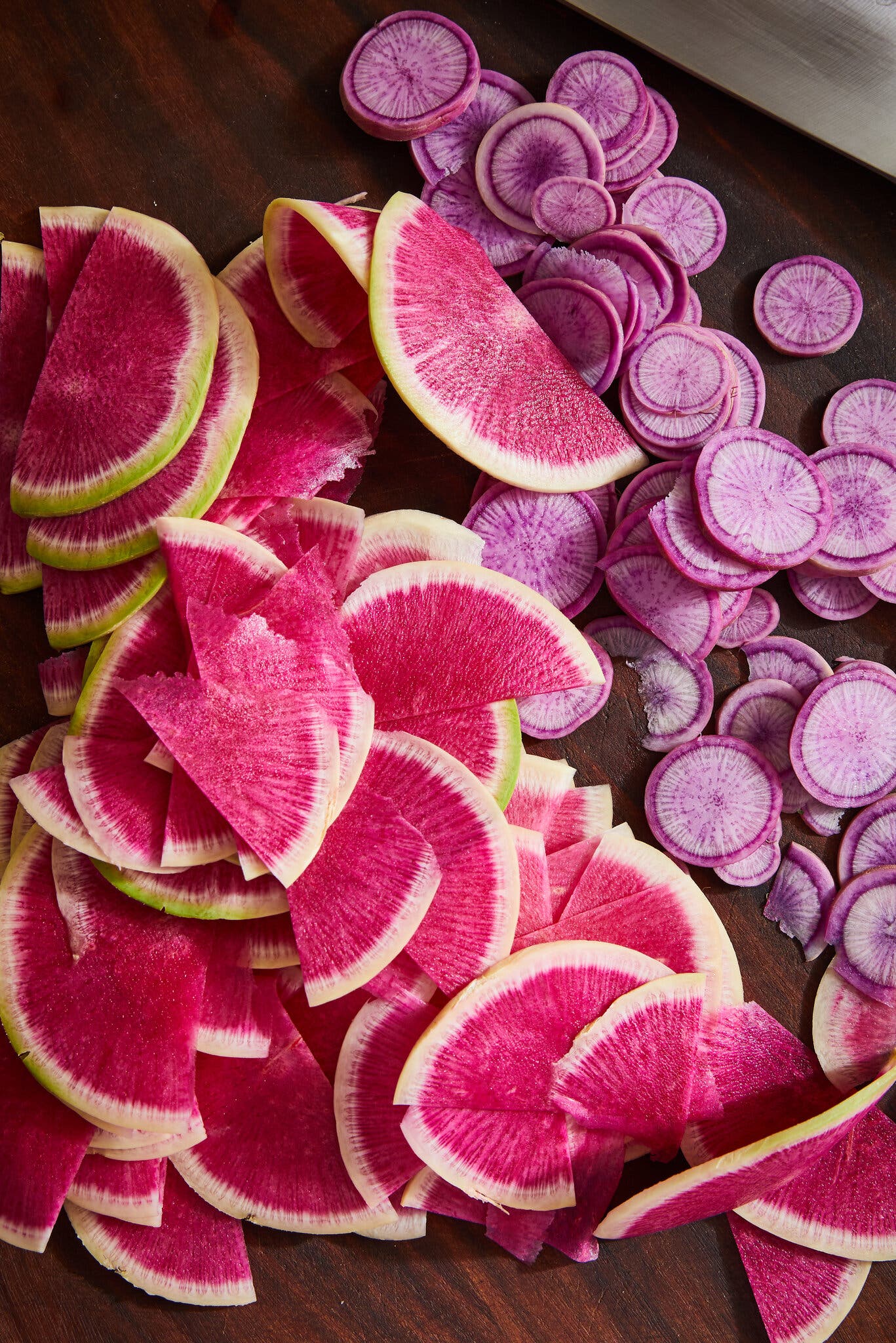
Cutting vegetables for salad can induce a deliberate state of mind that carries over to the table.Credit…Michael Graydon & Nikole Herriott for The New York Times. Food Stylist: Alison Roman. Prop Stylist: Kalen Kaminski.
When Dr. Bays teaches the ideas she outlines in “Mindful Eating,” she suggests eating one bite at a time. Or, as she sometimes calls the technique, Put Down That Fork.
“This is hard at first, but you take one bite and then put down your eating utensil,” Dr. Bays said. “And then you savor that bite until it’s chewed and swallowed.”
Not only does this help you eat more slowly, but, she said, “it makes eating so much more enjoyable. When it’s enjoyable, the sense of satisfaction comes earlier. You don’t have to wait until your stomach is stretched and you’re groaning.”
Focus is a key precept of mindfulness.
“Don’t eat while you’re doing something else,” said Lisa R. Young, an adjunct professor of nutrition at New York University whose diet-advice book “Finally Full, Finally Slim” draws heavily on the mindful-eating school of thought.
Dr. Young tells readers not to eat standing up, or while watching television or while working. (She calls this “eating al desko.”) Instead, she suggests chewing thoroughly and tuning in to all your senses.
Certain dishes force me to shift to a lower gear. Chewing a raw carrot takes about as much time as reading a chapter of “Gravity’s Rainbow.” Most salads are slow food, especially when all the components have been carved or chopped or shredded into different shapes and sizes. I can trance out while cutting up radishes, scallions, cucumbers and hard-cooked eggs for a composed salad based loosely on Thai yum yai. The trance doesn’t totally end when I bring the bowl to the table, either.
Taking time over a meal is one way of tuning out the static in the air before sitting down. Another useful method, and this came as a surprise, is exercise.
I walk about an hour a day, usually in the morning. Whether this helped me lose weight, I don’t know, but I’m sure it clears my mind. When I get back from a walk, I can feel the blood moving away from the moss-gathering zones of my body and up toward my brain. At least, that’s how it feels. For sure, I make more rational decisions about breakfast on days when I walk.
Of course, there are days when my walk takes me to a local pastry shop that makes excellent cinnamon buns. But when I eat that cinnamon bun, I promise you, I do it mindfully.
Recipes for Mindful Eating
Mushroom and Tofu Sticky Rice | Smoky Spiced Eggplant Dip | Cold Soba Noodles With Dipping Sauce | White Bean Dip With Cumin Chile Oil | One-Pot Sesame Salmon and Quinoa | Chicken Noodle Soup | Spicy Peanut Stew With Ginger and Tomatoes | Red Curry Mussels and Roasted Sweet Potatoes | See all recipes from this series
More From This Series
Credit…Rachel Vanni for The New York Times. Food Stylist: Spencer Richards.
Credit…Rachel Vanni for The New York Times. Food Stylist: Spencer Richards.
Follow New York Times Cooking on Instagram, Facebook, YouTube, TikTok and Pinterest. Get regular updates from New York Times Cooking, with recipe suggestions, cooking tips and shopping advice.
Read the full article here