

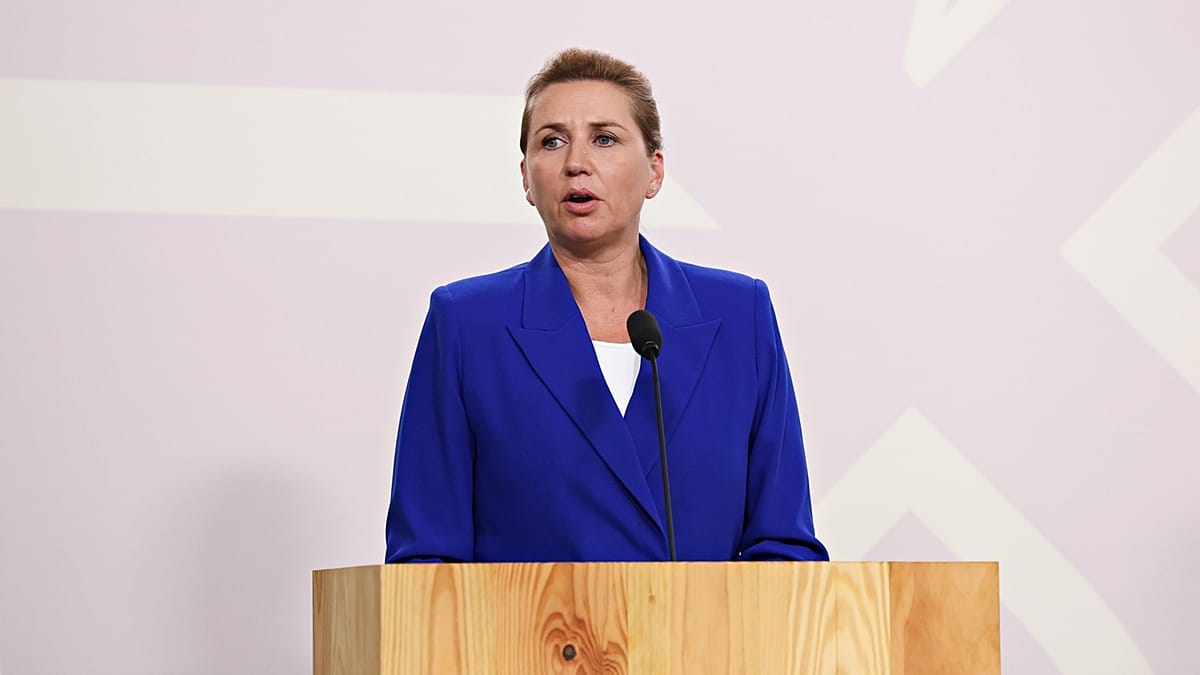
Denmark is ready to discuss with the United States matters related to the security and economy of Greenland, but sovereignty is off the table, Danish Prime Minister Mette Frederiksen said amid rising tensions with President Donald Trump.
“We can negotiate anything,” Frederiksen told the Danish parliament on Tuesday. “But we cannot negotiate our very fundamental values, sovereignty, the identity of our countries and our borders. Our democracy.”
Her comments come as European leaders close ranks to defend Denmark and Greenland against Trump’s expansionism, while extending their hand for a diplomatic solution.
Ursula von der Leyen said that if Trump goes ahead and imposes 10% tariffs on eight European countries to force the sale of the mineral-rich island, the European Union will hit back with an “unflinching, united and proportional” response.
“Plunging us into a dangerous downward spiral would only aid the very adversaries we are both so committed to keeping out of our strategic landscape,” she said during her address at the World Economic Forum in Davos, Switzerland.
Meanwhile, French President Emmanuel Macron, who also spoke in Davos, said the bloc “should not be hesitant” to use its Anti-Coercion Instrument, also known as its “trade bazooka”, in the current geoeconomic environment, referring both to the US and China.
“This is crazy. I do regret that, but this is a consequence of just unpredictability and useless aggressivity,” Macon said, adding: “We have to remain very calm.”
In reaction to the statements, Scott Bessent, the US Secretary of the Treasury, told Europeans to “sit back, take a deep breath, do not retaliate, do not retaliate.”
Trump had earlier in the day doubled down on his bid to acquire Greenland, posting a digitally-generated picture of him putting a US flag in the semi-autonomous territory.
Catch up on today’s development in the live blog below:

${title}
${body}
Live ended
In case you missed it: the highlights of the day
Tensions between Europeans and Americans remained high on Tuesday as Donald Trump doubled down on his intention to apply extra tariffs on eight European countries to force the sale of Greenland.
Here’s what the main characters of the day had to say:
- Speaking in Davos, European Commission President Ursula von der Leyen said that if Donald Trump goes ahead with the 10% tariffs on 1 February, the European Union will hit back with an “unflinching, united and proportional” response. She described the duties as a “mistake” that risked a “downward spiral” and urged dialogue to strengthen security in the Arctic.
- Also in Davos, French President Emmanuel Macron said the EU “should not be hesitant” to trigger its Anti-Coercion Instrument in the current geoeconomic environment and said the “endless accumulation of new tariffs” was “fundamentally unacceptable. Even more so when they are used as leverage against territorial sovereignty.”
- Speaking from Strasbourg, High Representative Kaja Kallas said that “tariff threats will not pressure Denmark into handing over Greenland” and predicted the commercial escalation would impoverish both sides of the Atlantic. “We have no interest in picking a fight, but we will hold our ground.”
- In reaction to the statements, US Treasury Secretary Scott Bessent told Europeans to “sit back, take a deep breath, do not retaliate” and said the NATO alliance was “very safe” with Trump. Meanwhile, US Commerce Secretary Howard Lutnick said that if the EU decides to respond, “it will go back to tit-for-tat”.
- From Copenhagen, Danish Prime Minister Mette Frederiksen said her country was open to negotiating “anything” related to political security, investment and the economy in Greenland – but insisted that “we cannot negotiate our very fundamental values, sovereignty, the identity of our countries and our borders, our democracy.”
We’re closing this live blog for today, and we’ll be back tomorrow with more updates. Thank you for reading us.
‘President Trump is trying to replace the UN’, says Belgian Foreign Minister
Speaking to Euronews at Davos on Tuesday, Belgian Foreign Affairs Minister Maxime Prévot accused United States President Donald Trump of seeking to “replace the United Nations’ system” with his transitional “Board of Peace”, a body ostensibly set up to administer post-war Gaza.
While it remains unclear exactly how many leaders have been asked to join the body, Prévot told Euronews that Belgium has not been invited, decrying the project as “totally unacceptable” and adding that Trump was trying to “create his own personal board”.
Read the full story.
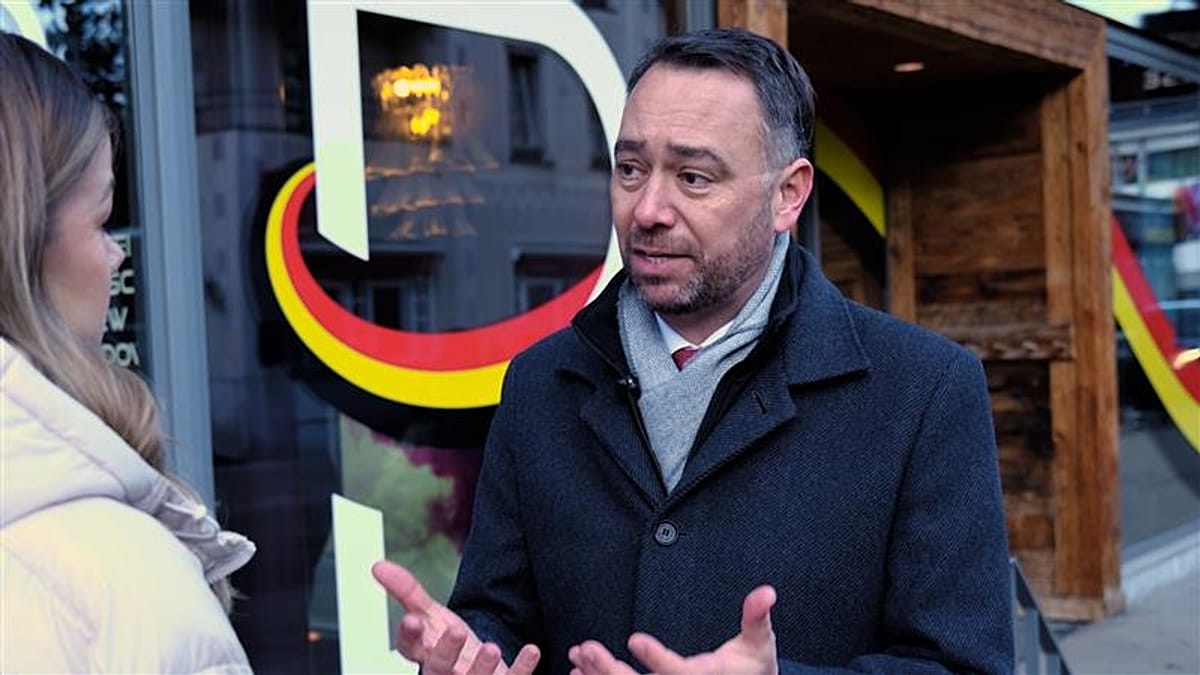
‘President Trump is trying to replace the UN’, says Belgian FM
US President Donald Trump is trying to supplant the United Nations with his supposedly transitional “Board of Peace”, Maxime Prévot told Euronews. #12MinutesWi…
Analysis: Last year, EU countries were split on Trump tariffs. Will they act as one now?
Let’s go back to April last year, when Donald Trump stepped onto the Rose Garden to announce his self-styled “reciprocal tariffs”. The announcement of across-the-board, universal duties caused a market meltdown that forced Trump to hit the pause button and enter discussions with individual countries.
In the case of the European Union, the talks were handled by the European Commission, which has exclusive competence to set the commercial policy on behalf of the 27 member states. Though the Commission was the leading voice during the months-long negotiations, it was heavily influenced by the views of member states.
Back then, opinions were all over the place. France and Spain were in favour of hitting back at the tariffs, which they considered completely unjustified. But others, like Italy and Ireland, whose export-oriented economies have deep links with the US market, urged caution, fearing that going into an all-out trade war would backfire against the European economy. Germany was caught between the two camps.
The cacophony of voices tied the Commission’s hands. Despite repeatedly saying that “all options are on the table,” the Commission never triggered any sort of retaliatory measure. This set the stage for a meeting in Scotland in late July at which Ursula von der Leyen and Donald Trump concluded the EU-US trade deal. Its lopsided terms were immediately denounced as a capitulation and humiliation for Europe.
Now, the tariff threat is completely different, with Trump exploiting the US’s trade power with the intention of seizing the sovereign territory of an EU and NATO member state. There is no precedent for this assault, and the whole transatlantic alliance is on the precipice of collapse.
Privately, diplomats in Brussels note that this time around, there is improved European unity to back up a hard-hitting response. During Sunday’s emergency meeting of ambassadors, Hungary was the only country that didn’t take the floor to express support for Denmark. The prospect of using the Anti-Coercion Instrument (ACI) is no longer opposed, though not yet fully endorsed. Still, the focus now is on diplomacy to avoid a worst-case scenario on 1 February.
If the EU responds to new US tariffs, it will be ‘tit-for-tat’, says Commerce Secretary
US Commerce Secretary Howard Lutnick said during a panel in Davos that if the EU responds to new US tariffs, “it will go back to tit-for-tat”.
“I don’t see Europeans blowing up the deal” signed by the sides last year, which tripled tariffs to 15% on EU goods but placed a ceiling on stacked up duties,” he added.
Earlier in the day, European Commission chief Ursula von der Leyen said the EU would respond in an “unflinching, united and proportionate” way to tariffs over Greenland.
Watch: Macron says ‘endless accumulation of tariffs’ is ‘fundamentally unacceptable’
French President Emmanuel Macron said the US is aiming to “weaken and subordinate Europe” with trade pressures and new tariffs that are “fundamentally unacceptable.” pic.twitter.com/GrYmvbi6pX
— euronews (@euronews) January 20, 2026
EU Parliament President Metsola in touch with Congress speaker to coordinate on Greenland crisis
The European Parliament President Roberta Metsola is “in regular contact” with her US counterpart, Mike Johnson, speaker of the House of Representatives, sources told Euronews.
“I have an excellent relationship with Johnson, and we are always very much aligned in the discussions that we have”, Metsola said at a press conference in Strasbourg on Tuesday.
There is constant contact at staff-to-staff level, which will continue later this week to coordinate on the latest developments on both sides, especially following Johnson’s visit to the UK and his speech in the House of Commons, according to EU Parliament sources.
Metsola said she wants to deepen dialogue with the US Congress in order to help to solve the diplomatic crisis between the EU and the US.
“We should explain our position, be self-confident, listen and also be honest. And that’s what I will always engage in”, she said.
A Congressional staff delegation will also be visiting the European Parliament on 16 February to discuss security and defence issues.
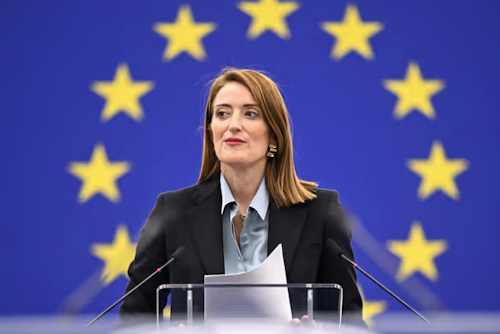
‘Do not retaliate’, Scott Bessent tells Europeans
Earlier today, both Ursula von der Leyen and Emmanuel Macron vowed to hit back if the additional duties are imposed on 1 February – but Scott Bessent, the US Secretary of the Treasury, has told Europeans they should not retaliate against Donald Trump’s 10% tariff threat.
“I would say exactly what I said after Liberation Day last April, when the president imposed tariff levels on the whole world,” Bessent said at the World Economic Forum in Davos.
“I tell everyone: sit back, take a deep breath, do not retaliate, do not retaliate.”
“The president will be here tomorrow and he will get his message across. I believe he is going to have meetings. And again, also, have an open mind.”
Bessent claimed that the US acquisition of Greenland, which belongs to the Kingdom of Denmark, would be necessary to “prevent a conflict” in the increasingly strategic Arctic region.
“There’s the opportunity for the US to become embroiled (or) exposed in a kinetic war if another country moved in on Greenland, and no country is going to assert control of Greenland if the US controls Greenland,” he said on stage.
Asked whether Trump’s extraordinary ultimatum put the NATO alliance at risk, Bessent seemed unconcerned by that scenario and urged European countries to continue stepping up their defence spending.
“I think that the NATO alliance is very safe, sound. And thanks to President Trump, it’s never been more secure,” he said. “When President Trump came in, in his first term, the European countries and Canada were not meeting their spending quotas as a percentage of GDP. Now they are. They’ve got a lot of catch-up to do.”
“Europeans have been spending the money on social welfare, on roads, on education. And it’s time for them to pay more, which they’ve agreed to do.”
Credit: Associated Press.
Canada PM puts conditions on Board of Peace membership and defends Greenland sovereignty
Speaking in Davos, Canadian Prime Minister Mark Carney said Canada had been invited to join the US-proposed Gaza “Board of Peace”, part of Donald Trump’s 20-point plan to end the Israel-Hamas war, but stopped short of confirming whether Ottawa would take part.
Carney said efforts to complete the first phase of the peace process should be welcomed, while stressing that key questions remain about the initiative’s structure and purpose – asking, “Is it for Gaza?”
He added that any such mechanism must be accompanied by the immediate and unrestricted flow of humanitarian aid into Gaza and address shortcomings in governance.
On Greenland, Carney underscored Canada’s role in Arctic security, saying the country “stands firmly with Greenland and Denmark and fully supports Greenland’s right to determine its own future”.
Trump ‘making sure Arctic is secure’, says US ambassador to NATO
The US ambassador to the NATO military said on Tuesday that Donald Trump is now “making sure that the Arctic is secure” after re-energising the alliance.
“Nobody has strengthened NATO more than President Trump. Nobody has brought an energy and the necessary capabilities to the table more than President Trump, in fact I would say by a long shot,” Matthew Whitaker told Fox News.
“I mean, President Trump has taken an organisation that was once described as brain dead only a few years ago and brought a vitality and a strength that wasn’t there before. President Trump gets the credit for that and now he’s making sure that the arctic is secure.”
In the year since being sworn for his second term, @POTUS has breathed new life into the United States of America and injected energy into @NATO. No one has brought more to the table than President Donald Trump – economically or militarily. pic.twitter.com/WYqc0sBw4A
— U.S. Ambassador to NATO (@USAmbNATO) January 20, 2026
Clashes between protesters and police outside the European Parliament in Strasbourg
Hundreds of protesters, mainly from farmers’ associations, clashed with the police outside the European Parliament in Strasbourg on Wednesday.
A large protest was organised by agricultural sector representatives against the EU-Mercosur trade deal. Farmers with their tractors occupied the main street around the Parliament, chanting slogans and carrying signs against the deal and Commission President Ursula von der Leyen.
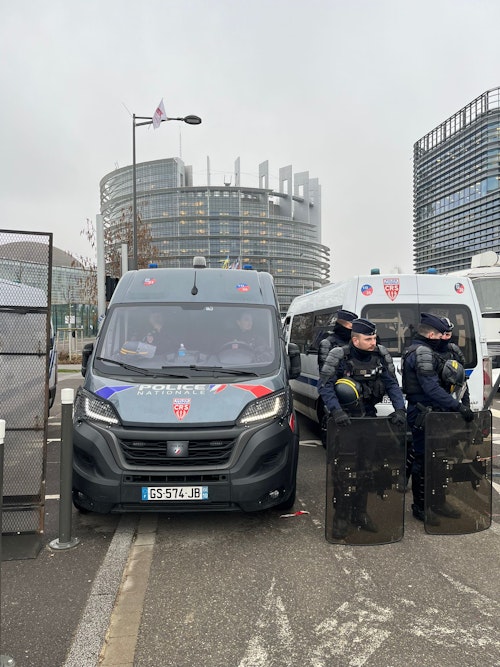
In the afternoon, they approached the police barricade with several people seen launching firecrackers, empty bottles, and other objects towards officers, who used teargas to disperse protesters.
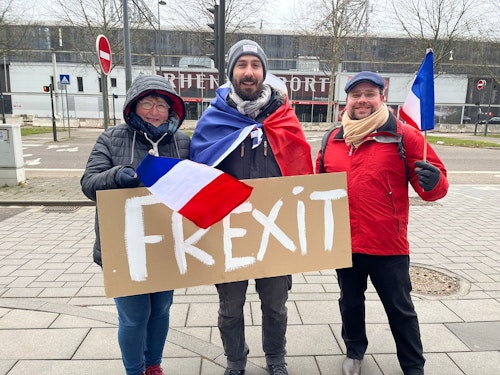
Some members of Parliament who had joined the protesters complained to the police about their behaviour. “This is unacceptable,” said Belgian MEP Estelle Ceulemans.
Tomorrow, the Parliament will vote on the referral of the deal to the EU Court of Justice, as some MEPs see it as illegal. The vote is expected to be very tight, with many political groups divided among lawmakers in favour or against the referral, which would block the approval process of the deal.
Watch: ‘Tariff threats will not pressure Denmark into handing over Greenland,’ says Kaja Kallas
“Let me be abundantly clear: tariff threats will not pressure Denmark into handing over Greenland,” High Representative Kaja Kallas said on Tuesday.
“We have no interest in picking a fight, but we will hold our ground.” pic.twitter.com/ve7F47bAaS
— euronews (@euronews) January 20, 2026
We can negotiate anything but our sovereignty, says Danish prime minister
Danish Prime Minister Mette Frederiksen spoke before the Danish parliament on Tuesday and addressed the crisis over Greenland’s future, making it clear her country is open to negotiating with the United States on security, investment and economics, but not on sovereignty.
“I don’t think there are any Danes or Greenlanders who have wanted us to become the centre of a conflict between the United States and Europe,” she said. “We have always stood guard by the transatlantic alliance. We have never sought any conflict, and we have consistently wanted cooperation, and we have been a faithful and close ally for many years.”
“Yet we are threatened on the very territory of the Kingdom of Denmark, in the self-determination of Greenland, by our closest ally throughout the ages, (which has) now heralded increased tariffs against us and against those countries that do exactly what has been called upon to be responsible for security in the Arctic,” she added, referring to the reconaissance mission to the island backed by several European nations.
“We can negotiate anything. Political security, investment and the economy. But we cannot negotiate our very fundamental values, sovereignty, the identity of our countries and our borders. Our democracy.”
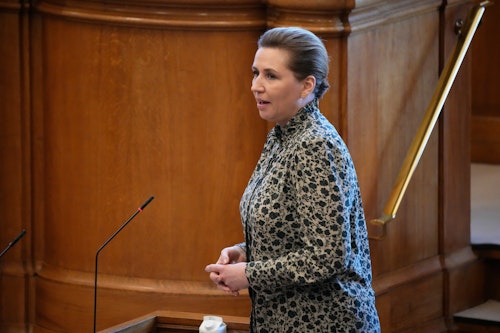
Credit: Associated Press
Board of Peace membership will be discussed during extraordinary EU summit
The question of whether the European Union should join the Board of Peace that Donald Trump is trying to set up will be part of the discussions at the extraordinary summit of EU leaders scheduled to take place on Thursday evening.
The summit was convened in response to Trump’s tariff threats over Greenland, but the agenda will include a broader discussion on the turbulent state of EU-US relations.
As my colleague Mared Gwyn Jones reported earlier today, EU officials and diplomats are looking sceptically at the Board of Peace, which was supposed to ensure the future of the Gaza Strip after Israel and Hamas agreed to a ceasefire.
The board’s design vastly exceeds its original objective, and its “charter” is worded in a manner that could challenge the United Nations Security Council as the prime seat for multilateralism. Others fear that the Board of Peace is nothing but a facade for Trump to legitimise his expansive foreign policy, which he has nicknamed the “Donroe Doctrine”.
French President Emmanuel Macron, who received an invitation to join, is poised to refuse the offer, according to sources close to the Elysée Palace. Meanwhile, European Commission President Ursula von der Leyen, who has also been invited, is still weighing her options.
However, the fact that Trump has invited Russian President Vladimir Putin and Belarusian President Alexander Lukashenko to take part in the project makes Europe’s participation politically untenable.
California Governor Gavin Newsom tells Europeans to ‘stand tall, firm and united’
California Governor Gavin Newsom said “Europeans should decide for themselves” and that “they’ve been played” by Donald Trump.
On the sidelines of the World Economic Forum Davos, Newsom said Europe is paying the price for not having raised the Greenland issue last year, when Trump first flirted with the idea of “having” Greenland based on supposed national security concerns.
“This is code red, and you guys are still playing by a set of rules,” Newsom said, describing Trump as a “T-Rex” and “wrecking ball”.
“This guy is not mad, he is very intentional… The goal is whatever he wants… the world in his image.”
Approached by reporters at the opening of the WEF, Newsom called on Europeans “to stand tall, stand firm, stand united!”
“This is not diplomacy, it‘s stupidity!” he said.
Trump is set to address the WEF on Wednesday.
Belgian Prime Minister warns Atlantic era is ending
Belgian Prime Minister Bart De Wever told an audience in Davos that recent actions and rhetoric by Donald Trump – including claims regarding Greenland and the imposition of additional tariffs – signal that the Atlanticist era is over.
“Either we stand together, or we stand divided, and if we are divided, it marks the end of an era,” De Wever said. “Eighty years of Atlanticism are truly drawing to a close.”
Quoting Italian philosopher Antonio Gramsci’s Prison Notebooks – “The old world is dying, and the new world struggles to be born: now is the time of monsters” – De Wever added that it is up to Trump “to decide whether he wants to be a monster or not”.
De Wever stressed that if the US is to be considered an ally, “it must behave like an ally”. He argued that Europe must now “wake up” and take responsibility for building its own prosperity, as the US has shifted its strategic focus toward the Pacific, a change he said would persist beyond Trump.
“Trump can toy with us; he can make us slaves because we have made ourselves slaves,” De Wever concluded.
Macron’s aviators explained
Wondering why the French president was sporting sunglasses while delivering his speech indoors?
We’ve got the answer.
Macron was first seen wearing his Top Gun-esque sunglasses during an official event last Thursday when he delivered his annual well-wishes to troops, this time outdoors and under bright sunshine.
At the time, journalists were told by his staff that he had to protect his blue eyes because a vessel in one of them had bled. It was described as “totally benign”.
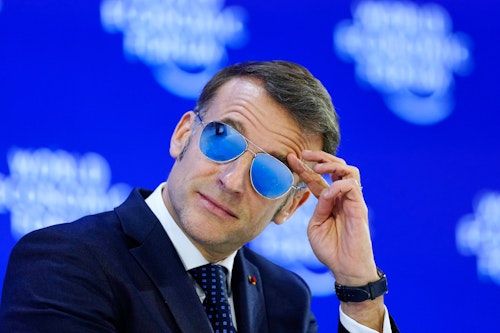
Photo credit: AP Photo/Markus Schreiber
Europe has ‘very strong tools’ to defend its interests and should use them – Macron
To defend its interests, Europe should use the “very strong” tools at its disposal, Macron said, including safeguard and mirror clauses, the introduction of a European preference, incentives for more foreign direct investments and, if necessary, the Anti-Coercion Instrument.
The latter tool was described by the French leader as “a powerful instrument” which Europe “should not hesitate to (use) in today’s tough environment”.
He said it would be “crazy” for the EU to have to trigger this instrument, designed in 2023 at a moment of heightened trade tensions with China, against the US.
“Can you imagine that? This is crazy. I do regret that but this is a consequence of just unpredictability and useless aggressivity,” Macon said, adding: “We have to remain very calm.”
The French leader also called on Europe to “de-risk” its supply chains, especially for raw materials, rare earths, semiconductors and chips, and to diversify its trade partnerships.
European industry ‘being killed’ by others not respecting level playing field
Europe must “fix its key issues” including lack of growth and competitiveness, Macron said during his intervention in the Swiss mountains.
Doing so, he said, would require more “protection, simplification, and investment”.
The French president said Europe remains “too naive”, explaining that its market remains open to everyone despite some countries, including the US and China, sometimes limiting European companies’ access to their own markets.
“Europeans are the only ones not to protect their own companies and their own markets when the other countries don’t respect the level playing field,” Macron said. “This is why we have to be much more realistic if we want to protect our chemical industry, our industry from the automotive sectors to a lot of others, because they are being literally killed by the lack of respect of a normal framework and a level playing field,” Macron said.
Europe must boost its strategic autonomy while championing ‘effective’ multilateralism – Macron
The French president said that in order to weather increased competition and unfair practices from other countries, Europe should adopt a two-pronged approach: boost its sovereignty and autonomy and engage in “effective multilateralism” at the same time.
Macron said that while Europe should not “passively accept the law of the strongest”, which would lead to “vassalisation and bloc politics”, it should not adopt “a purely moral posture” that could see it marginalised.
France and Europe’s commitment to multilateralism and cooperation is at the core of why “we have decided to join the mutual exercise in Greenland without threatening anyone but just supporting an ally in another European country, Denmark,” Macron said.
US trying to ‘weaken and subordinate Europe’ – Macron
The French President has left the stage after delivering a speech in defence of multilateralism and the international rules-based order, taking aim at China and the US in turns for trying to weaken Europe.
The world is shifting “towards autocracy and democracy”, Emmanuel Macron said, and “towards a world without rules where international law is trampled underfoot and where the only law that seems to matter is that of the strongest and imperial ambitions are resurfacing”.
But, he said, “without collective governance, cooperation gives way to relentless competition. Competition from the United States of America, through trade agreements that undermine our export interests, demand maximum concessions, and openly aim to weaken and subordinate Europe.”
The US’s “endless accumulation” of tariffs is “fundamentally unacceptable”, Macron also said, “even more so when they are used as leverage against territorial sovereignty”.
Trump’s Gaza Board of Peace becomes entangled in Greenland dispute
The delicate balancing act facing Europe, as it seeks to defuse tensions with Trump over Greenland, is unexpectedly being complicated by United States President Donald Trump’s flurry of invites to world nations to join his Gaza Board of Peace.
Diplomats worry the Board of Peace is now becoming intwined with the Greenland crisis, as Europeans need to coordinate whether they accept their seats or not.
France has said it does not intend to join over fears the Board’s charter – which makes no mention of Gaza – calls into question the “principles and structure of the United Nations” and grants “extensive powers” to Trump, the Board’s Chair. Germany and the European Commission, also invited, have not indicated whether they will accept.
But the sweeping mandate Trump is seemingly granting the board, and the glaring lack of focus on war-torn Gaza and its future, is troubling officials in Brussels.
EU officials and diplomats have privately raised serious concerns about the board’s framework, members’ selection, mandate and governance structure, and want it to revert back to Gaza rather than create a parallel UN Security Council.
And while a Palestinian-led technocratic committee has been tasked with leading Gaza’s day-to-day affairs, there are concerns about the lack of Palestinian representation on the two separate senior panels of the Board, which oversee investment, diplomacy and governance.
The invitation handed to Vladimir Putin to sit on the board also makes Europe’s participation politically untenable.
Yet any country’s outright refusal to join the board would risk infuriating Trump and further escalating tensions just as the dispute over Greenland reaches boiling point. Trump overnight threatened a 200% tariff on French wine and Champagne in retaliation for Paris’s scepticism over the board.
European approach to Arctic should be ‘realistic and principled’, says Kaja Kallas
More from the speech of Kaja Kallas at the European Parliament.
She defended the European countries that joined a reconnaissance mission to Greenland and now face a 10% tariff from Donald Trump. “This presence is aimed at keeping the region safe, predictable and stable. It poses a threat to no one,” she said.
Kallas raised concerns about the “growing” risks posed by Russia and China in the Arctic region and said these issues should be addressed by allies together at NATO, rather than pitting one against the other.
“Geopolitical tension and geoeconomic competition in the Arctic require that the European Union, together with partners, responds,” she said. “Our response must be realistic and principled, and it must be guided by international law.”
“No country has the right to take over the territory of another. Not in Ukraine, not in Greenland, not anywhere in the world,” she added, prompting applause in the chamber.
The EU is currently working to update its own Arctic strategy, the High Representative said, with a multi-faceted approach to take into account sustainable development, social cohesion and the environment.
“Security is not only about military presence,” she said. “It’s all about trust, it’s about stability, it’s about people.”
‘Tariff threats will not pressure Denmark into handing over Greenland,’ says Kaja Kallas
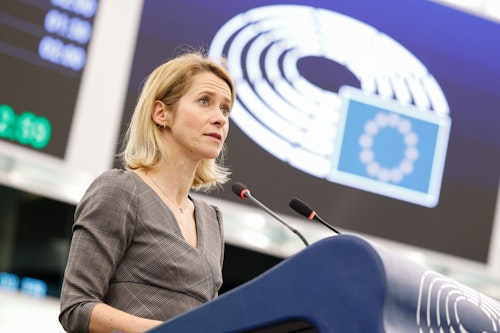
High Representative Kaja Kallas has just delivered a speech at the European Parliament in Strasbourg addressing the future of Greenland and Donald Trump’s tariff threat.
“Greenland belongs to its people. No threat or tariffs will change that. Sovereignty is not for trade,” Kallas said. “The European Union stands without doubt with Greenland and the Kingdom of Denmark in defence of their territorial integrity and sovereignty.”
“Saturday’s remarks by President Trump create a situation we haven’t seen before. Our response must be to remain calm, hold our crown and act in unity,” she added.
Kallas celebrated the fact that Danish, Greenlandic and American officials had entered direct talks to resolve the matter, saying it is the “responsible” thing for allies to do. But, she noted, “the tone of these talks matters, and threats made outside of them.”
“Let me be abundantly clear: tariff threats will not pressure Denmark into handing over Greenland. They only risk making both Europe and the United States poorer and undermining our shared prosperity,” she told lawmakers. “We have no interest in picking a fight, but we will hold our ground. Europe has a slate of tools to protect its interests.”
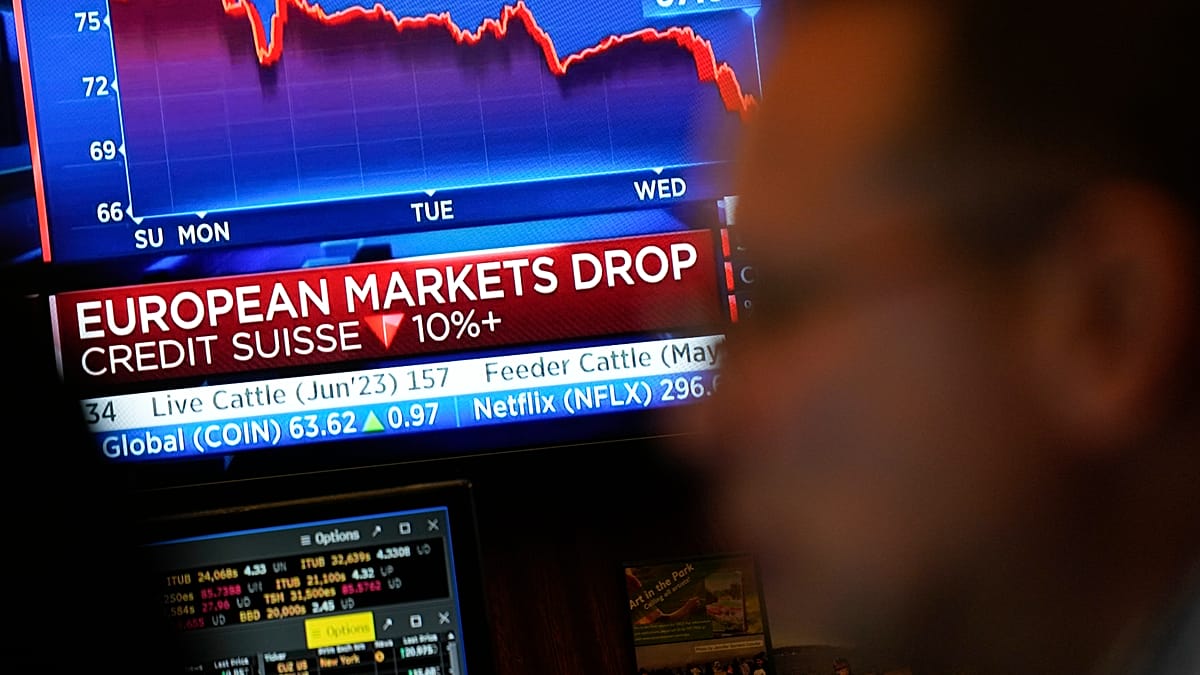
European markets drop, drink stocks sink after Trump tariff threat
European markets are weathering their second day of heavy losses this week, with sell-offs persisting as EU-US trade tensions simmer.
At around 12pm CET, France’s CAC 40 was down 1.28%, Germany’s DAX slid 1.52%, Italy’s FTSE MIB dropped 1.49%, while Spain’s IBEX 35 fell 1.66%. The UK’s FTSE 100 was down 1.11%, while the broader STOXX 600 dipped 1.23%.
Investors are watching nervously as world leaders gather in Davos for the World Economic Forum’s annual summit, and US President Donald Trump doubles down on his intention to conquer Greenland — threatening extra tariffs on eight European countries that stand in his way.
In light of the recent threats on winemakers, major French beverage firms saw their stock suffer on Tuesday. LVMH, which owns Moët & Chandon, Dom Pérignon, and Veuve Clicquot, dropped 2.57% in Paris, while Rémy Cointreau fell 2.83%.
Read the full story below.
European markets drop, drink stocks sink after Trump tariff threat
Major beverage firms in France are seeing their share prices slide after US President Donald Trump threatened to impose a 200% tariff on French wine and champa…
‘Escalation is not the solution’, Cyprus President says on Greenland
“We greatly value the transatlantic relations and EU-US partnership, and we really believe that escalation or attempts of imposition are in no one’s interest,” Cyprus President Nikos Christodoulides, who took over the rotating presidency of the Council of the EU earlier this month, said.
In a press conference held after addressing the European Parliament in Strasbourg on Tuesday, Christodoulides said the EU should work to de-escalate the situation with the US and keep the dialogue open.
“We will continue discussing the issue on Thursday during the extraordinary European Council in Brussels. We will evaluate the situation and we’ll take decisions during the Council,” he said.
Both in the press conference and during his speech in the Parliament’s plenary, Christodoulides stated Cyprus stands in “full support and solidarity with Denmark and the people in Greenland”.
He said he is in close contact with the Danish Prime Minister and talked to her on Sunday about the Greenland crisis.
‘We cannot count anymore on the United States’ said MEP in charge of defence policy report
“We have to be realistic: we cannot count anymore on the United States as a partner that will stand with us in defending European interests. We need to be able to do that ourselves,” MEP Thijs Reuten told Euronews in an interview.
Reuten is the rapporteur of the Parliament’s 2025 report on the EU common security and defence policy, which will be voted on by his fellow lawmakers on Wednesday in Strasbourg.
He believes that a pivotal change in European security is happening and that the EU should “be able to have operations without the United States”.
The report states, among other things, that the Parliament is “concerned” by non-EU countries’ interference in Greenland, “notably inflammatory narratives and the conduct of hybrid actions on Greenland’s territory, as well as the US Government’s formulation of explicit threats against Greenland’s sovereignty”.
“We need now to move towards a real European defence union, towards getting a real industrial base in Europe, to leave all national interests behind, because we cannot defend ourselves if we keep on thinking in 27 member states,” the MEP said.
While he acknowledges that the Union is now “too dependent on the United States”, he also believes that in two or three years the EU can “already be quite far” in building an autonomous defence system, if it “leaves behind all the excuses and all the national interests in the 27 capitals”.
US attitude on Greenland ‘incomprehensible’, Belgian FM tells Euronews
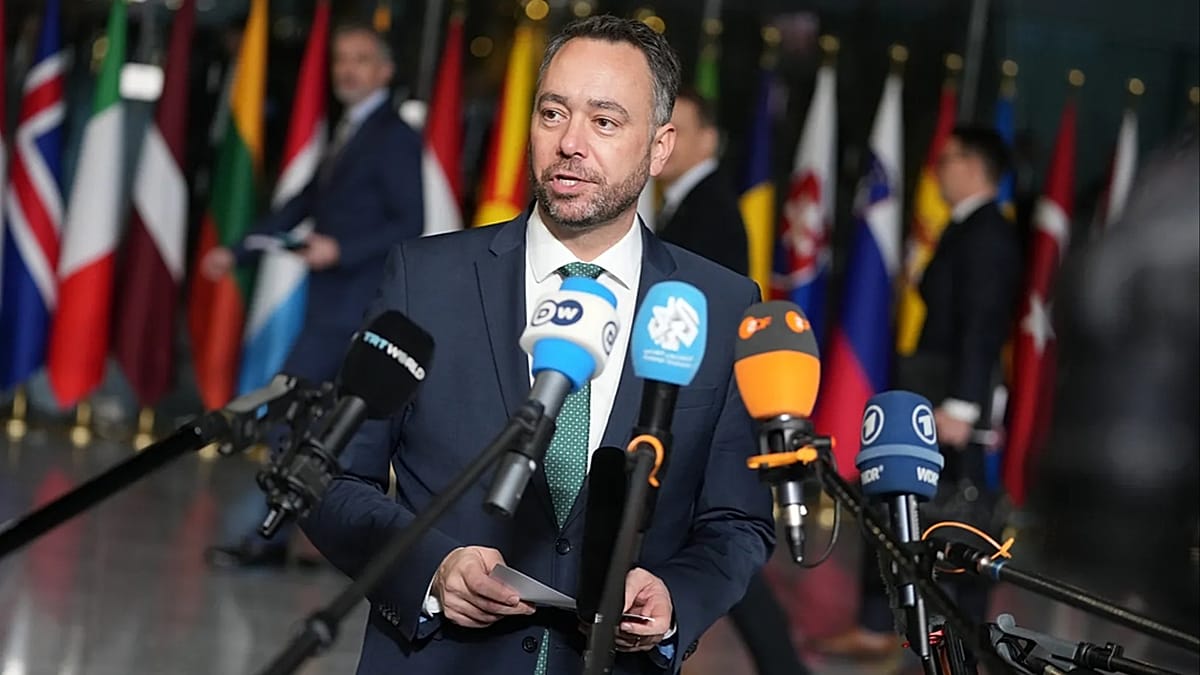
Donald Trump’s plan to take control of Greenland is “incomprehensible and unnecessarily hostile”, Belgium’s Foreign Minister Maxime Prévot told Euronews’ 12 Minutes With programme from Davos.
Yet despite his criticism of Trump’s actions, Prévot hopes pragmatism will prevail.
“I hope that it will be possible in the coming days and weeks to go back to a more reasonable way of thinking and acting,” he said. “I think it’s crucial.”
“We absolutely need to avoid any escalation on this tariff war, because it will be bad for both parties, also for the US. And I hope it will be possible to find a reasonable solution in the coming weeks. Otherwise, we would be forced to use the anti-coercion instrument, for instance.”
Read the full write-up of the interview below.
US talk on Greenland ‘incomprehensible’ and hostile, Belgian FM says
US President Donald Trump’s plans to take control of Greenland are “incomprehensible and unnecessarily hostile”, Belgian Foreign Minister Maxime Prévot told Eu…
Robert Fico: World leaders don’t take the EU seriously
Robert Fico, Slovakia’s prime minister, said on Monday that the EU “would be in a completely different position than we are now” if it acted “the same way” the US does.
Fico made the comment on X following a conversation with German Chancellor Friedrich Merz during which they discussed Fico’s recent talks with US President Donald Trump and Secretary of State Marco Rubio.
“The President of the United States is clearly pursuing the nation-state interests of the US. If the EU acted in the same way, we would be in a completely different position than we are now,” Fico said, blaming the bloc’s green initiatives and migration policies for the lack of influence on the world stage.
“World leaders do not take the EU fully seriously, and this can be attributed to our nonsensical climate targets and our suicidal migration policy. In this spirit, I will send an open letter to the President of the European Commission tomorrow and inform all prime ministers and heads of EU member states.”
Fico said he proposed several solutions to Merz over the issues he mentioned.
PHONE CALL WITH GERMAN FEDERAL CHANCELLOR F. MERZ AFTER THE MEETING WITH THE U.S. PRESIDENT
Dear friends,
just a few minutes ago I finished a phone call with German Federal Chancellor Friedrich Merz @bundeskanzler regarding the serious international situation. Above all, I… pic.twitter.com/4d1McrHvoL— Robert Fico 🇸🇰 (@RobertFicoSVK) January 19, 2026
In Davos, von der Leyen pitches ‘European independence’ versus Trump’s worldview
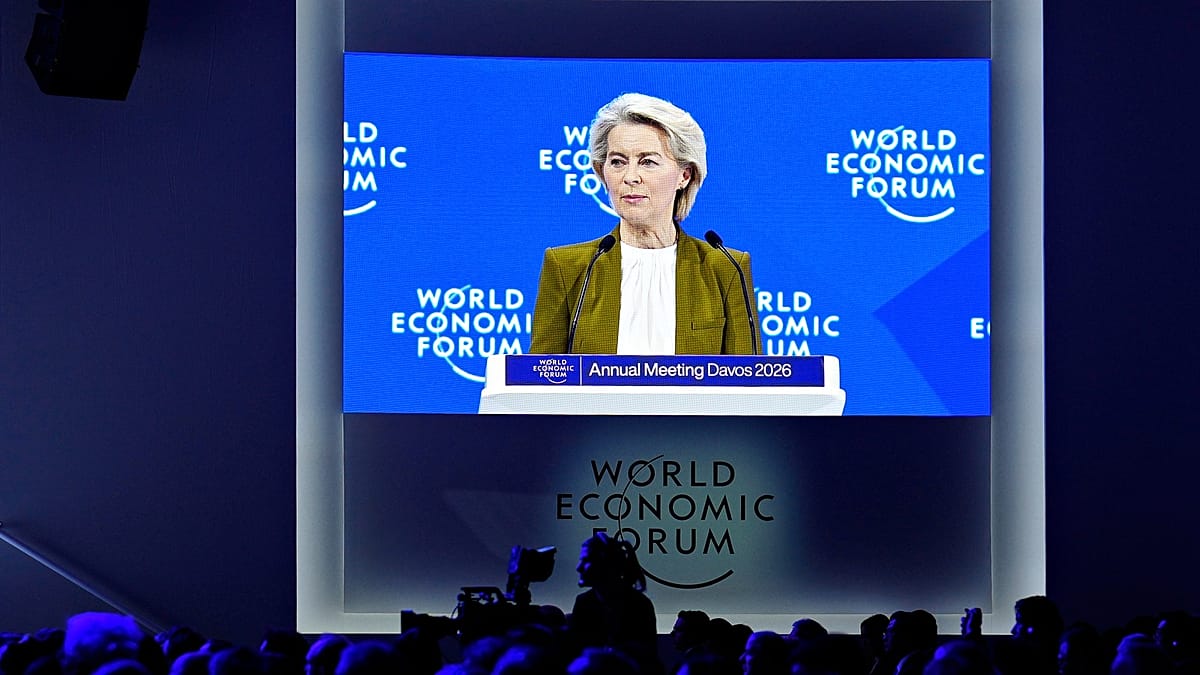
As we reported on this blog, Ursula von der Leyen took the stage at the World Economic Forum in Davos, Switzerland, to make a strong case for “European independence”, arguing the “seismic” changes experienced by the global order should be seized as a catalyst rather than a cataclysm.
Though this is not the first time that the president of the European Commission has advocated for greater autonomy, her speech took on a new meaning against the extraordinary crisis triggered by Donald Trump’s tariff threat to seize Greenland.
Here’s how von der Leyen’s worldview contrasted with Trump’s.
Von der Leyen pitches ‘European independence’ versus Trump’s worldview
As Donald Trump promotes his expansionist foreign policy, upending the transatlantic alliance along the way, Ursula von der Leyen called on Europe to seize the…
China vice-Premier: We should be seen as a partner, not a rival
China’s Vice-Premier He Lifeng also argued in Davos for China’s continued expansion and called for greater accommodation from the United States and Europe on trade matters.
Acknowledging that relations between China and the US have experienced “ups and downs,” he said both sides should “help each other,” stressing that cooperation brings mutual gains while confrontation leads to losses.
He further complained that “in many cases, when China wants to buy, others are unwilling to sell,” adding that trade disputes have increasingly been framed as security concerns – a veiled criticism of Europe, China’s third-largest trading partner in goods and services.
He emphasised that China’s economic progress has been driven by “reform, opening up and innovation,” not by government subsidies.
The European Parliament to hold an ’empty’ confidence vote against the Commission
The European Parliament on Monday evening held the debate ahead of a no-confidence vote against Ursula von der Leyen’s European Commission scheduled for Thursday.
The confidence vote was tabled by the far-right Patriots for Europe (PfE) group and asked for the Commission’s resignation over the EU-Mercosur trade deal signature. But due to recent developments in transatlantic relations and a feeling of fatigue following previous failed attempts to unseat the Commission, nobody inside the European Parliament seems to care much about this vote, which was seen as crucial.
Monday’s debate took place in an almost empty hemicycle, with only a few dozens of MEPs present and no group leaders in the room bar Manon Aubry from The Left. Not even Jordan Bardella, the PfE president, took part in the debate.
The European Commission itself seems not to attach much importance to the vote. Commission President Ursula von der Leyen did not show up in the Parliament on Monday, replaced by Commissioner for Trade, Interinstitutional Relations and Transparency Maroš Šefčovič. She had been present during the previous debates ahead of confidence votes in July and October 2025.
Thursday’s vote is a foregone conclusion. The motion is set to fail, as it is very far from reaching the two-thirds of the votes required in the European Parliament for the motion of censure to be approved.
The leaders of almost all the political groups made clear their intention to vote against the motion. European People’s Party (EPP), Socialists and Democrats (S&D), Renew Europe, Greens/EFA, and The Left will not join the PfE’s call to unseat the Commission, despite some harsh critics on the deal coming from the leftist parties.
The European Conservatives and Reformists (ECR) appear split although their leader, Patryk Jaki, criticised the deal and the Commission itself during the debate. The Europe of Sovereign Nations would be the only other group to fully support the no-confidence initiative. This means that roughly one-fifth of EU lawmakers will vote to force the Commission to resign, in a ballot set to pass almost unnoticed.
Zelenskyy may attend Davos if progress made on peace deal documents
While Volodymyr Zelenskyy is not expected to attend Davos this year, he told journalists in a Whatsapp group that he stands ready to fly in to finalise details over a possible peace plan.
The Ukrainian President, who is not on the official Davos programme, said that his “top priority” right now is to “help people with energy”.
Russia has for weeks targeted energy infrastructure in Ukraine, including substations serving nuclear power plants, temporarily depriving many Ukrainians of power in the depths of winter.
Zelenskyy said he “would go” to Switzerland if there is progress on a possible 20-point peace deal Ukraine has been working on with the US.
“I am grateful to the American and Ukrainian teams for working together. There is one last mile to go to finalise these documents. If the documents are ready, we will have a meeting and a trip. If there are energy packages or even a meeting and decisions on additional air defence, of course, I… will go,” Zelenskyy wrote on Whatsapp.
“There are signals from the team in Davos that, for example, they have almost finished the document on the restoration of Ukraine,” he added.
Hungary against joint EU statement on Greenland
Hungarian Foreign Minister Péter Szijjártó said yesterday in Prague that the country is against the EU issuing a joint statement on the situation over Greenland.
“We consider (Greenland) a bilateral matter, where the solution is possible through negotiations between the two parties. I do not consider this to be a European Union matter,” Szijjártó said following a meeting with his Czech counterpart.
He added that Hungary’s envoy to the EU made the country’s position on this issue clear during a meeting of ambassadors on Monday evening.
Balázs Orbán, political adviser to Prime Minister Viktor Orbán (no relation), also said today that the Greenland crisis is a “NATO-internal matter”.
❗️Greenland is a NATO-internal matter, not an EU competence; therefore, 🇭🇺 Hungary does not support a joint EU statement. The matter should be addressed through dialogue between the parties concerned. https://t.co/e2oBbaV6a4
— Balázs Orbán (@BalazsOrban_HU) January 20, 2026
China’s vice-premier: ‘Tariff and trade wars have no winners’
China’s Vice-Premier He Lifeng on Wednesday criticised “tariff and trade wars” at the World Economic Forum in Davos, a day after Donald Trump reiterated his threats to impose additional tariffs on eight European countries if they resist his efforts to annex Greenland.
“Tariff and trade wars have no winners,” he said, warning that such conflicts fragment the global economy and disrupt the international allocation of resources.
Without naming the United States, he cautioned that a “handful of countries” should not claim privileges based on power, adding that the world must not revert to a “law of the jungle in which the strong bully the weak”.
He reaffirmed China’s commitment to free trade, inclusive globalisation, and adherence to World Trade Organisation rules.
Von der Leyen promises ‘massive’ investment in Greenland
During her Davos speech, Ursula von der Leyen outlined four key principles to guide the European Union’s approach to Greenland and the Arctic region:
- Full solidarity with Denmark and Greenland. “The sovereignty and integrity of their territory is non-negotiable,” she said.
- A “massive” surge in investment in Greenland to support “the local economy and infrastructure” on the island.
- Cooperation with the US and Western allies to strengthen Arctic security, building on the defence initiatives that the EU has rolled out in recent years.
- Closer cooperation with regional partners, such as the UK, Norway and Iceland, to reinforce security partnerships. She also added Canada, which is on the other side of the Atlantic, to the list of regional partners.
She then notes that the European Commission’s upcoming “security strategy” will include an upgrade to the Arctic strategy, with a focus on Greenland. “At the heart of this will be the fundamental principle: It is for sovereign people to decide their own future,” she says.
EU response to Trump’s tariffs will be ‘unflinching’, says von der Leyen
If Donald Trump goes ahead with the 10% tariffs against eight European countries to force the sale of Greenland, the European Union’s response will be “unflinching”, von der Leyen just said in Davos.
“We consider the people of the United States not just our allies, but our friends,” she said. “And plunging us into a dangerous downward spiral would only aid the very adversaries we are both so committed to keeping out of our strategic landscape. So our response will be unflinching, united and proportional.”
The Commission has put on the table a list of retaliatory measures worth €93 billion, which was drafted during last year’s trade negotiations but was never used. The executive also has at its disposal the Anti-Coercion Instrument, which would enable broader tit-for-tat across multiple economic sectors, such as services, investment, intellectual property and public procurement.
‘A deal is a deal’, von der Leyen tells Trump
Von der Leyen concludes her speech by addressing the crisis over Greenland triggered by Donald Trump’s 10% tariff, which would hit six EU countries, the UK and Norway.
“When it comes to the security of the Arctic region, Europe is fully committed. And we share the objectives of the United States in this regard,” she says.
“Arctic security can only be achieved together. This is why the proposed additional tariffs are a mistake, especially between long-standing allies.”
Von der Leyen then points to the trade deal that she and Trump agreed on last year in Scotland, which introduced an all-inclusive 15% tariff on most EU goods. Despite its lopsided terms, the European Commission insisted that the agreement would help inject stability and predictability in commercial transatlantic relations. This promise is now up in the air after Trump’s 10% threat.
“In politics as in business: a deal is a deal,” von der Leyen says. “And when friends shake hands, it must mean something.”
Privately, EU officials and diplomats say that if Trump goes ahead with his 10% threat, the Scotland deal will immediately fall apart.
Von der Leyen: ‘We are choosing fair trade over tariffs’
Ursula von der Leyen continues her speech with a defence of free trade, which inevitably reads as a rebuke to Donald Trump’s tariff threats.
The recently signed EU-Mercosur trade deal, she says, sends a “powerful message to the world”.
“We are choosing fair trade over tariffs. Partnership over isolation. Sustainability over exploitation. And that we are serious about de-risking our economies and diversifying our supply chains,” she says.
More trade deals are in the works with Australia, the Philippines, Thailand, Malaysia and the United Arab Emirates. An EU-India agreement is on the verge of conclusion, she added, referring to her upcoming visit to the country on 27 January.
“There is still work to do. But we are on the cusp of a historic trade agreement,” she says about the India deal. “Indeed, some call it the mother of all deals. One that would create a market of 2 billion people, accounting for almost a quarter of global GDP. And, crucially, that would provide a first-mover advantage for Europe with one of the world’s fastest-growing and most dynamic economies.”
“Europe wants to do business with the growth centres of today and the economic powerhouses of this century,” she went on. “From Latin America to the Indo-Pacific and far beyond, Europe will always choose the world. And the world is ready to choose Europe.”
Ursula von der Leyen takes the stage in Davos and pitches ‘European independence’
Ursula von der Leyen, the president of the European Commission, has taken the floor at the World Economic Forum in Davos, beginning her speech with a pitch about “European independence”.
“The world may be very different today, without any question. But I believe the lesson is very much the same. That geopolitical shocks can – and must – serve as an opportunity for Europe. And in my view, the seismic change we are going through today is an opportunity, in fact, a necessity to build a new form of European independence,” she told the audience in Davos.
“This need is neither new nor a reaction to recent events. It has been a structural imperative for far longer.”
The European Union, she added, can only “capitalise” on the far-reaching changes if it admits the changes to the world order are here to stay.
“Of course, nostalgia is part of our human story. But nostalgia will not bring back the old order. And playing for time – and hoping for things to revert soon – will not fix the structural dependencies we have,” she went on. “So my point is: if this change is permanent, then Europe must change permanently too. It is time to seize this opportunity and build a new independent Europe.”
All EU leaders ‘agree with the importance’ of summit – EU official
An EU official has told Euronews that “all member states agree with the importance” of Thursday’s extraordinary meeting and that it will take place as foreseen at 19.00 CET.
Doubts were briefly raised overnight about Emmanuel Macron’s attendance after Donald Trump made public texts the two leaders had exchanged in which the French president invited his US counterpart to a meeting and dinner at the Elysée on the same evening.
But at the summit this morning, the official added that “President Macron confirmed his presence”.
European Commission to hold Security College on Thursday
European Commissioners will on Thursday convene for a Security College, an official confirmed to Euronews.
This will be the second time this format will be held after being created in March last year by Ursula von der Leyen in March in order for Commissioners to be “regularly briefed on security developments, from external and internal security to energy, defence, research, cybernetics, trade, and foreign interference”.
Trump threatens 200% tariffs on French wine over Macron’s refusal to join Board for Gaza
The US President also doubled down overnight on his tariff diplomacy, threatening to slap an additional 200% tariff on French wine and Champagne following Emmanuel Macron’s refusal to accept his invitation to join the Gaza Board of Peace.
Asked by reporters in Miami about Macron’s refusal, Trump said: “Well, nobody wants him because he’s going to be out of office very soon.”
“So you know, that’s all right. What I’ll do is, if they feel like [being] hostile, I’ll put a 200% tariff on his wines and champagnes, and he’ll join. But he doesn’t have to join.”
A source in the French president’s entourage said they “have taken note” of Trump’s latest threat.
“As we have always emphasised, tariff threats to influence our foreign policy are unacceptable and ineffective,” they added.
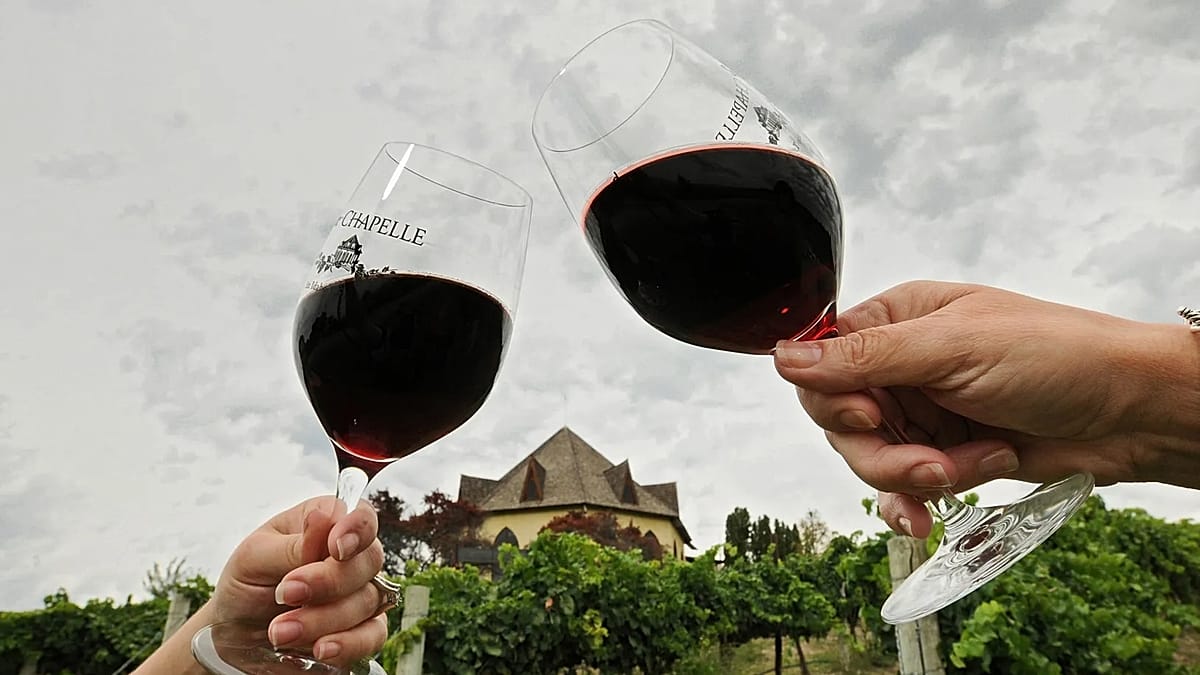
Trump pledges tariffs on wine if France does not join Gaza peace board
The “Board of Peace” was an idea initially proposed by Trump last September as part of his plan to end the war in Gaza, although the initiative now seems to be…
Trump leaks text message from Macron pitching a G7 meeting on Greenland
More from Donald Trump’s overnight social media. He posted a text message from French President Emmanuel Macron that says:
“My friend,
We are totally in line on Syria. We can do great things on Iran. I do not understand what you are doing on Greenland. Let us try to build great things:
1) I can set up a G7 meeting after Davos in Paris on Thursday afternoon. I can invite the Ukrainians, the Danish, the Syrians, the Russians in the margins.
2) Let us have a dinner together in Paris together on Thursday before you go back to the US.
Emmanuel.”
The text message, which has been confirmed by a source in the French president’s entourage, is remarkable because Macron appears to propose a meeting and a dinner with Trump on Thursday, the same day that EU leaders are scheduled to meet for an extraordinary summit.
Additionally, Macron is willing to invite a Russian delegation to the margins of a G7 meeting, which would represent a big break from Europe’s strategy to diplomatically isolate the Kremlin. Earlier this month, Macron suggested reopening direct communication with Vladimir Putin, an idea backed by Italian Prime Minister Giorgia Meloni.
Europe’s impossible puzzle: defend Ukraine from Putin and Greenland from Trump
For the past four years, European leaders have been working overtime to defend Ukraine’s sovereignty and territorial integrity against Russia’s war of aggression, often putting together strongly worded statements of condemnation, holding phone calls at late hours and getting together for hastily convened crisis meetings.
But now, the script has been flipped dramatically and European leaders find themselves doing the exact same thing – joint statements, phone calls and crisis meetings – to defend Denmark’s sovereignty and territorial integrity against a country that, on paper, is supposed to be their time-honoured ally and main security guarantor: the United States.
The parallelism exemplifies the impossible puzzle that Europe, as a political family bound by a shared commitment to international law, faces in the second Trump era.
Read the analysis.
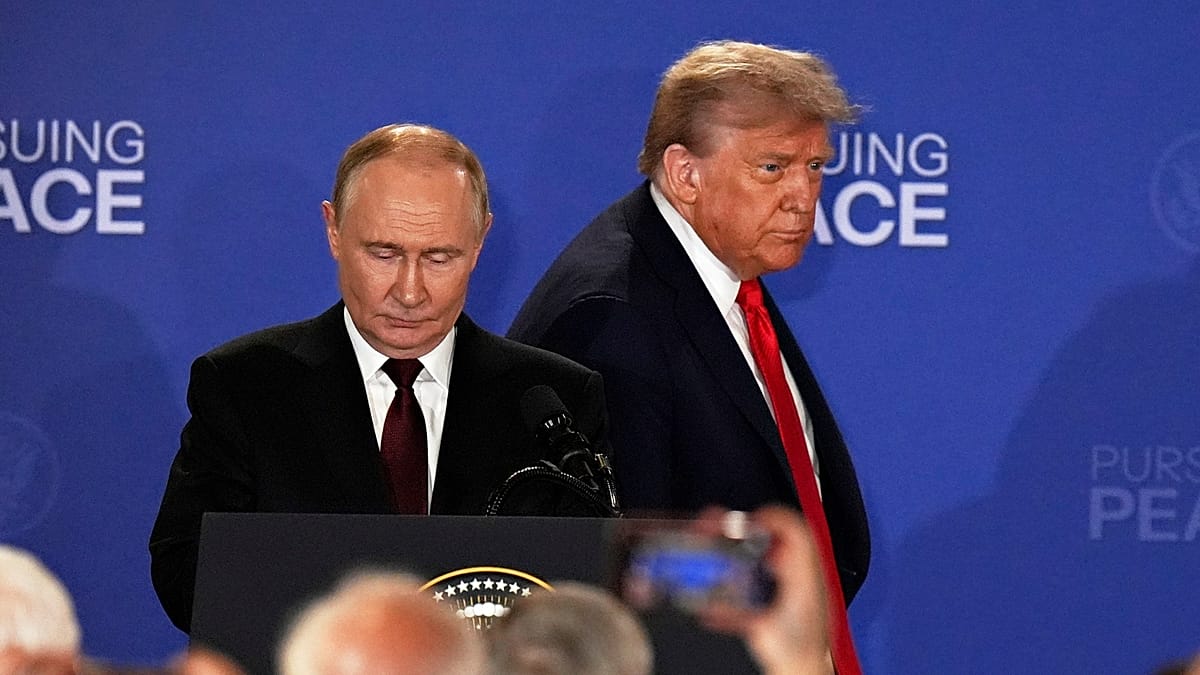
Europe’s puzzle: defend Ukraine from Putin and Greenland from Trump
Europe’s rush to defend of Denmark’s sovereignty against threats from the US echoes the defence of Ukraine’s sovereignty against Russia – and raises the uncomf…
Trump mocks European leaders in latest post showing Greenland as US territory
Donald Trump posted overnight a digitally altered picture of himself with European leaders in the White House that shows him next to a map that depicts Greenland, Canada and Venezuela as part of the territory of the United States, echoing his self-styled “Donroe Doctrine”.
The original picture is from August, when European leaders hastily flew to Washington to meet with Trump after his contentious meeting with Russian President Vladimir Putin in Alaska.
Trump posted another picture that shows him, alongside Vice President VD Jance and Secretary of State Marco Rubio, placing the American flag on Greenland, which is described as “US Territory Est. 2026”.
The social media posts are an ominous sign for European diplomacy.
Donald J. Trump Truth Social Post 12:58 AM EST 01.20.26
President Trump just posted a photo of the Oval Office with him displaying a map that shows Greenland, Venezuela and Canada as part of the United States of America pic.twitter.com/krAMvY65Qa
— Commentary Donald J. Trump Posts From Truth Social (@TrumpDailyPosts) January 20, 2026
Trump agrees to a meeting in Davos but says ‘there can be no going back’
The US President said earlier this morning that he agreed to a meeting “of the various parties” in Davos on Wednesday during a “good” call with NATO Secretary-General Mark Rutte on Greenland.
But he doubled down on his claim that total US control over Greenland, the semi-autonomous territory of the Kingdom of Denmark, is “imperative for National and World Security”.
“There can be no going back – On that, everyone agrees!” Trump wrote.
And we’re back!
Good morning everyone and welcome to the second day of our special coverage on the row opposing the US and Europe over Donald Trump’s bid to annex Greenland.
Today, you can expect coverage from Davos – where Ursula von der Leyen and Emmanuel Macron are scheduled to give speeches and lots of meetings are expected to happen behind closed doors – as well as Brussels, where EU finance ministers are meeting.
Time to buckle up for another intense news day.
Read the full article here