



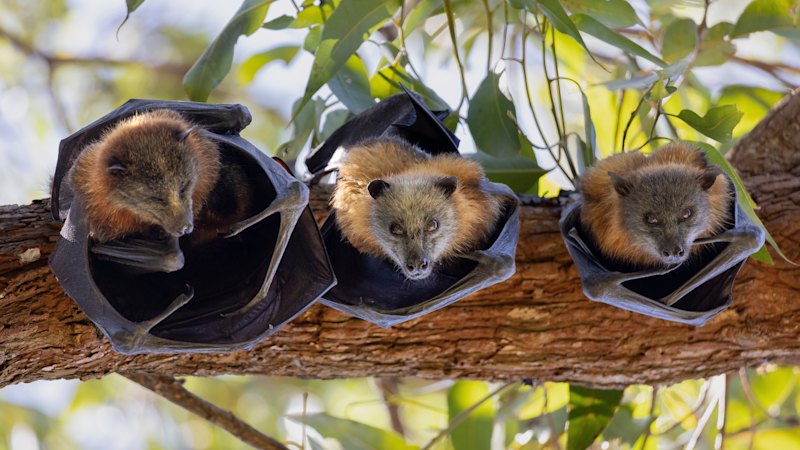
It’s raining bat poo – and that could be worth close to $1 billion.
Scientists who sought to estimate the economic value of flying foxes have found that the activity of just one species, the grey-headed flying fox, is worth between $271 and $955 million annually to the timber industry alone.
The study published in Scientific Reports also found flying foxes plant about 91 million new trees each year by dispersing seeds and pollinating flowers.
“We actually think that it’s an understatement, particularly for the number of trees, at least, because we only modelled for the grey-headed flying fox,” University of Sydney research student and lead author of the study, Alfred Ortega González, said.
“What about the other three flying fox species, and how much are they actually contributing?”
The extraordinary effect flying foxes have on Australian forests – which may have barren scars visible from space if it weren’t for the bats, the researchers speculate – is down to their unique biology.
“They are able to carry more seeds, fruits and pollen throughout the ecosystem than many other species,” such as birds, insects and other mammals, González said.
Grey-headed flying foxes are among the largest megabats in the world, and bats are the only mammals that truly fly rather than glide.
Lifting their heavy bodies skyward requires a turbocharged metabolism and gorging on fruit each night to fuel their 50 to 100-kilometre journeys. As a result, one flying fox can defecate 60,000 seeds in a single night.
Biologists call it “seed rain”.
“When you start adding those numbers up then you start seeing how important they become for Australia in general,” González said.
Wildlife biologist Dr Alexander Braczkowski, who supervised the research, said the team used CSIRO data of 1200 flying fox colonies and mapped the range bats travel from each roost site.
They calculated the grey-headed flying foxes alone help plant and pollinate native trees across an area the size of Sweden. They dubbed the animals’ area of influence the “bat ripple”.
Braczkowski is known for his work in Uganda studying Jacob the three-legged lion.
He says their analysis doesn’t even consider other ecosystem services the bats undertake, such as carbon sequestration via the trees the bats plant.
Flying foxes may clash with their human neighbours in the suburbs, but without them, Australia may be far less bushy and biodiverse.
“Don’t forget that Australia had bounties on flying foxes until the ’40s,” Braczkowski said. “They’d hit them with napalm.”
The biologists hope their study underscores the value of flying foxes as populations collapse under the pressure of land clearing and extreme temperatures made more likely by climate change.
The findings also make efforts to cool flying fox colonies during heatwaves all the more worthwhile.
“Giving a dollar value or currency to nature – personally, I’m not very fond of the idea, although I see the importance of doing it. Nature should be valued for itself, but that’s really a romantic idea,” González said.
“At the end of the day, money talks, right?”
The Examine newsletter explains and analyses science with a rigorous focus on the evidence. Sign up to get it each week.
 Angus Dalton is the science reporter for The Sydney Morning Herald.Connect via X or email.
From our partners
Read the full article here