




It’s not the worst space invader in the airline industry.
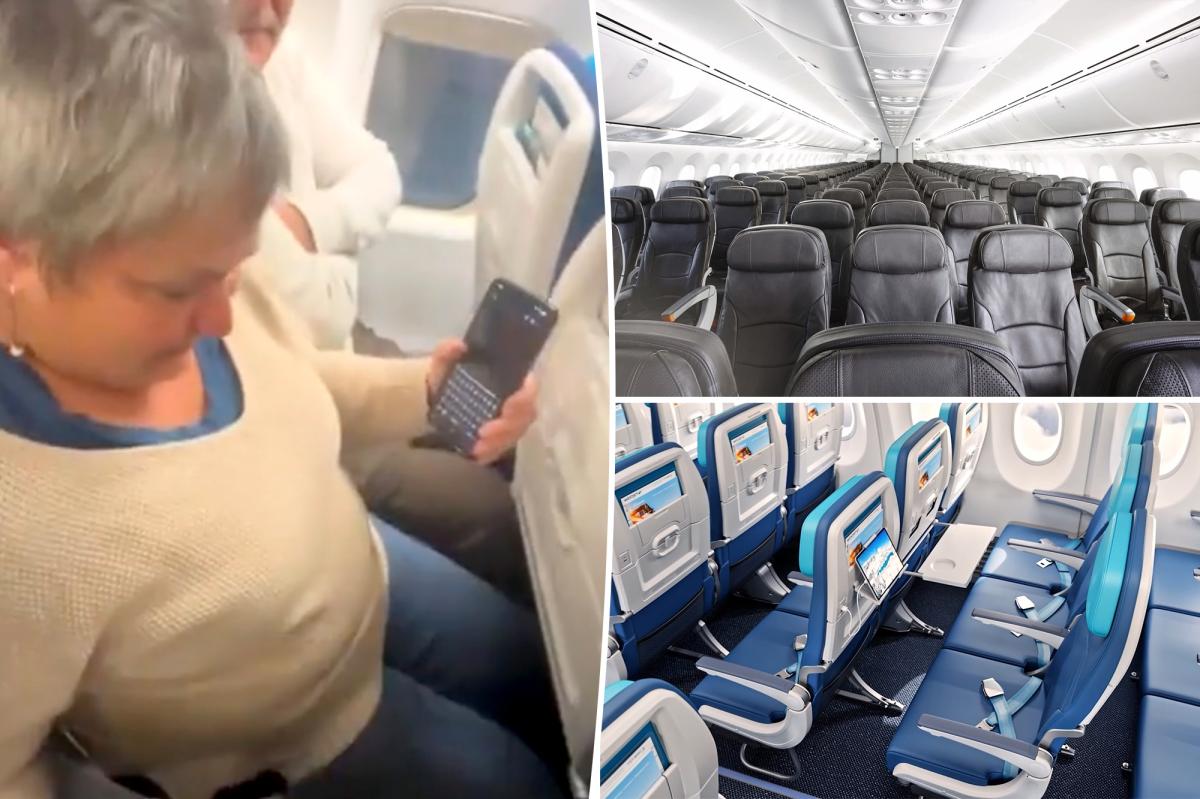
Earlier this week, a video went viral showing WestJet passengers crammed into a space so tight their knees extended under the seat in front of them.
The clip, posted to Reddit, came on the heels of the Canadian carrier rolling out a fixed recline design in its new planes that prevents coach passengers from leaning their seats back unless they pay extra for premium seats.
The configuration, which allows for an extra row and therefore lower fares and ostensibly more money, sparked fears of a massive sky shrinkflation movement wherein airlines increasingly seek to maximize profits by narrowing seat space.
In this case, WestJet’s smallest seat pitch clocked in at a claustrophobic 28 inches — a far cry from the minimum 30-31 inches most carriers aim for.
However, as flight experts have pointed out, this dinky amount of legroom is already an industry standard, while some airlines offer even less.
When it comes to seat space, the worst offenders include Spirit (28 inches in standard economy) — which clocked last for legroom according to a 2024 Upgraded Points Survey — Frontier (28 inches in typical coach), and Jetstar (between 28 and 29 inches depending on the plane), Aerospace Global News reported.
However, the distance between the front of the seat in row 1 and the bulkhead ranges from 26.9 inches on the A321 to a tight 23.9 inches on the A321neo LR.
Airlines with the scrawniest seat pitches, per AGN:
- Spirit (28 inches in standard economy)
- Frontier (28 inches in standard economy)
- Jetstar (28 on A320/A321 with 28-29 on A320neo and 29 on A321neo LR)
- Scoot (28–29 on A320/A321)
- Wizz Air (29-29)
- WestJet (28 inches in some rows on new design aircraft)
- Vueling (28 inches on A321neo with some seats clocking in at 27.6)
Thankfully, contrary to popular belief, a tight pitch isn’t always synonymous with extreme discomfort.
Airlines can mitigate the cramped nature by reshaping and angling the seatback shells to maximize usable leg clearance and do away with obstacles such as seatback pockets located near the knees.
As for safety concerns, there is no documented evidence that seat pitch can hinder an evacuation, according to the Federal Aviation Administration.
Conversely, some evacuation drills have shown that lower seats are easier to climb over, which helps facilitate passengers’ escape.
This is also why regulators like the FAA have not imposed a minimum seat pitch mandate, although airlines must prove that they can evacuate an aircraft in 90 seconds under certification requirements.
That being said, flying in a veritable sardine can with wings be quite grueling.
Fortunately, despite the fact that major US carriers have lost between 2 and 5 inches of legroom since the 1980s, there are still plenty of domestic carriers with spacious pitches.
Business Traveler even ranked the airlines with the legroom-iest cattle classes in 2025, according to stats from the aviation data firm OAG.
The top five are:
- JetBlue (32.7 inches)
- Southwest (31.7 inches)
- Delta (31.0 inches)
- Alaska (31.0 inches)
- American (30.3 inches)
Read the full article here