




The first snowfall this year didn’t amount to much. Three inches at most, followed by freezing rain to give it weight and a crust. But as it was winding down, my thoughts weren’t about shoveling the front steps or putting sand down to aid with traction. And I knew the plow guy would be coming by to take care of our driveway.
Instead, my thoughts turned upward. In winter, I’m obsessed with my roof. And with a simple tool that has become my indispensable ally in maintaining my house properly in cold weather.
Don’t miss any of our unbiased tech content and lab-based reviews. Add CNET as a preferred Google source.
My roof rake.
It’s not much to look at. Sixteen feet of aluminum pole with a perpendicular 22-inch-wide blue plastic blade at one end. But it makes all the difference in keeping melting snow from turning into streams of water that leak into the house. That’ll damage walls, ceilings, light fixtures and anything else that’s under the drip, drip, drip. Over time, it could develop into a mold problem.
Inside your house, leak detectors are handy gadgets for all kinds of water mishaps, but prevention is always the better policy.
If you live in an area that regularly receives snow, pay attention to the buildup on your roof. In one sense, snow on the roof is a positive thing. It indicates that you have sufficient insulation in your ceiling and attic to prevent warm air from escaping, as well as proper ventilation to help keep the roof cool.
But that snow will melt, producing runoff that heads downhill to your eaves and gutters. That’s where the problem begins.
The winter of 2015 was a brutal one in Massachusetts, with roughly 90 inches of snow falling in less than a month. That year, the ice dams won.
As that water reaches the edge of your roof, it becomes more exposed to cold temperatures, and it’ll refreeze, creating ice dams. Those frozen blockages will build up and prevent the next waves of meltwater from falling harmlessly off your roof. Where does that water go? It backs up under your shingles and through the roof decking, following a new gravitational pathway into your living spaces.
I have witnessed this leaking. I have repaired the damage. I have vowed never to let it happen again.
Which is why I’m outside right after every snowfall, raking away.
There aren’t any really compelling technological fixes for this problem. There is no Roomba for your rooftop. Whole-roof heating systems do exist, but they cost thousands of dollars and are a significant construction project. Here in New England, it’s common to see homes with a heating cable snaked along the lower portion of the roof, just above the eaves. But for my house, even that more modest option would, as a rough estimate, run somewhere between $1,000 and $2,000 to install.
With any heating system, there’ll also be ongoing electricity costs and a potentially messy cycle of melting and refreezing.
A roof rake will set you back less than $200. It’s low tech, and it works.
How to handle a roof rake
I’ve been using my roof rake after every snowstorm, even the minor ones, for many a snowy winter here in central Massachusetts.
I had to learn the hard way. Before I bought my roof rake, I went after the ice dams themselves, after they’d already become way too thick, and water was dripping, sometimes fiercely, into the house. I was outside on a ladder, in the cold, whaling away with a hatchet. Not the way to go.
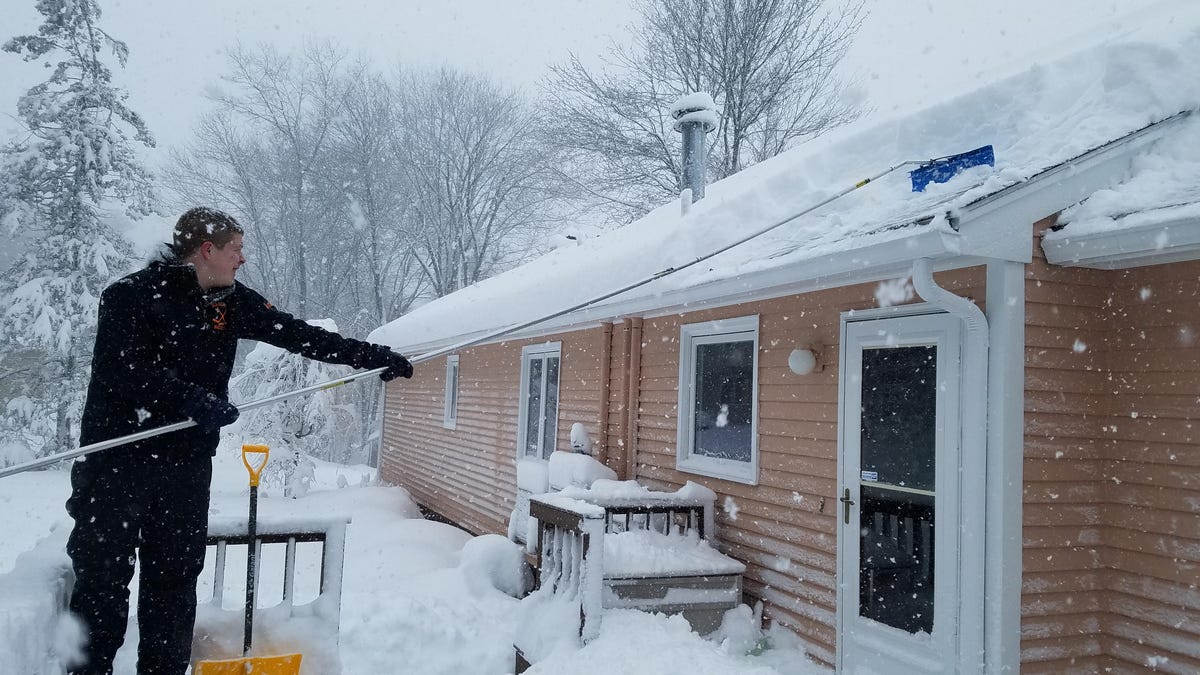
This is me, clearing the roof after a refreshingly light snowfall.
A roof rake is so much quicker and simpler — and again, it’s that all-important ounce of prevention. You stand on the ground, reach up with the rake and gently pull a big shovel’s worth of snow off the roof at a time. Take a step or two and repeat the process. I get around my house in about 20 minutes.
OK, it is a mild arm and shoulder workout. The rake doesn’t weigh much, but it is top-heavy, and you’re reaching up and away from your body. When the snow is thick, wet, crusty or all of the above, you’ll have to make an extra effort with each stroke.
But if you’re familiar with the often backbreaking work of shoveling snow, you’ll welcome the change of pace.
How much snow do you have to pull down? The guides I’ve read recommend clearing as much as 6 feet up from the eaves, and when I started raking my roof, I used to go just as far as I could reach. If I wasn’t hitting that 6-foot mark, I was getting close.
Over time, though, I’ve found that just 1 to 2 feet is generally sufficient. That’s the critical area, right past the eaves, where freezing and ice dam buildup take place.
The guides also advise going easy when scraping down to the roof shingles, so you don’t wear them out prematurely. I have to confess I’m not that fastidious — I’m usually dragging right along the shingles themselves, rather than trying to leave a thin coating of snow — and it hasn’t seemed to be a problem.
And for heaven’s sake, be mindful of where the power lines come into your house. You’re waving a metal pole in the air, after all.
Remember to wear heavy gloves when you’re roof-raking. The aluminum pole gets really cold to the touch.
What’s the right roof rake to buy?
Like leaf rakes, roof rakes don’t have a lot of variety. A typical roof rake comes with four 4-foot lengths of aluminum pole that you attach end to end to get the full length, plus the short blade attachment. (Mine has three 5-foot lengths, along with the blade segment.) The width of the blade ranges between approximately 17 and 24 inches.
The 16-foot length I have is enough for my house, a raised ranch, even on the side where the ground slopes away, and I can get just the first foot or so of snow from the roof. If you have a taller house or you really want to clear the way up on the roof, you could always get additional sections. The blade section of my pole angles toward the roof, which is helpful.
Some rakes have little wheels on the bottom of the blade to avoid scraping directly on the shingles. Seems like a smart design.
Other roof rakes aren’t actually rakes at all. Instead of a blade, the business end is open, with prongs holding one end of a plastic slide that runs parallel to the pole. Instead of pulling, you push into the snow, and the slide provides a slick runway for you to fall to the ground. I’ve never tried one of these, but having spent enough time wielding a standard roof rake, I have my doubts. It seems best suited for powder.
Prices for roof rakes typically range from $50 to $60 and can get to around $200. Years back, I bought a very basic model, and it’s still going strong — an excellent investment.
Gone are the days when I actually went up onto my roof and tried shoveling in addition to raking. In fairness, that was a legendary winter. In 2015, New England experienced four major snowstorms in less than a month, dumping around 90 inches of snow during that short span. No one could keep up.
But short of another “Snowmaggedon,” I know my roof rake will continue to serve me well. Whenever a snowstorm wanes, the two of us will head outside to start the clearing.
Read the full article here