



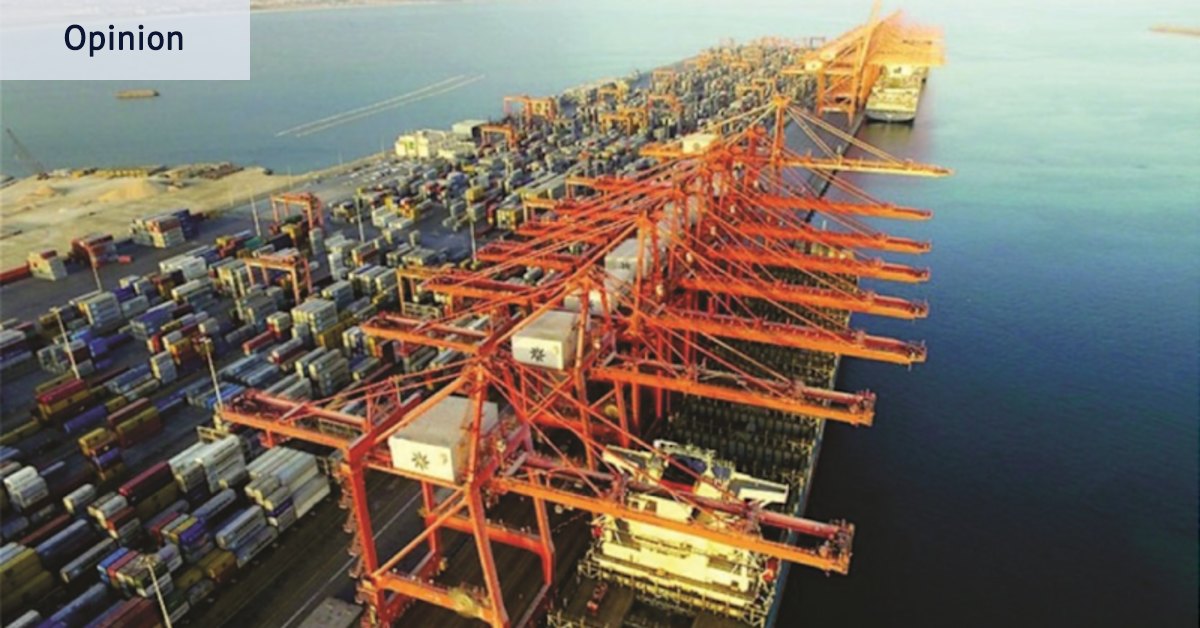
Situated on the coast of Oman with desert on one side and the Arabian Sea on the other, Duqm is a desolate place.
Once a fishing village, this port now services a newly constructed oil refinery. On one side of the man-made basin is a modern oil export terminal. At the other end sits the Duqm dry dock. Built to provide service and maintenance facilities for shipping just 15 years ago, the current clientele looks more like a maritime Tatooine cantina scene. Like the Star Wars version, the dry dock is a desert-rimmed magnet for misfits and ne’er-do-wells.
Over half of the tankers are sanctioned for their role in Russia’s oil trade. These outlaw vessels are its so-called “shadow fleet”.
Shadow fleet tankers routinely carry Russian oil to buyers happy to pay above the price cap set by G7+ nations that include Australia.
Critics are calling it “blood oil” because some of the money spent in Australia goes to the Russian war machine.
Australian imports from Indian refineries using Russian crude more than doubled between September and October, according to the Centre for Research on Energy and Clean Air (CREA), a European non-profit group that tracks the market.
Duqm port in Oman.Credit: Image via Instagram
CREA estimates that Australia imported $3.8 billion of oil refined from Russian crude between February 2023 and June 2025, generating $2 billion in tax revenue for the Kremlin.
Tracking tankers can be as simple as checking flightradar24.com to see where Grandma’s flight is before heading to the airport for pick-up. Like that Qantas flight, every tanker is required to transmit its location and other critical data using the Automatic Identification System required by the International Maritime Organisation’s International Convention for the Safety of Life at Sea (SOLAS). However, unlike flight trackers, obtaining a tanker’s location is complicated by its proximity to land-based receivers and limited public availability of satellite receiver data.
Shadow fleet tankers often add another layer of opacity. They frequently change names, ownership and flags of convenience to evade scrutiny. It is not uncommon for these vessels to conduct on-water ship-to-ship transfers of cargo, or to spoof their GPS location to confuse tracking. GPS can be jammed by combatants using strong radio emitters in areas like the Black Sea. Hopefully unlike Grandma’s flight, signals can disappear for weeks, only to reappear nearer their destination halfway around the globe.
Incongruously, this maritime Omani watering hole for shady tankers sits adjacent to the UK Joint Logistics Support Base, a facility built to support UK naval operations in the Indian Ocean and Middle East.
Six of the sanctioned tankers currently in Duqm are part of Australia’s 2025 oil product supply chain through India.
The Gulf of Kutch is located just across the Arabian Sea on the north-west coast of India. Of several oil refineries in that area, Reliance Industries’ Jamnagar refinery stands out. It is the largest such facility in the world, enjoying the Indian government’s choice to ignore international sanctions against Russia. From almost nothing prior to the 2022 invasion, Jamnagar’s Russian diet grew to more than 50 per cent of its feedstock.
India is now Australia’s number four supplier of imported refined petroleum products with Jamnagar accounting for almost all that supply. Ten per cent of our imported refined product comes from this one refinery and half of that product is sourced from Russian oil fields mostly operated by Kremlin-controlled oil company Rosneft.
Loading
Following the Herald’s “blood oil” series, Reliance Industries announced recently it would stop taking Russian oil at its Jamnagar export refinery and would no longer use the Russian crude to make the petrol and diesel it sells to Australia.
The Australian government considers the refining process to be a sanctifying act. When oil companies import fuel from India, Australia determines it to be Indian-origin and waves it through. In so doing, it ignores the seedy supply lines that created the material.
The earlier Duqm patron serves as a good example. This tanker may be currently known as Blint, but prior to Oman, the vessel was also known as Jaguar, Argent, Signal Puma, S Puma and Primo Stealth. It is perhaps easier to simply use its International Maritime Organisation number – 9293002.
Loading
The flag of registration is similarly variable. While sailing under the flag of Comoros to Oman, it has enjoyed operating under flags of convenience from Gabon to Guinea-Bissau; land-locked Mongolia for several weeks in 2023 being the most absurd.
Under a variety of names and flags, IMO9293002 has moved oil from Russia’s Baltic ports to the Gulf of Kutch half a dozen times in the past two years.
Things got particularly messy earlier in 2025. As Jaguar, the tanker had delivered another 107,000 tonnes of Russian oil to Jamnagar where it would be processed and onsold to buyers including Australia. Jaguar had moved its registration from Gabon to Guinea-Bissau. Guinea-Bissau cancelled the registration. Jaguar returned to Gabon registration which was then revoked due to the tanker’s Russian trading activities.
On the tanker’s return to Russia through the Baltic Sea, the Estonian navy sought to inspect what had become a vessel without nationality. While escorting it through Estonian waters, a Russian fighter jet intervened by briefly entering Estonian airspace. This caused a Portuguese F-16 to be scrambled in response.
It was an interaction that had the potential to escalate with dire consequences: an interaction that happened because of the ongoing oil trade between Russia and India. This in turn is a trade that is propped up by Australia importing oil products from third-party refiners.
Loading
Once rechristened Blint, the tanker made one more Russian oil delivery to Jamnagar. “Going dark” through the Baltic and again through the Red Sea, the vessel enjoyed respite in the Omani cantina for wayward tankers at Duqm before moving on to the Gulf of Suez.
Meanwhile, tankers continue to arrive in Australia carrying “blood oil” from Jamnagar. The Proteus Bohemia is the latest to arrive in Botany Bay this week, followed by the Nordmarlin in early December. Ours is a market that drives the Russian oil trade with India using shadow fleet tankers. This week’s sanctioning by Australia of a further 45 tankers is a lacklustre response when all the shadow activity is on the high seas beyond Australia’s jurisdiction.
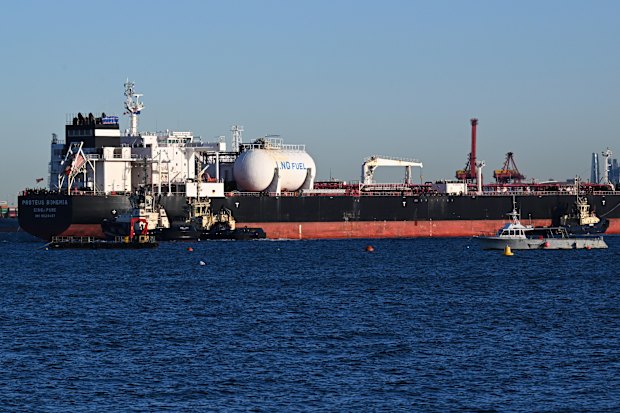
The oil tanker Proteus Bohemia, containing fuel that originated in Russia, moves from Port Botany to Kurnell on Tuesday.Credit: Janie Barrett
The European Union is introducing sanctions against Russia’s oil trade through third-party refiners in January 2026. The UK is following suit.
At what point will Australia call last drinks at the Omani tanker cantina?
Mark Corrigan is a chemical engineer with knowledge of global oil movements. He has been part of the Herald’s “blood oil” series as an active campaigner against the use of Russian oil in Australia.
Get a note directly from our foreign correspondents on what’s making headlines around the world. Sign up for the weekly What in the World newsletter here.
Read the full article here