



In Randa Abdel-Fattah’s novel Discipline – the one she was going to be discussing at Adelaide Writers’ Week – one of the villains is a Muslim academic.
To save his own flagging career, Dr Ashraf Magdy seizes on an Israel-Gaza conflict, and some Australian protests, to accept government funding for a deradicalisation and social cohesion project to “channel” the anger of young protesters.
Meanwhile, Ashraf’s politically feisty PhD student, Jamal, is fighting university disciplinary procedures over social media posts saying “Zionism is racism,” and chanting “from the river to the sea”.
The cover of Randa Abdel-Fattah’s novel Discipline.
To protect his grant, Ashraf distances himself from his student. He explains that, as a Muslim academic at an Australian university, he is “stuck in a tiny corner in a large structure.
“Because it was impossible to tear the whole thing down, [Ashraf] would at least try to make his small corner as strong and as special a space as he could,” she writes.
To the author, Abdel-Fattah – herself a Palestinian Muslim academic at an Australian university – the character is a contemptible sellout.
“His idea is reform, not change,” she said in an interview last year. Change can only come from “insurgency, insurrection”, she told a conference.
“Instead of confronting your enemy on their terms, meeting them where they want, you create sites of tension and disruption,” says the other character, Jamal, who is painted in a much more favourable light.
Loading
Tension and disruption are understatements about the events that have surrounded Abdel-Fattah in the past week. After her disinvitation from Adelaide Writers’ Week under pressure from lobbyists and parts of the media, the festival itself lies in ruins.
The festival’s director quit, followed by most of the board, whose members were later replaced. Amid a week-long slanging match about hypocrisy, mutual deplatforming, breaches of cultural safety versus cultural vandalism and accusations of terrorist sympathies, Abdel-Fattah has vowed to pursue defamation action against the South Australian premier.
In a twist, on Thursday, the new festival board regretted and reversed their original decision, apologising to Abdel-Fattah. It’s too late for this year, but she has been invited to next year’s festival. She is considering accepting.
Until these events exploded into public view, only those watching closely would have known much about this outspoken academic and author. But her activism, and the controversy surrounding her, has been building for decades.
‘Does my head look big in this?’
“I don’t want to be spat at on the way to school again,” wrote the 18-year-old Randa Abdel-Fattah in a letter to the editor published in The Age in 1998.
The letter directly addressed then prime minister John Howard, who had just committed 250 Australian troops to a Bill Clinton military campaign in Iraq. Abdel-Fattah recalled her experiences during the first Gulf War in 1990-1, when she was 11.
Loading
“I don’t want one more person to accuse me of belonging to a terrorist organisation; I don’t want to pray in another mosque that has broken windows and obscene graffiti desecrating its walls; I don’t want to be told, for the zillionth time, to leave a country I was born in.”
Abdel-Fattah was born in 1979 in Sydney to a Palestinian father and an Egyptian mother. She grew up in Melbourne and went to the King Khalid Islamic College.
She told an interviewer later that, as a young woman in a hijab, there were “many instances of being spat at and being told, ‘Go home you wog. I’d be called ‘tea-towel head’ and ‘camel jockey’.”
At 15, she drafted her first book – which was published in 2005 as Does My Head Look Big in This – a story about a young, hijab-wearing Muslim girl in Australia. Fourteen other books followed – many for children and young adults – including No Sex in the City, Coming of Age in the War on Terror and 11 Words for Love.
Along the journey, she has collected the Victorian Premier’s Literary Award Prize for Writing for Young Adults, and other prizes.
Meanwhile, Abdel-Fattah got a law degree and worked as a solicitor for more than a decade, moving back to Sydney and going into academia, where she researches Islamophobia, race, feminism, Palestine and activism.
She is married and is the mother of four children. (She said in an interview this week had been a “teaching moment” for them.)
A fierce backlash
A shift in Abdel-Fattah’s activism – and the controversy surrounding it – came after October 7, 2023, when Hamas launched its murderous attack on Israel.
On October 8, 2023, she updated her social media profile picture to that of a paraglider (one of the ways Hamas escaped the Israeli enclosure around the enclave). The parachute was in the colours of a Palestinian flag.
She later removed the image, and on Monday apologised, telling ABC News: “At that point, I had no idea about the death toll, about what was happening on the ground. Of course I do not support the killing of civilians.”
In a Guardian podcast, where she was less contrite, she said she had posted the image as “a celebration of a symbol of freedom … of Palestinians breaking out of their blockade”.
Even a year after October 7, in a piece written for the first anniversary of the Hamas attack, she reproduced early messages being sent around her circles about what one message described as a “massive prison break!”
“If you ask me about hope, there was a glimmer on October 7,” she wrote on the anniversary. “It was palpable, real, and exhilarating. If you ask me about confusion, fear, and expectations, they were there in the early hours and days.”
As Israel’s war on Gaza came to its full fury – ultimately being described by a UN commission of inquiry as a genocide (a charge Israel denies) – Abdel-Fattah’s protest was relentless.
In 2024, she posted: “If you are a Zionist you have no claim or right to cultural safety”. Our duty as humans, she wrote, was to “deny you a safe space to espouse your Zionist racist ideology”, and to “ensure that every space Zionists enter is culturally unsafe for them”.
At the end of that year, she wrote, “May 2025 be the end of Israel”. She decried Zionism as a “death cult” and said to the Australian community broadly: “May every baby slaughtered in Zionism’s genocide haunt you who openly support or acquiesce through your gutless silence.”
These statements have been seized upon by her critics and prompted a fierce, determined backlash against her.
She insists her detractors have shorn her statements of relevant context and made it about her, while ignoring what she calls the “livestreamed genocide” in Gaza.
“They are morally bankrupt,” she said on the We Used to be Journos podcast this week, “and I refuse – I refuse to explain myself to people who have no moral framework … I won’t have the outrage mob deny me my rage, and my grief.”
Abdel-Fattah would not speak to this masthead for this story. Through intermediaries, she said she would not be quoted in a story that also quoted Zionists.
The effect of her new prominence has been far-reaching.
In 2025, three years after Abdel-Fattah was awarded an $870,000 Australian Research Council grant to study Arab-Muslim Australian social movements, the grant was suspended in response to complaints – one of them from Labor’s Education Minister Jason Clare.
At issue was a speech Abdel-Fattah made in which she celebrated using part of the funding to print out revolutionary quotes and have activists put them in jars rather than run an academic conference.
A 700-signature academic open letter supported her and, late last year, after a 10-month investigation, her employer, Macquarie University, found no basis for further investigation. The grant was restored.
Then, when the University of Queensland Press proposed to publish Discipline, her first novel for adults, Murdoch tabloid The Courier-Mail reported that “Jewish community leaders urged the University of Queensland to reconsider the partnership”.
The university published anyway, but when Abdel-Fattah was due to talk about the book at the Bendigo Writers Festival last year, a group dedicated to fighting antisemitism in the academy pushed for her session to be governed by a “code of conduct” to ban any “inflammatory, divisive, or disrespectful” language or topics.
She pulled out, followed by dozens of other authors, leaving the festival in disarray.
If these events hinted at a lesson for Adelaide Writers’ Week, it’s a hint the board and the South Australian premier refused to heed. In the post-Bondi environment, they said, she and her previous comments were culturally unsafe.
In resigning last week, the literary festival’s former director, Louise Adler, cited “relentless, co-ordinated letter-writing campaigns” in the lead-up to the board’s decision. In the Guardian, she described that campaign as part of “increasingly extreme and repressive efforts of pro-Israel lobbyists to stifle even the mildest criticism”.
For the organised Jewish community, Abdel-Fattah’s words contain multiple contradictions.
“This is a person who asserts that Zionists have no right to cultural safety yet demands cultural safety for herself,” Alex Ryvchin, the co-chair of the Executive Council of Australian Jewry, told this masthead.
“She signs petitions to deplatform those she doesn’t like and then is outraged when she loses her own platform. She demands the freedom to speak but targets people who criticise her with defamation suits.
“She claims to be a feminist yet she shared a link containing the names and personal information of hundreds of Jewish women and claimed that the rape of Israeli women was being weaponised against Palestinians.”
Ryvchin’s comment about the link is a reference to the widespread release of the leaked WhatsApp messages of Jewish creatives, which contained personal details and led to some of them being doxxed online.
“She claims to support human rights yet made her cover photo a depiction of Palestinians paragliding a day after Hamas terrorists paraglided into the Nova festival and murdered hundreds of civilians,” Ryvchin said.
At the core of the argument over Abdel-Fattah’s advocacy is a definitional debate. She draws an uncompromising distinction between Judaism and Zionism – a movement that regards Israel as the rightful homeland of the Jewish people.
Abdel-Fattah defines Zionism as a purely political philosophy under which Israel became a “settler-colonial state” on the land of the indigenous people, Palestinians.
That makes Zionism and Zionists fair game for the strongest possible language, which she says is entirely different from antisemitism – hatred directed towards the Jewish people.
In Discipline, her activist character, Jamal explains: “A racial vilification claim only makes sense if Zionism is being treated as a religious or ethnic identity. That’s like saying Marxism or socialism or communism are identity categories.”
She also draws a sharp distinction between Palestinian activism and the Bondi terror attack, which authorities believe was inspired by Islamic State ideology. It’s the merging of the two in comments by South Australian Premier Peter Malinauskas that has prompted Abdel-Fattah’s defamation threat against him.
“Insurgency and insurrection” might be her mode of campaigning, but other Palestinian activists say her activism is entirely in line with the broader movement.
“She is in the centre. She is mainstream,” says one of its key leaders, Nasser Mashni – who is also a friend of Abdel-Fattah. “When you come for Randa, you come for all of us.
“To Palestinians like Randa and I, Zionism is not a simple, innocuous statement about a Jewish homeland. Our grandparents were murdered, were driven from their homes. Their livestock, lands and businesses were stolen by Zionists, and the next day they told the world they made the desert bloom.”
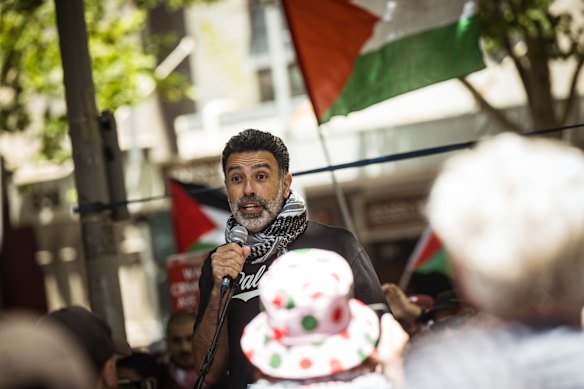
Nasser Mashni speaks at a rally in Melbourne.Credit: Chris Hopkins
Another friend of Abdel-Fattah, Palestinian author Samah Sabawi, says: “I don’t think she wants to be controversial.
“We’re born Palestinians. We are, by our existence, deemed controversial … So if a Palestinian voice is going to challenge the status quo of Israel’s policies, then we’re going to attract controversy.”
For now, Abdel-Fattah is at the centre of a culture-war storm over speech, terror and what constitutes legitimate protest. It’s given her a broader platform. Her invitation to next year’s festival suggests that, for the next 12 months, she might remain there.
Asked on a podcast this week how she felt, Abdel-Fattah said she was tired. This storm blew in during the school holidays.
But she has also sought the storm. She wants to be where the “tension and disruption” are – and she said she has found it “galvanising … invigorating.
“To collapse a festival in, like, three or four days, and to show that community outrage over power? I mean, come on! This is exciting,” she told host Jan Fran.
“It speaks to our power when they attack us in this way.”
The Booklist is a weekly newsletter for book lovers from Jason Steger. Get it delivered every Friday.
Read the full article here