



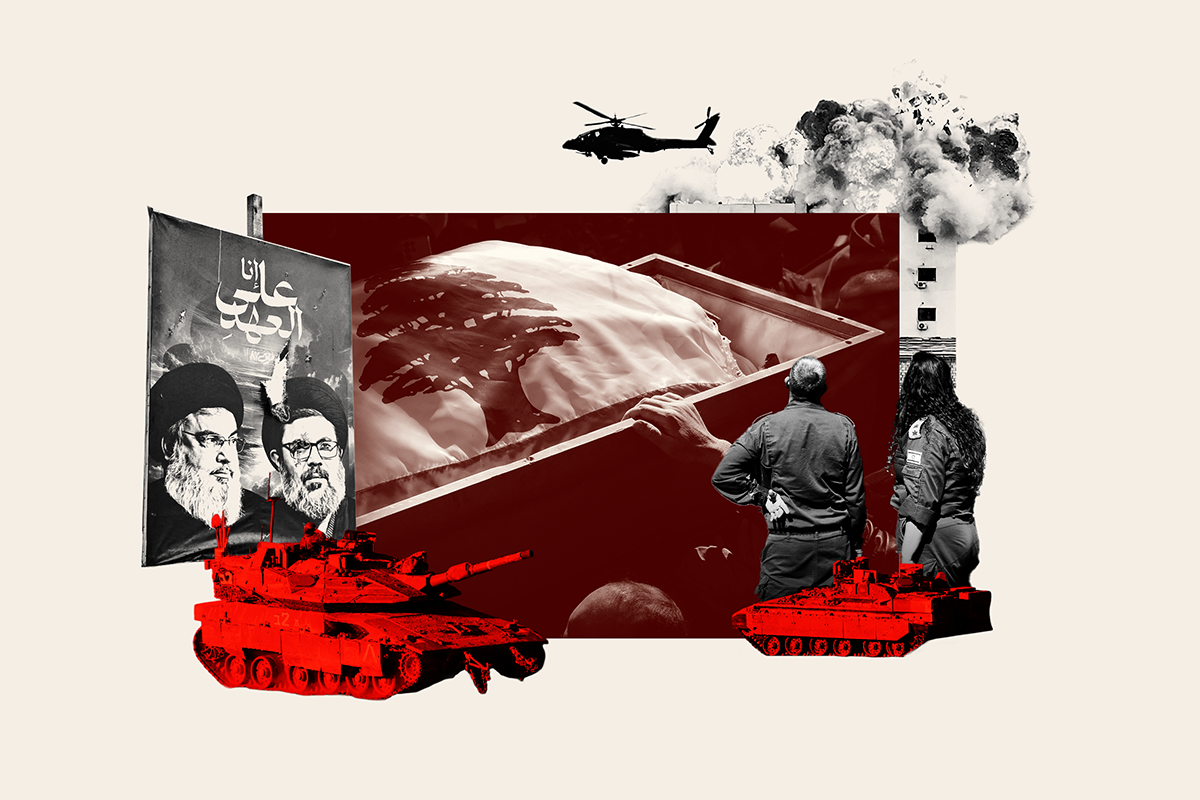
With the Middle East in the throes of its most expansive war in decades, Lebanon is once again caught in the crossfire as Israel pursues a renewed air and ground offensive in response to Hezbollah’s strikes in support of its Iranian Islamic Republic ally’s fight for survival.
But the current conflict poses a risk potentially more dire for the Lebanese state than at any point since the 15-year bloody civil war that tore through the nation until 1990. Since then, a precarious power-sharing system has prevailed across sectarian lines, informally allowing Hezbollah, an Iran-backed Shiite Muslim political and paramilitary movement born out of resistance to Israeli occupation in the midst of that internal conflict, to retain a standing army and vast arsenal of advanced weapons to rival that of the Lebanese Armed Forces (LAF).
After three Israel-Lebanon wars, the latest sparked by the Palestinian Hamas movement’s attack against Israel in October 2023, Israel is now looking to capitalize on a wave of regional upheaval emanating from the conflict in Gaza in order to realize the permanent disarmament of Hezbollah, which, like Hamas, is considered by both Israel and the United States to be a terrorist organization.
And while the Israel Defense Forces (IDF) has already intensified cross-border operations in response to the group’s first rocket fire since a November 2024 truce, both Israeli Prime Minister Benjamin Netanyahu and U.S. President Donald Trump are placing pressure on the Lebanese government to play a decisive role in restricting Hezbollah’s military activities by empowering the LAF to disarm the group, a prospect that threatens the cohesiveness of an already strained Lebanese state.
Karim Émile Bitar, an associate professor at Saint Joseph University of Beirut and associate research fellow at the Institute for International and Strategic Affairs in Paris, warned of “serious risks in expecting the LAF to confront Hezbollah directly.”
“The army remains the last genuinely cross-sectarian institution in Lebanon and one of the very few that still enjoys a broad degree of public trust,” Bitar told Newsweek. “Using it to fight Hezbollah could expose it to a dangerous internal fracture. Hezbollah is not simply a militia but also a major political actor with a large social base within the Shiite community, and many Lebanese soldiers themselves come from that community.”
“If the LAF were ordered to engage Hezbollah militarily, it could create a ‘double bind’ situation for the army: either it obeys political directives and risks internal division and even mutiny, or it refuses and undermines the authority of the state,” Bitar said. “Either scenario would weaken one of the last pillars of national cohesion.”
“More broadly, such a confrontation would risk transforming a regional war into a Lebanese civil conflict.”
A Tale of Two Armies
The LAF was established in its current form in 1991, a year after the Taif Agreement put an end to the Lebanese Civil War and called for the disbanding of all militias and the surrender of heavy weapons. That accord had a key caveat, however, allowing Hezbollah to remain as a “resistance force” engaged in attempts to expel Israeli forces, which invaded the country in 1982 in a bid to uproot Palestinian militias operating in southern Lebanon.
The IDF withdrew in 2000, with its allied South Lebanon Army quickly collapsing, allowing Hezbollah to retain a powerful presence across the south and in other majority-Shiite Muslim areas such as southern Beirut and the eastern Beqaa Valley. In 2006, a year after popular protests expelled heavy Syrian influence over Lebanon, war returned as Israel and Hezbollah engaged in a monthlong conflict set off by a Hezbollah ambush against Israeli troops along the border.
The United Nations Security Council resolution that ended that conflict called for the disarmament of Hezbollah as well, along with the withdrawal of the IDF and the deployment of the LAF in the south. In practice, Hezbollah consolidated its presence, expanded its support base and amassed a growing arsenal of weapons, including rockets, mortars, drones and even precision-guided missiles, while Israel routinely penetrated Lebanese airspace and waters.
After years of intermittent clashes, the war in Gaza brought the deadliest battle yet between Israel and Hezbollah, which suffered extensive losses—including the killing of Secretary-General Hassan Nasrallah, who had led the group since 1992—and ultimately signed a ceasefire in November 2024. Israel continued to regularly strike across Lebanon as regional conflict persisted, with Hezbollah rejoining the battle two weeks ago in response to the killing of Iranian Supreme Leader Ayatollah Ali Khamenei in U.S.-Israeli strikes that brought direct war to Iran.
The LAF has thus far sought to remain neutral throughout the conflict, even as it lost several soldiers in Israeli strikes, including three reportedly killed on Tuesday. That neutrality is now under pressure as Netanyahu recently warned the Lebanese government that “Hezbollah’s aggression will bring catastrophic consequences upon Lebanon” if the group is not disarmed.
But even a Lebanese government with top figures who have openly called for reining in Hezbollah now at the helm —including President Joseph Aoun, former commander of the LAF, and Prime Minister Nawaf Salam—finds itself in a difficult position, risking the unraveling of a crucial and elusive cornerstone of Lebanese unity.
“The risks of using the Lebanese Army against Hezbollah in the middle of an ongoing regional war are extremely high, and they are not only military risks but political and communal ones,” Amal Saad, a lecturer at Cardiff University’s School of Law and Politics in Wales, told Newsweek. “The army has historically tried to stay out of direct confrontation between Hezbollah and Israel, and the reason is obvious: once the army is seen not as a national institution but as an instrument in an internal anti-Hezbollah campaign, it risks fracturing its legitimacy, especially in Shiite areas, and potentially reopening the specter of internal strife.”
Saad, a leading expert on Hezbollah and a veteran Lebanese scholar with direct experience in instructing senior LAF officials, warned such a rift may not be limited to Shiites, but also other sects such as Sunni Muslims and Christians, recalling how both mid and high-ranking LAF personnel of various backgrounds routinely referred to Israel as “the enemy.”
The LAF and Hezbollah have cooperated in the past, dividing labor on both sides of the Lebanese-Syrian border to battle the Islamic State militant group (ISIS) after the group first took root there in 2014. There is also precedent for Lebanese troops refusing to disarm Hezbollah amid soaring tensions, as occurred after May 2008, when deadly weeklong clashes between Shiite and Sunni Muslim militias stemming from a dispute over Hezbollah’s telecommunications network previously fueled fears of another all-out civil war.
“The idea of large sections of the army effectively doing Israel’s dirty work for it, in the midst of an Israeli invasion no less, is absurd,” Saad said. “And needless to say, if Israel can’t disarm Hezbollah then how on earth could the most underequipped army in the entire Middle East fare?”
“It’s also important to add that if LAF commander Rudolf Haykal were replaced under U.S. pressure, and a showdown were ever attempted, Hezbollah would not shy away from confronting the army,” she added, “and this has been insinuated in previous interviews with Hezbollah officials.”
Newsweek reached out to representatives of Hezbollah and the Lebanese government for comment.
Hezbollah’s War on Two Fronts
Hezbollah continues to command significant support among its base, yet frustrations toward the group’s intervention on behalf of foreign allies and the subsequent destruction wrought upon Lebanon have triggered a growing wave of discontent across Lebanese society.
Even prior to being dragged into a regional conflict, Lebanon had been grappling with an economic crisis that has only spiraled since 2019. While Aoun and Salam’s appointments prevailed over political paralysis, the government continues to struggle to provide basic services, now under further strain due to the wartime displacement of more than one million people. Many of those displaced are within Hezbollah’s support base, which is now scattered among communities less sympathetic to the group, stirring tensions.
“One of the most serious challenges facing Hezbollah right now concerns the roughly 800,000 displaced Shia from the south and Dahyeh who have been treated in ways that are unprecedented and discriminatory,” Saad said. “Many feel the government has largely neglected their situation, failing to provide adequate support or protection at a time of acute vulnerability.”
She pointed to examples of police gathering identity cards of displaced Shiites in predominantly Christian and Sunni areas, new curfews and bans on political activity and even allegations that Beirut Mayor Ibrahim Zeidan recently proposed deporting internal refugees by sea, remarks denied by Zeidan.
“I think hostilities from both sides will sharpen the pre-existing political divide,” Saad said. “There is clearly a large segment of Lebanese opinion who are not just virulently against Hezbollah, but who are openly supportive of the government’s co-belligerence in this war. I say co-belligerence, because the government has been actively trying to assist Israel in achieving its aims of neutralizing and criminalizing Hezbollah’s resistance and preventing its own army from defending the border villages.”
“Hezbollah’s support base will remain steadfast despite initial discontent with the operation,” she added. “Others, primarily though not exclusively, from the Sunni community, may also be sympathetic given the community’s longstanding hostility toward Israel.”
As Israel and Hezbollah intensify operations, Bitar argued that “the effect on Lebanese public opinion is likely to be complex.”
“On the one hand, most Lebanese blame Hezbollah for exposing the country to devastating retaliation and for making strategic decisions without a national consensus,” Bitar said. “On the other hand, large-scale Israeli military operations that cause extensive civilian destruction historically tend to generate a nationalist reflex, strengthening Hezbollah’s narrative and shifting part of the public debate away from criticism of the group.”
“In other words,” he added, “the paradox is that while Hezbollah’s unilateral decision to engage Israel remains very controversial domestically, the more destructive the Israeli campaign becomes, the more it risks helping Hezbollah regain some legitimacy among segments of Lebanese society.”
This debate also runs through the ranks of the LAF, which so far has been attempting to stay clear of the fighting.
“The biggest challenge is that Israel is expanding its occupation of South Lebanon, and Hezbollah is the only force pushing back against this expansion while the LAF is withdrawing,” Mohanad Hage Ali, deputy director for research at the Malcolm H. Kerr Carnegie Middle East Center in Beirut, told Newsweek.
“If the LAF is going to be deployed against Hezbollah as it’s fighting an Israeli occupation, this will cause local tensions within the Lebanese Shia community,” Hage Ali said, “because the LAF will be seen as a force assisting Israeli occupation, and it’s not a good look for a national army to be fighting a local group pushing back against a foreign occupation.”
Local conditions also factor in, as despite the massive displacement, Hezbollah continues to rely on southern support networks, which Hage Ali pointed out include residents and families with a history of violence related to conflicts with Israel dating back to the first Arab-Israeli War of 1948.
“For many of them, this is basically a repeat. And you know, they see an existential danger,” Hage Ali said. “So, let’s see how it evolves. So far, I’m seeing them expanding. I think Israel has already taken the first line of towns, and I think they’re moving into the second line, which I think it would be more difficult from there on.”
Now or Never
From Israel’s point of view, a combination of growing domestic opposition toward Hezbollah and the weakening of both Iran and its regional Axis of Resistance faction constitutes a critical opportunity to uproot a longtime foe right across its border.
One Israeli military official told Newsweek that, while Hezbollah was believed to command hundreds of Radwan Force special units, this number had been degraded from the thousands within the group’s ranks, including scores of top commanders, when the war first began in October 2023. Between 80–90 percent of the group’s stockpiles of rockets, mortars, drones and missiles are also assessed to have been depleted or destroyed, though still numbering in the tens of thousands.
The short-term goal of the current IDF operation, according to the Israeli military official, was to remove the immediate threat posed by Hezbollah to civilians in northern Israel, while the long-term objective was the removal of the group’s armed presence across all of Lebanon. In doing so, the Israeli military official said that the Lebanese government should play a direct role, and credited the LAF with having made some progress, though not enough to alter Israel’s current threat perception.
In fact, data shared with Newsweek by the Israel-based Alma Research and Education Center indicated that Hezbollah’s cross-border attacks over the past two weeks exceeded the average tempo of strikes launched during the roughly yearlong phase of the initial Israel-Lebanon conflict that raged between October 2023 and November 2024.
Sarit Zehavi, founder and president of the Alma Center and a former IDF intelligence officer, called it “a historical mistake to expect the Lebanese government to disarm Hezbollah and to focus on that, because the Lebanese Army and the Lebanese government are not willing to clash with it.”
“Forget about disarmament of Hezbollah by the Lebanese government,” Zehavi told Newsweek. “It’s not happening, especially not while the commanders of the Lebanese Army, some of them are collaborating with Hezbollah. Others are very comfortable with Hezbollah. Others have political reasons.”
Rather, she argued, the Lebanese government should leave the military element to Israel and focus on cracking down on Hezbollah’s other sectors, including cash flows, political activities and social and health care services provided by the group.
“They are terrified of the fact that a Lebanese will open fire against a Lebanese, terrified of the idea of a civil war, so let’s leave that to Israel,” Zehavi said. “We made a decision. We are going to defend our people. We will do what it takes in South Lebanon, because we have been waiting for too long, 20 years. It’s not happening. It is not part of the solution. It’s part of the problem, actually. And let’s give the Lebanese government other missions to do to create the overall picture of weakening Hezbollah strategically, and we will deal with the military.”
Zehavi also said she understood those fears expressed by Lebanese officials of a potential outbreak of sectarian conflict, though she argued that, at a time when Hezbollah’s “base is displaced now, and there is a humanitarian crisis now, it will be much more difficult” for such a conflict to erupt.
“I do think that we need to put the pressure on the Lebanese government to try and to take this risk,” she added, “because Hezbollah is not going to be weaker than what is happening in the current context.”
Reached for comment, a White House spokesperson referred Newsweek to recent remarks by Trump, who told reporters on Monday that he supported the Israeli ground offensive in Lebanon.
“Look, Hezbollah is a problem. It’s been a problem for a long time, not just now,” Trump said before recalling a conversation with someone he described as a “very substantial person, wealthy person whose parents live in Lebanon” and had “gotten used to the fact that it’s being bombed.”
“Hezbollah is a big problem and they’re rapidly being eliminated,” Trump said before ending the press conference.
Read the full article here