

Boat Industry Association general manager Neil Patchett said interest in electric propulsion was increasing “exponentially”, but said the boats were better suited to some uses than others.
“The problem is battery density. To do a complete day out at a typical speed on a family runabout, the battery required would be so large it would consume a significant area of the vessel’s carrying capacity,” he said.
“They aren’t the silver bullet for boating as an alternative propulsion system, but they’re attractive for high use, high turnover use, such as hire and drive arrangements,” he said.
Prospective buyer Warren Bingham believes the industry will develop quickly with easy access to fast chargers. He’s been keen to buy electric since he sold his 23-foot (seven-metre) internal combustion engine boat 18 months ago.
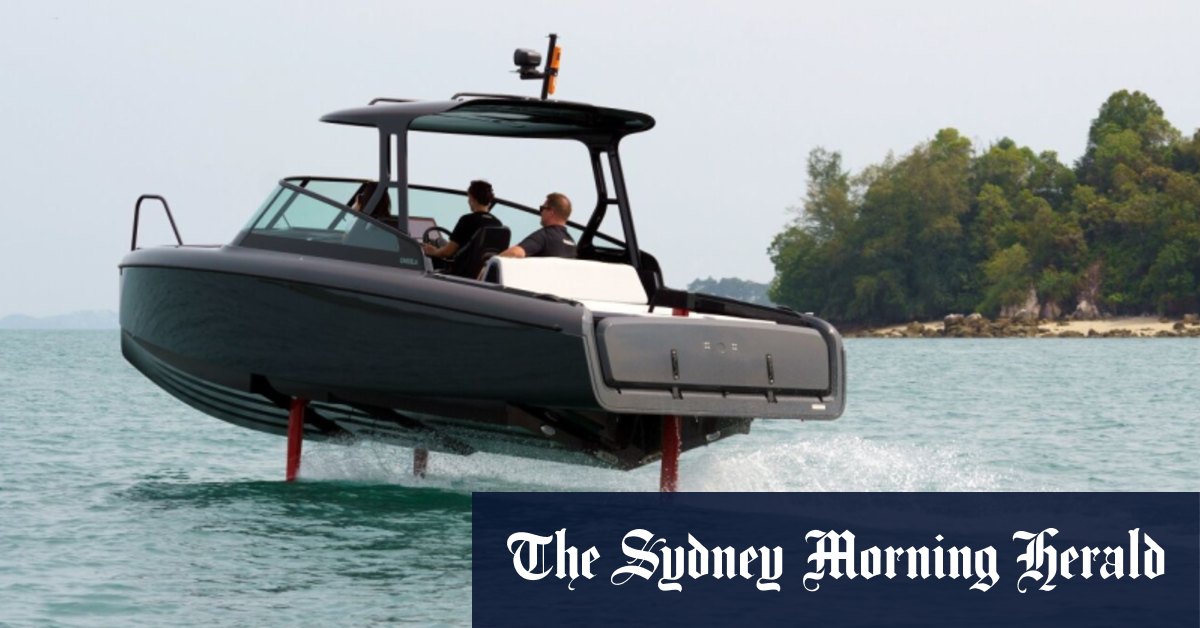
He’s been eyeing a C-8 Candela, a luxury electric hydrofoil boat where the engine and propeller sit on a wing underneath, lifting the body out of the water. It’s lightweight, meaning it can quickly reach the speed needed to sit on a flat plane.
“It’s the sort of experience that’s unique and changes the definition of boating. I hope to get out on it at least once a week,” he said. But it’s not cheap: the luxury boat retails for about $750,000.
A C-8 electric hydrofoiling vessel in Singapore.Credit: Bloomberg
Peter Hrones, the chief executive of electric boat supplier Carbon Yacht, said most electric boat buyers like Bingham were avid electric and solar users.
“Mostly people that turn up to the showroom are driving an electric car, they have solar at their house or boat shed so they won’t buy combustion fuel,” he said.
“People have been waiting for these electric boats.”
Read the full article here