




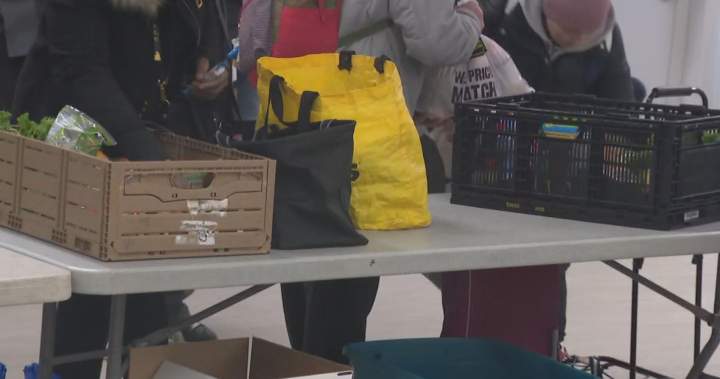
Even as more Canadians turn to them for help, food banks and shelters say they’re struggling to keep up with a new survey showing some are having to turn people away.
The State of Food Charity in Canada, produced by the National Network of Non-Profits and conducted by Ipsos, shows 89 per cent of non-profits across the Second Harvest network saw an increase in demand for food in the past year.
Yet 33 per cent said they have a waitlist for providing support, and 35 per cent had to turn people away either due to limited food available or lack of resources.
“The demand is so high for food right now that it breaks my heart and everybody when we have to say we have a waiting list,” said Vivian Etuka with Bethel Outreach Community Services in Etobicoke, Ont.
Second Harvest works with nearly 2,500 organizations across the country, including food banks and shelters, to help feed people. More than 1,600 responded to the survey.
Among those organizations that had a waitlist, the survey reports the average number of people was 878.

Get daily National news
Get daily Canada news delivered to your inbox so you’ll never miss the day’s top stories.
It was estimated that of those who turned people away, two in five had to refuse more than 50 people. According to Second Harvest, an average of 269 people were turned away.
“When we talk about people that come to food banks, these are your neighbours, your coworkers; we’re seeing nurses at the food bank,” said Etuka. “I’ve never seen more teachers.”
It’s not just working adults either.
Jamie Seabrook, a researcher and professor in epidemiology and biostatistics, said there’s a diversity of food bank clients, young and old, and working and not working.
“It (the survey) dispels the myth that those who use food banks are all unemployed,” Seabrook said. “People that are earning an income are not getting enough income to support the rising cost.”
According to Second Harvest, 49 per cent of the groups surveyed don’t access food or other supports through the federal, provincial or regional food bank network.
What the survey also showed was 36 per cent of the food that’s available at the organizations surveyed comes from Second Harvest and 91 per cent say the network helps them offer more food. Another 80 per cent say Second Harvest provides more healthy and nutritious food.
“Canada has enough food to come out of this situation, but too much good food is still going to waste while organizations supporting people are struggling to keep up with demand,” said Lori Nikkel, CEO of Second Harvest, in a statement.
Both Second Harvest and the organizations surveyed urged action as Canadians continue to struggle with food insecurity, saying affordable housing and matching social assistance to rising prices takes time.
By helping food banks now, those who rely on them will also get help, they said.
“When we put families, or when we see wait lists or we have to turn somebody around, hunger doesn’t go on a wait list; that parent is still hungry, that parent still has to provide for the family,” Etuka said.
The federal government says it is reviewing the survey and said it will be responsive as Canadians navigate uncertainty in food costs.
—with files from Global News Nathaniel Dove
© 2026 Global News, a division of Corus Entertainment Inc.
Read the full article here