


Updated ,first published
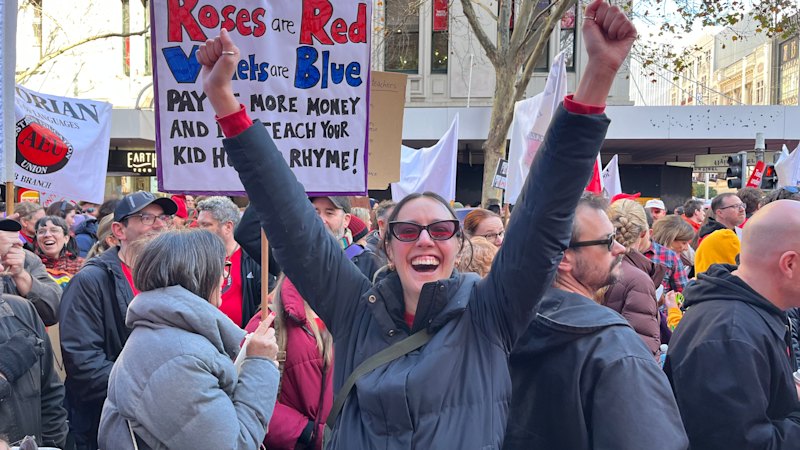
Victorian educators have endorsed the state government’s latest pay and conditions offer, calling off a third statewide strike at the eleventh hour and ending protracted industrial action.
Of the Australian Education Union’s 56,000 eligible voters in Victoria, 80 per cent endorsed an offer on Monday morning that includes a minimum pay increase of 28.3 per cent over four years.
The entire workforce of more than 95,000 educators will vote over the coming weeks on whether to accept the offer endorsed by AEU members, as required under the Fair Work Act.
As part of the endorsement, teachers, principals and education support staff agreed to cancel planned industrial action on Wednesday, which would have resulted in widespread disruption at public schools for the third time this year.
AEU Victoria boss Justin Mullaly said he was confident the year-long negotiations had come to an end, following the resounding “yes” from union members.
“Given the significant numbers of teachers, education support staff, and school leaders that are union members, there isn’t much of a difference between a union vote and an employee vote in terms of past experience,” Mullaly said.
The latest offer included a $2000 bonus when the agreement begins, which is expected to be in October. Educators at the top of their salary band are also set to receive an annual payment of 1 to 2 per cent of their salary.
After-school meeting hours will also be capped at 40 a year – down from 80 hours.
Existing face-to-face teaching hour maximums of 18.5 hours for secondary teachers and 21 hours for primary teachers would also be secured in the agreement, not in a deed, under the new offer.
Under the new agreement, graduate teachers will start on $96,589 from November next year, up from $79,589.
An experienced teacher’s pay will increase from $118,063 to $151,419 by 2029, including a $15,393 boost this year – taking them ahead of NSW teachers.
Mullaly said voting members also took into consideration the Carroll government’s commitment to delivering full funding for public schools, as set out in the Gonski reforms.
“But they’ve still got to do one thing: they’ve got to sign an agreement with the federal government, and that’s a critical next step that they’ve got to take,” he said.
The union had originally sought a 35 per cent pay increase over three years, which would have resulted in graduate teachers starting on more than $107,400 by 2028 and experienced teachers earning more than $159,300 by 2028.
AEU leadership has strong faced internal pressure from its left faction to reject anything less, with members of some sub-branches organising their own industrial action as recently as Monday.
Mullaly said any action taken after Monday would not be protected, and members would risk being fined by the Fair Work Commission.
“I’ll be writing to the government this afternoon to indicate very clearly that there will be no further industrial action, whether that be stop-work, bans or limitations,” he said.
The state government revealed on Monday that the deal was estimated to cost $5.4 billion over the agreement’s four years.
Premier Ben Caroll said that while the cost of paying teachers was more than budgeted for in the May budget, it was “provisioned for”.
Carroll said the endorsement from union members was a historic milestone for the education state.
“Education, under my premiership, will be the single most important public investment we make in our future,” he said.
The latest offer was the first from Education Minister Gabrielle Williams, who took over the portfolio from Carroll when he became premier last month.
Williams said Labor would prioritise an agreement with the federal government to ensure “full and fair funding for Victoria’s students”.
“These are the subject of negotiations that are live right now with the Commonwealth government,” she said on Monday. “We are getting on with that right now.”
The Schooling Resource Standard, developed by the Gonski review of school funding in 2011, sets the benchmark amount needed to be spent to provide a good education to a student.
All states and territories have agreed with the Commonwealth to fund their schools to at least 100 per cent of the Schooling Resource Standard by 2034, but Victoria has not settled its final terms of that deal with the federal government.
Victoria and Canberra have signed a two-year deal securing 90 per cent of the funding benchmark to state schools, with the Commonwealth paying 20 per cent and the state paying 70 per cent, which is set to expire at the end of this year.
The public school educators’ pay negotiations have broader implications for the sector and about 40,000 Catholic school staff, who are negotiating their own enterprise agreement. Catholic teachers have had pay parity with Victorian public school teachers since the 1990s.
With Kieran Rooney, Noel Towell
Start the day with a summary of the day’s most important and interesting stories, analysis and insights. Sign up for our Morning Edition newsletter.
From our partners
Read the full article here