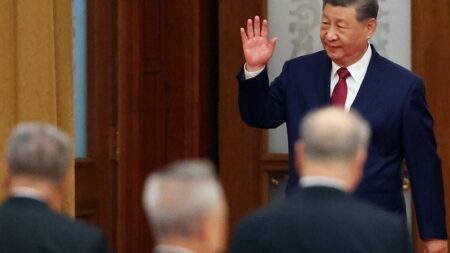


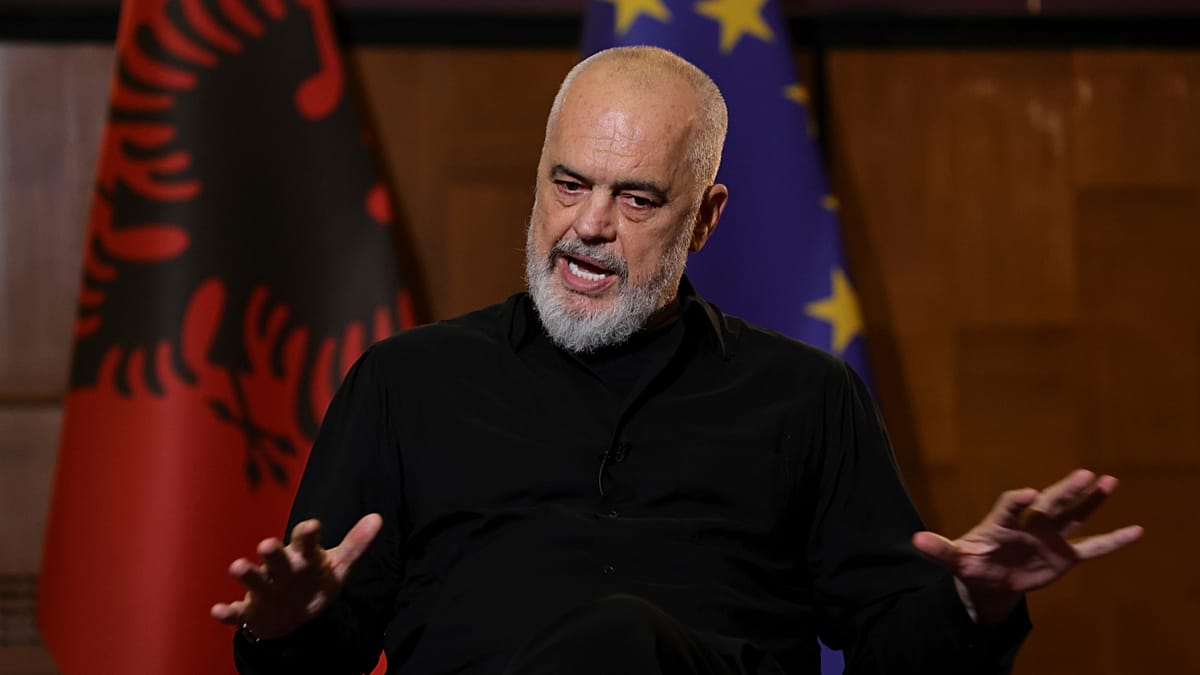
Standing in the city that became the symbol of Europe’s division and reunification, Albanian Prime Minister Edi Rama delivered a sweeping vision for the continent’s future, urging the European Union to show the same strategic courage that enabled German reunification more than three decades ago.
Addressing senior German business leaders at the German Committee on Eastern European Economic Relations in Berlin, Rama argued that Europe is approaching a defining moment in its history. One, that requires leadership rather than bureaucracy.
“Berlin, the place where perhaps the greatest geopolitical transformation of our lifetime became reality. And not only because a wall fell. But because, after the wall fell, a leader emerged with the courage to understand what history demanded next. Helmut Kohl did not see German reunification as an administrative challenge. He saw it as a geopolitical necessity. Against caution. Against skepticism. Against the conventional wisdom of the time,” he said during his speech.
The Albanian leader repeatedly invoked former German Chancellor Helmut Kohl as an example of political leadership capable of recognising strategic realities before institutional structures had fully caught up.
“I increasingly believe that Europe itself is approaching a similar moment. A moment when continuing to manage reality through procedures, hesitations and inherited assumptions is becoming more dangerous than taking strategic decisions. A moment that calls for what I would describe as a new Helmut Kohl moment.”
According to Rama, the European Union is making a strategic mistake by discussing the continent’s future architecture while leaving the Western Balkans on the outside. “Because Europe today faces a question remarkably similar to the one Germany faced then.” He pointed to the growing importance of energy infrastructure, digital networks, military mobility and critical raw materials, arguing that the region has become central to Europe’s ambitions.
“The energy corridors Europe needs cross our geography. The digital networks Europe wants require our territory. The critical minerals Europe has suddenly rediscovered as strategic lie beneath our soil. China understands this. Russia certainly understands it. Europe understands it too. Yet sometimes forgets it when writing its own plans,” Rama said. For Albania, Rama added, EU accession is not simply a political objective but a transformational project.
‘Give us seats before giving us vetoes’
Rather than waiting for full membership, Rama proposed a gradual integration of candidate countries into key European structures.
“Bring us into Europe’s strategic architecture now. Give us seats before giving us vetoes. Give us participation before giving us commissioners. Give us responsibility before giving us every institutional ornament. Bring us into the Energy Union. Into the Digital Union. Into common security frameworks. Into common financial instruments. Into common supply chains,” he demanded during his speech in Berlin, once again, comparing his country’s situation to the aftermath of the fall of the Berlin Wall.
“Helmut Kohl did not ask whether reunification was administratively perfect. He asked whether continued division remained strategically acceptable. That is a profoundly different question. And perhaps it is the question Europe should ask itself today,” Rama said, again mentioning Kohl.
AI, democracy and the battle for truth
The second major theme of Rama’s speech focused on artificial intelligence and what he described as a growing threat to democratic societies from algorithm-driven manipulation, saying that “for the first time since the Industrial Revolution, technological leadership may determine not only who becomes wealthier, but who remains sovereign.”
Rama highlighted Albania’s own digitalisation efforts, saying that “For its part, Albania is pursuing one of the most ambitious digital transformations in Europe.”
However, he warned that technological progress is also reshaping the information environment in ways that threaten democratic institutions: “An algorithm can now accomplish in minutes what propaganda machines once required years to achieve.”
The Albanian prime minister questioned whether military spending alone can protect European democracies. “We are discussing sovereignty. Europe is investing hundreds of billions of euros in military capabilities, air defence systems, cyber security, critical infrastructure protection and strategic autonomy. All of that is necessary. But what value will all these shields have if our societies remain defenceless against the systematic manipulation of human minds?” He asked, adding that “Europe does not need only a shield from missiles. It also needs a shield for the age of algorithms.”
Kushner project sparks protests
Rama’s remarks came against the backdrop of growing protests over a controversial tourism development project on Albania’s southern Adriatic coast linked to Jared Kushner, US-President Donald Trump’s son-in-law.
The proposed investment would include developments on the island of Sazan and a nearby stretch of coastline. The Albanian government has promoted the project as a major opportunity to attract high-end tourism and boost economic development.
Environmental organisations and local activists, however, have raised concerns about the potential impact on protected habitats and biodiversity. Thousands of protesters have taken to the streets in recent weeks, blowing whistles and carrying cardboard cut-outs of flamingos, one of the migratory bird species whose habitat campaigners say could be threatened by the development.
The demonstrations have also evolved into a broader political movement, with some protesters demanding Rama’s resignation and calling for early elections.
Without mentioning the project directly, Rama referred to the controversy as an example of how social media can spread misinformation and amplify outrage.
“And if I had to choose where to begin, I would begin there. In recent weeks my own country experienced a vivid example. A proposed tourism development project on Albania’s coast suddenly became the centre of an international digital storm. Environmental catastrophe was presented as an established fact. Corruption was declared proven before any proof existed. Conspiracies multiplied by the hour. Claims became headlines. Headlines became truths. Truths became dogmas. And anyone asking for evidence was treated as a suspect.”
Rama argued that public debate around the project had become detached from facts and claimed that online campaigns were accelerating the spread of unverified allegations.
“Outrage generated millions of impressions before facts had a chance to speak. Narratives travelled around the world before documented procedures could travel across a single room. This is no longer an Albanian phenomenon. It is a European phenomenon.”
He has repeatedly rejected calls to halt the development and defended his government’s environmental record, while also suggesting that foreign cyber actors have sought to influence public debate surrounding the project.
European Union officials are monitoring the development as part of Albania’s accession process to ensure compliance with EU environmental and governance standards.
Reform efforts under scrutiny
Rama’s appeal for EU membership comes as Albania continues efforts to demonstrate progress on rule-of-law reforms demanded by Brussels.
This week, Albania’s Special Anti-Corruption and Organised Crime Structure (SPAK) launched another major operation targeting an alleged international drug trafficking and money laundering network. Prosecutors say criminal proceeds were channelled into sectors including real estate, construction and hospitality, with assets worth an estimated €150 million seized.
The operation is part of a broader anti-corruption drive that Albanian authorities have presented as evidence of the country’s readiness to move closer to EU membership. Despite these efforts, Albania continues to face criticism over organised crime and corruption.
For Rama, however, the larger question is no longer whether Albania is ready for Europe, but whether Europe is ready for Albania. “Europe today needs courage. The courage of Adenauer. The courage of Kohl. The courage to reunify. The courage to innovate. The courage to recognise that enlargement is not charity.”
Read the full article here