



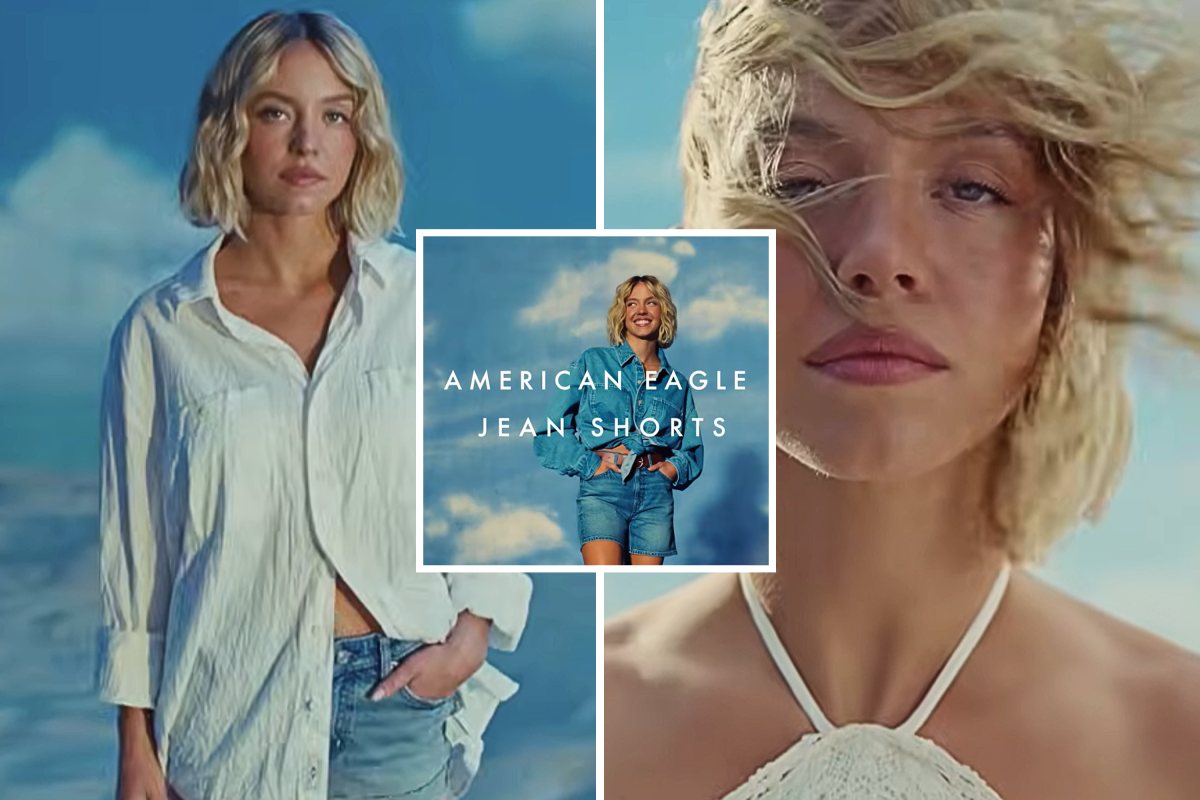
American Eagle has launched a new Sydney Sweeney advert that leans directly into the cultural backlash that once threatened to engulf both the actor and the brand—this time marketing its new jean shorts with a wink rather than a flinch.
In the video, Sweeney debuts a wavy bob haircut and casually quips, “What brand am I wearing? Yeah, that one…American Eagle jean shorts,” positioning the product—and the provocation—as inseparable. The campaign matters because it tests a now-familiar modern rule: online outrage can be loud, but it does not always translate into commercial consequences, for both brand and celebrity.
Newsweek reached out to Sweeney and American Eagle for comment.
Sydney Sweeney’s History With American Eagle
In 2025, Sweeney fronted American Eagle Outfitters under the slogan “Sydney Sweeney Has Great Jeans”—a line widely interpreted as a pun on “jeans” and “genes” that ignited accusations of subtle eugenics messaging, racism and dog-whistle politics.
The backlash was driven largely by left-leaning commentators online—though social media users of a variety of backgrounds and political persuasions joined in—particularly given Sweeney’s appearance as a blonde-haired, blue-eyed white woman.
Now, by revisiting that moment with self-awareness rather than apology, American Eagle appears to be making a simple commercial argument: neither it nor Sweeney needs universal approval to succeed—especially if critics were never customers to begin with.
“When Sydney Sweeney appeared in American Eagle’s latest campaign, one that knowingly nods to last year’s ‘great genes’ controversy, it definitely wasn’t a brand error; it was deliberate,” PR expert and publicist Lynn Carratt told Newsweek. “We only need to look at the rise in American Eagle’s share price after the campaign launched: it rose 6 percent. Controversy sells and creates engagement.”
Carratt’s assessment crystallizes a widening gap between digital discourse and real-world outcomes. Since the original campaign, American Eagle has not distanced itself from Sweeney. Instead, the brand has doubled down—demonstrating confidence in its understanding of who its audience actually is, and who merely dominates the froth and bubble of discourse on social media.
The fallout from the initial advert played out at rapid speed. Allegations of racism and coded messaging spread quickly online. Sweeney’s political leanings, already subject to speculation after images surfaced in 2022 showing her family members wearing MAGA hats at a party, intensified scrutiny. Reports that she was a registered Republican further polarized opinion. When President Donald Trump publicly praised the campaign, the episode escalated into a full cultural proxy battle—far removed from jeans.
Sweeney’s response was minimal. In a subsequent GQ interview, she downplayed the controversy, expressing surprise at the reaction and emphasizing her personal love of denim. Her refusal to mount an explicit defense or issue a clarifying statement frustrated critics and satisfied others who viewed the silence as deliberate restraint.
Even within Hollywood, the moment sparked tension. White Lotus and Sex Education‘s Aimee Lou Wood responded to a circulating clip of Sweeney’s interview with a vomiting emoji on Instagram—a move widely interpreted as shade and one that later went viral on TikTok.
Yet that sustained visibility failed to materialize as tangible damage. Sweeney has, despite some of the films she has graced flopping, starred in several high-profile productions since the controversy like The Housemaid, while sustaining her role in HBO’s buzzy drama, Euphoria. The actress her over 26 million followers on Instagram, sparked Oscar rumors for her performance in Christy, and content featuring her regularly trends online.
“Social media platforms have become powerful places for cultural conversation, but they are not always reliable indicators of broader public sentiment,” Carratt said. “Backlash tends to be driven by highly engaged, highly visible users.
“While their influence is undeniable, they do not necessarily represent the majority of consumers.”
Carratt noted that controversies rooted in interpretation rather than clear wrongdoing rarely produce lasting commercial consequences. Without strong consensus on harm, outrage struggles to convert into sustained boycotts.
The “great genes” debate, she argued, falls squarely into this category.
‘The Outraged Audience and Paying Audience Don’t Overlap’
That disconnect becomes even clearer when viewed through the lens of consumer behavior. Women’s consumer expert Shampaigne Graves told Newsweek the financial logic never supported the backlash narrative.
“Outrage travels fast, but it rarely travels to the register,” Graves said. “American Eagle’s core buyer, young women shopping for jeans, was never the demographic leading the pile-on.”
While women control an estimated $31.8 trillion in global consumer spending, Graves stressed that brands must identify which women hold sway.
“Vocal critics and loyal American Eagle shoppers are not the same woman,” she said. “When the outraged audience and the paying audience don’t overlap, the math just doesn’t work.”
Graves also pointed to Sweeney’s refusal to issue a reactive apology as a strategically sound decision.
“When public figures apologize under social pressure without genuine policy or behavior change, they don’t earn goodwill,” she said. “They signal weakness to existing supporters while failing to convert critics.”
In that context, American Eagle’s new advert reads less like defiance and more like self-assurance. Rather than ignoring past criticism, the campaign incorporates it—acknowledging recognition without conceding fault.
“They’re not ignoring the controversy—they’re monetizing it,” Graves said. “That’s consumer intelligence.”
Read the full article here