





“This is absolutely an everyday occurrence across every health service,” she said. “We are seeing women who have had scans that are just not reliable.”
The missed diagnoses were fuelling late-term abortions, Khot said.
Dr Nisha Khot, president-elect of the Royal Australian and New Zealand College of Obstetricians and Gynaecologists. Credit: Alex Ellinghausen
“It’s heartbreaking for women to have those terminations done late just because they didn’t have an early diagnosis when it was possible to have an early diagnosis with a good quality scan,” she said.
“They get some pretty pictures but what they don’t realise is that they actually are not getting the information about whether this is a normal pregnancy.”
Diagnostic ultrasounds are offered in the public system at 11 to 13 weeks’ gestation and again during the second trimester at 18 to 20 weeks. But the rise in reassurance clinics has offered women the chance to pay for scans at other stages in their pregnancy.
Online reviews of reassurance clinics across Australia detail numerous alleged incidents where women have been incorrectly informed that they have miscarried when their baby is still alive. Others have been told the wrong sex of their child.
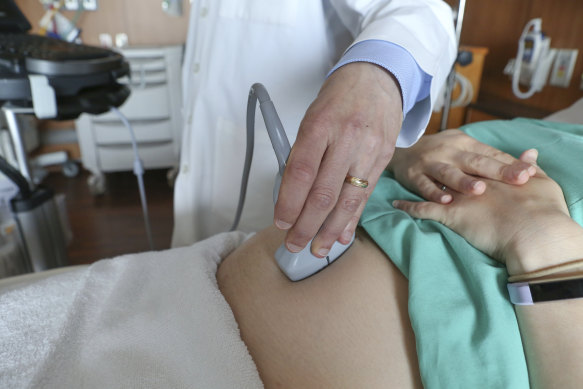
There are calls for sonographers to be regulated by the health practitioner watchdog.Credit: AP
This masthead spoke to one family who were informed by a reassurance clinic that they were having a single baby, only to later discover at a diagnostic ultrasound that they were having twins.
In 2023, Rohene Chatterjee found herself at an ultrasound clinic in Melbourne that offered reassurance scans. The then 27-year-old had experienced a miscarriage days earlier and it was the only clinic that had availability.
She said the transvaginal ultrasound was painful and the experience uncomfortable.
The clinical report sent to her doctor a few days later stated that one of Chatterjee’s ovaries was atrophic, which her doctor explained meant it wasn’t functioning. “I was really shocked,” she recalled.
A month later, she fell pregnant and an ultrasound at another clinic showed that the egg had originated from the same ovary that the previous clinic had deemed atrophic.
She said her experience at the second clinic was much more positive.
“I realised that it wasn’t meant to be uncomfortable,” said Chatterjee, who gave birth to her son in 2024.
Australasian Sonographers Association chief executive Tony Coles called for sonographers to be registered under the Medical Radiation Practice Board of Australia, one of 15 boards overseen by the Australian Health Practitioner Regulation Agency (AHPRA). He said this would protect patients, and restrict who could call themselves a “sonographer”.
Loading
“It leaves patients vulnerable,” he said of the current situation. “Ultimately, that undermines confidence in the quality and safety of ultrasound services.”
He said while it would be difficult to regulate reassurance scans because they could be conducted by non-medical staff, consumers needed to be aware of the risks.
“There are significant risks that come with doing non-diagnostic ultrasounds … the missed abnormalities and the false reassurance due to the lack of medical oversight. It creates a false belief that the scan is equivalent to a clinical assessment.”
Australian Medical Association Victorian president Dr Jill Tomlinson also supports the push for AHPRA to regulate sonographers.
“I strongly recommend that pregnant women have scans performed by qualified individuals, via a referral either from their GP or obstetrician, and that if they have concerns or anxiety about their pregnancy or their baby’s development that they discuss these with their antenatal provider,” she said.
It comes as the Australian Commission on Safety and Quality in Health Care develops guidelines to help women and their families navigate ultrasounds during pregnancy.
The commission’s Chief Medical Officer, Conjoint Professor Carolyn Hullick, said while some women chose to have non-diagnostic ultrasounds “as a souvenir image, for reassurance their baby is safe or a ‘gender reveal’, only diagnostic ultrasound performed by a qualified health professional should be relied upon to provide medical information about a baby’s development and health”.
“Diagnostic ultrasounds by qualified health professionals during pregnancy provide important information for maternal care teams, to get the best possible outcome for mother and baby,” she said, urging expectant mothers to check the qualifications of the person performing the ultrasound.
Associate professor Stefan Kane, director of maternity services at the Royal Women’s Hospital in Melbourne, said he understood why women were seeking additional reassurance during their pregnancy.
“They feel very uncertain about what’s normal, what’s not,” he said.
Kane said the danger lay in people confusing regulated medical imaging clinics with those offering non-diagnostic scans.
Loading
“People may not be able to tell the difference between the two,” he said. “They may think, ‘I’ve had this scan, it was a nice-looking machine. The person seemed to know what they were doing’ … when, in fact, the examination hasn’t been performed in the way that we would expect for a regulated medical imaging practice.”
An AHPRA spokesman said the decision to regulate a health profession sat with state and territory parliaments.
NSW Health Minister Ryan Park said professional bodies could apply to be registered by AHPRA.
“If an application is received by the Commonwealth to regulate sonographers, we would undertake and provide a merit-based assessment as part of consideration to that application,” he said.
A Victorian government spokeswoman said any decisions around regulations were based on the advice from AHPRA and the Department of Health. “If this advice is provided, we will of course, take it into consideration.”
The Morning Edition newsletter is our guide to the day’s most important and interesting stories, analysis and insights. Sign up here.
Read the full article here