



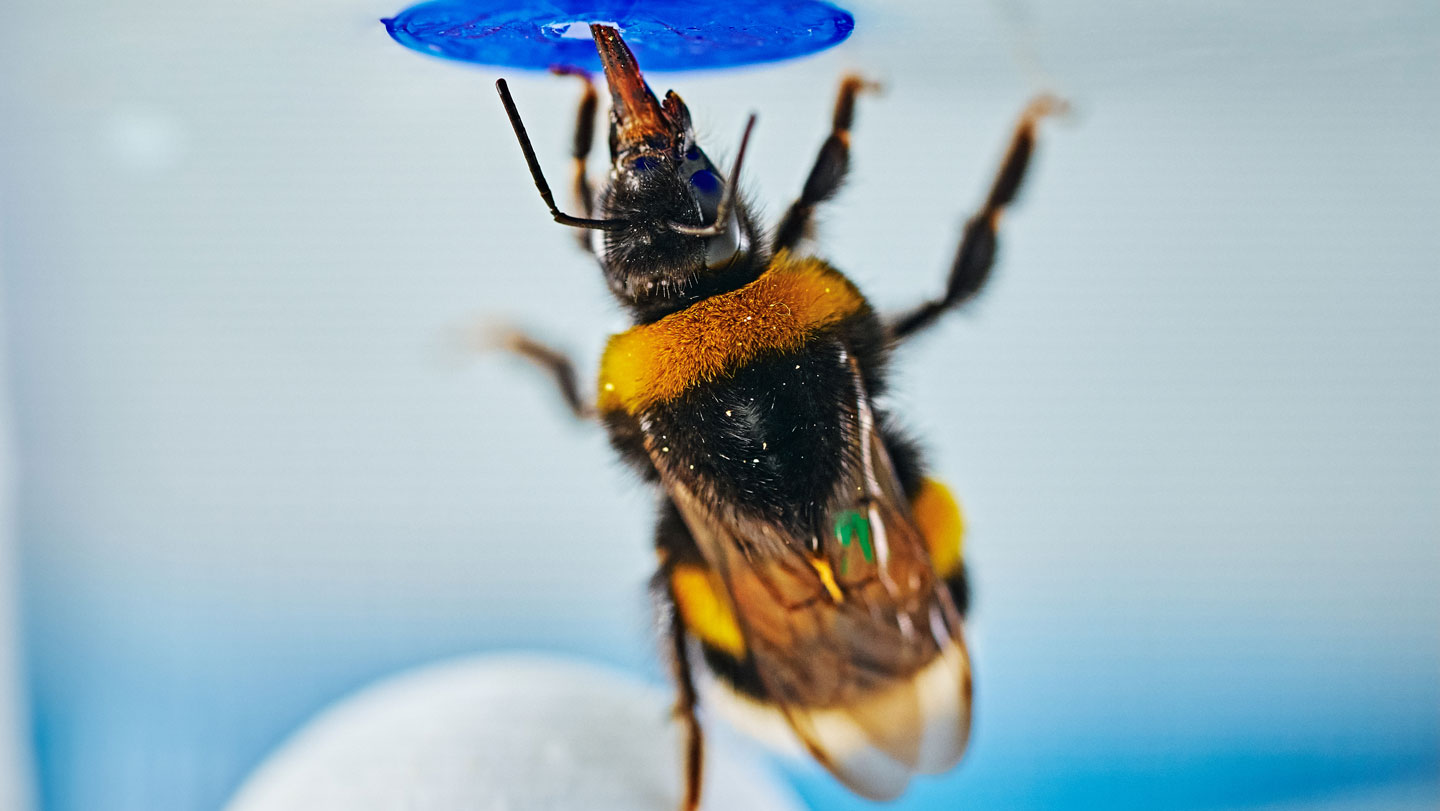
Bumblebees faced with a challenge know how to play ball.
Buff-tailed bumblebees can figure out on their own how to use a ball as a ladder to nab sugar from an out-of-reach fake flower, researchers report in the June 4 Science. The insects worked out the trick without specific training for the solution, suggesting a remarkable capacity for solving problems.
Bumblebees are brainy, with studies showing they may have emotions and can teach one another to score goals in a six-legged version of soccer. The new finding adds yet another skill to their repertoire. “Spontaneous problem-solving is something that has never been shown in any invertebrate before,” says Olli Loukola, a behavioral ecologist at the University of Oulu in Finland.
Vertebrates including chimpanzees and parrots can problem solve on their own, although researchers typically focus on captive animals with plenty of experience working out puzzles. “Our study is the first one where we can be 100 percent sure that these individuals don’t have any prior experience about any problem-solving tasks,” Loukola says.
Loukola and colleagues first taught bees two necessary associations: Balls are moveable objects and a blue ring — representing a flower — means food. The team then let the bees loose in plexiglass arenas too small for them to fly to reach a blue ring printed on the ceiling.
More than 70 percent of bumblebees figured out the solution. Those efforts were fruitful even after the team introduced two rooms inside the enclosures — one of which hid the “flower” — a hint that bees were working toward a goal, not relying on visual cues or stumbling on the solution while playing.
“There was not much room for trial and error or playfulness” in arenas with barriers, says behavioral ecologist Akshaye Bhambore, also of the University of Oulu. Bees had to find the flower plus remember where it was and retrieve the ball. “They had a goal in their mind, and they were able to understand the nature of the task,” Bhambore says.
The arenas were too small for cameras to capture subtle behavioral cues that would signal an aha moment that humans get when solving problems. The team next plans to use slow-motion cameras and video analysis to look for clues such as grooming when bumblebees have just figured out a puzzle.
Read the full article here