




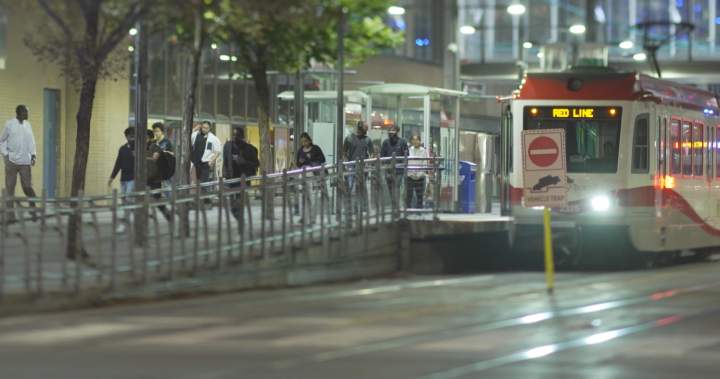
CTrains arrive fast, frequent and around the clock during the Calgary Stampede with hundreds of thousands of visitors taking in the festivities, but the city’s mayor has floated expanding that service year-round.
Mayor Jeromy Farkas told reporters that 24-hour train service is one of the takeaways from the Calgary Stampede that could be used to improve service.
“It’s a challenging endeavour from a service standpoint, but I think there’s also learnings that potentially could be applied to the rest of the year,” Farkas said.
“For me personally, I’d love to see, as an example, 24-7 train access, transit support throughout the rest of the year.”
Typcially, CTrains run between 4 a.m. and 1:30 a.m., but during what’s dubbed ‘The Greatest Outdoor Show on Earth,’ Calgary Transit fills that two-and-a-half hour gap for 24-hour train service.
During the Stampede, CTrains are scheduled to arrive every 10 minutes between 5 a.m. and 9:30 p.m., every 15 minutes between 9:30 p.m. and midnight, and every 20 to 30 minutes between midnight and 5 a.m.
The increase is largely due to the influx of riders travelling to and from Stampede Park.
Data from Calgary Transit showed there were 229,000 boardings on the CTrain on Parade Day (the first Friday of Stampede) this year; for comparison, there was an average of 128,000 CTrain boardings on Fridays in June.

Get daily National news
Get daily Canada news delivered to your inbox so you’ll never miss the day’s top stories.
“When there’s more trips, more service becomes particularly useful,” said Willem Klumpenhouwer, a transit research consultant. “Whether it’s the World Cup in Vancouver and Toronto, or the Stampede, transit really shines through on these big events.”
Calgary Transit declined to comment on Farkas’ idea to expand 24-hour CTrain service.
“It’s all about taking what we’re learning about the Stampede, and modelling it to be able to succeed on other major events like the World Cup of Hockey, and others that we’re looking forward to,” Farkas said.
According to David Cooper, principal at Leading Mobility, 24-hour train service in Calgary could be feasible outside of the Stampede, but it would come with a set of challenges that would need to be assessed.
He noted overnight service in other cities benefits shift workers, and those employed in logistics, health care and the service industry, but would mean “trade-offs” for maintenance like weekend closures.
“Typically when we look at 24-hour service, you start with buses first,” Cooper said. “Track time is very challenging to get when you run a very expansive LRT system; there’s only a couple of hours when you can do preventative and proactive maintenance on the system.”
Cooper pointed to Vancouver’s TransLink, which runs a “night bus” service in lieu of the SkyTrain overnight.
Although it’s unclear how significantly Calgary Transit’s budget would need to increase if the city was to pursue 24-hour CTrain service, Klumpenhouwer said city council would need to weigh the costs against other transit-related priorities.
“There is an argument that 24-hour service will serve people that currently can’t use transit to get around, however, it’s another form of what we call coverage service,” he said.
“It’s another form of providing a lifeline service that doesn’t currently exist, and that always has to be balanced and discussed against using those same dollars to improve existing service.”
Klumpenhouwer pointed to boosting service on Calgary’s MAX bus-rapid transit routes as an example.
According to an update to city councillors earlier this year on Calgary Transit’s strategy to increase service frequency, there remains a gap as “only a portion of the implementation costs have been funded.”
© 2026 Global News, a division of Corus Entertainment Inc.
Read the full article here