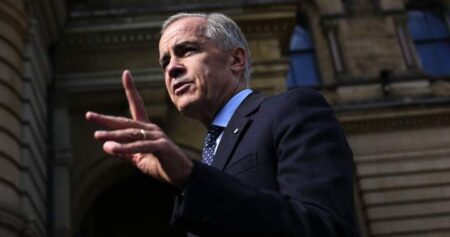
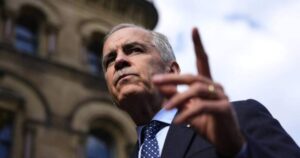


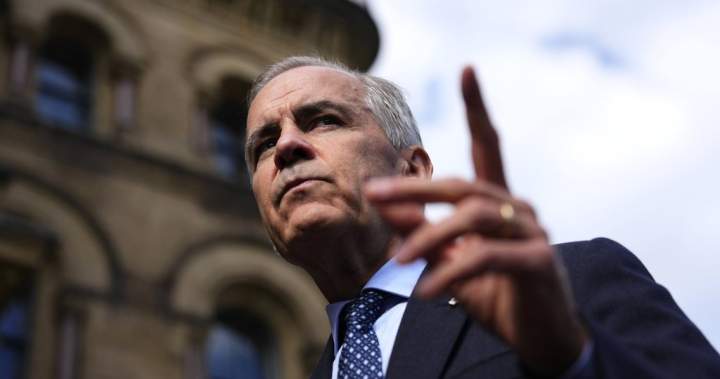
Prime Minister Mark Carney is set to meet with the French president this week, showcasing efforts to strengthen energy and defence ties with the European ally.
The Prime Minister’s Office announced Carney will visit Saint-Pierre-et-Miquelon, a French territory off the coast of Newfoundland and Labrador, on Sept. 20 where he’ll meet with President Emmanuel Macron.
The PMO says the pair will discuss deepening the countries’ partnership in “strategic sectors,” including aerospace, energy, critical minerals, and advanced technologies such as quantum, satellites and supercomputing.
Carney’s planned visit comes as the Wall Street Journal reports the prime minister is speeding up Canada’s pivot to Europe. It’s reported he’s even suggested to European leaders that Canada take on the title: “Associate Member of the European Union.”
Global News has reached out to the PMO, Macron’s office and the European Parliament for comment.
Carney’s visit with Macron is set to take place just days after the prime minister meets with his U.K. counterpart for the first time, British Prime Minister Andy Burnham.
Much like Macron, the two leaders are expected to discuss defence, security, energy and AI.
During his trip to Europe that begins Tuesday, Carney will also address the European Parliament in Strasbourg and attend the State of the European Union address.

Get breaking National news
Get breaking Canada news delivered to your inbox as it happens so you won’t miss a trending story.
Earlier this week, the EU’s ambassador to Canada said the bloc is crafting a new partnership with Ottawa unlike anything that currently exists, but did not provide specifics.
“What we have in mind is something different from what we have with other countries,” Geneviève Tuts said in an interview Wednesday with The Canadian Press. “That will be something unique.”
That partnership is still being carved out, but Tuts said it won’t look exactly like the arrangements the EU has with its neighbours like Switzerland and the U.K.
Finnish President Alexander Stubb, who speaks with Carney regularly, signalled support for Canada having a stronger relationship with the EU.
“Wouldn’t it be lovely if Canada was the 28th state of the European Union rather than the 51st state of the United States,” Stubb said during a speech in June.
The idea will be discussed when Carney visits this week, an invitation Tuts said was a rare gesture for a non-European leader.
Conservative Leader Pierre Poilievre criticized both Carney’s trip and the report the prime minister is pursuing Canada becoming an “associate member” of the EU.
“Mark Carney could not be more out of touch,” Poilievre said Sunday in a post on X.
Poilievre went on to say any such deal would not be about diversifying trade, and questioned if European border policies would apply in Canada or if small businesses would be “buried under the red tape of Eurocrats.”
He added he would ask these questions in Parliament but said the House of Commons is on summer break until Sept. 21.
The Opposition leader called on Carney to confirm if the Wall Street Journal report was true.
“We will NEVER be the 51st U.S. state. And we will NEVER be the 28th EU state,” Poilievre said.
No deal is expected at the meeting, only discussions, but Tuts said Brussels would then consult with member states on the deal. Canada would do the same with its provinces and territories. A possible announcement could, however, come at a late-October summit.
Carney has made it no secret he wants closer economic, security and political ties with the EU as Canada’s relationship with the U.S. continues to worsen amid the trade war.
“We will be looking to use the coming months to explore a deepening of that partnership across a broad range of areas and we’ll have more to say to that (next week) in Strasbourg,” Carney told reporters in Banff, Alta., this past Thursday, where his cabinet was gathering for a planning session.
Experts have said the EU is the “most obvious partner” in diversifying Canada’s trading relationships.
Christian Leuprecht told Global News that just as Canada could benefit from sourcing more of its military purchases from Europe as it works to dramatically boost defence spending, Europe could benefit from Canada’s supply of liquefied natural gas, oil and critical minerals.
On Saturday, President Donald Trump said Canada wants to reach a deal with the U.S. “very badly” and suggested an agreement could come “fairly soon” if Ottawa addresses his concerns about agricultural trade.
—with files from Global News’ Alex Boutillier and The Canadian Press
© 2026 Global News, a division of Corus Entertainment Inc.
Read the full article here