




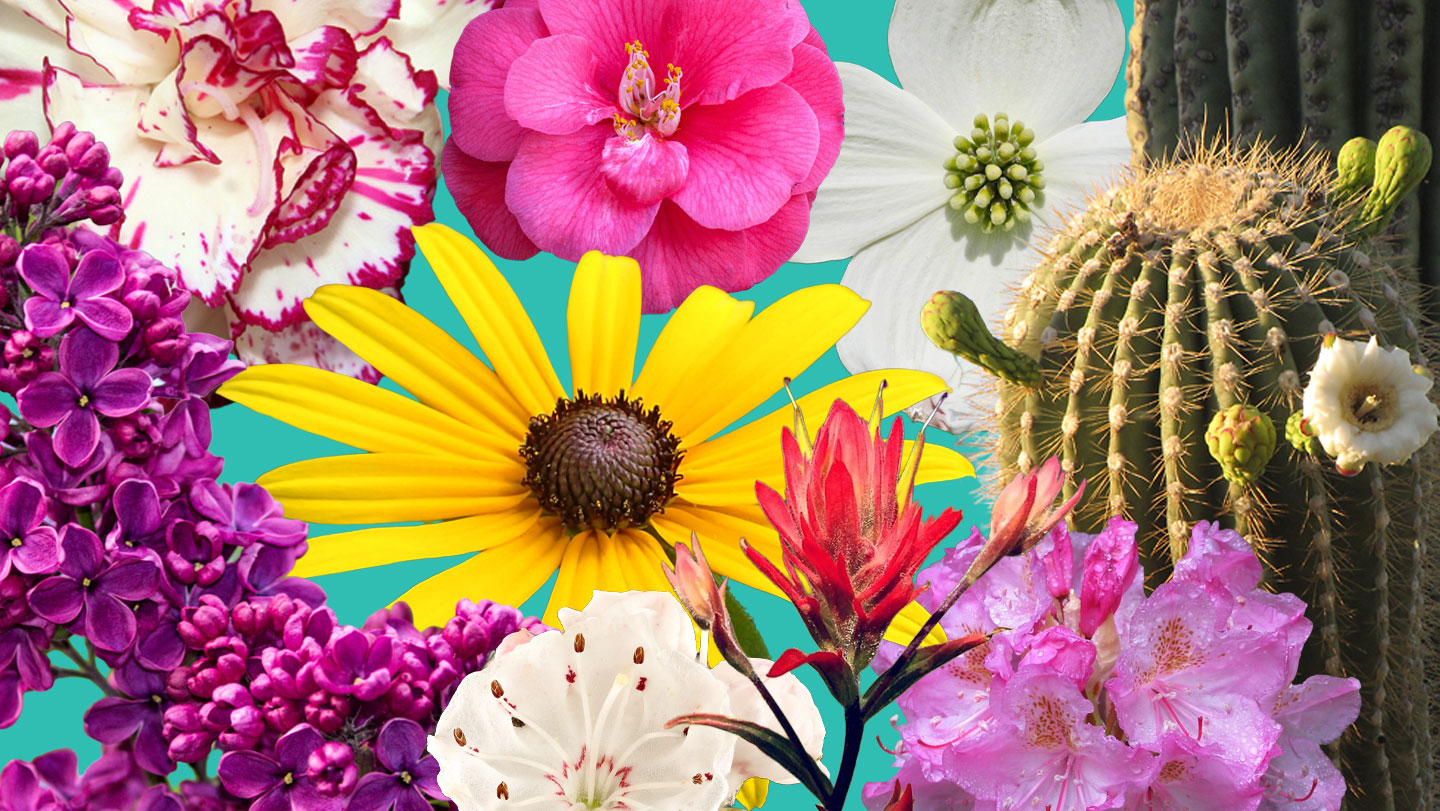
America is turning the big 250 this year. To celebrate, the U.S. Botanic Garden in Washington, D.C., has a new exhibit of state flowers.
Through October 12, visitors can go on a scavenger hunt in the glass-domed conservatory and outdoor gardens to find blooms representing all 50 states, the District of Columbia and U.S. territories. Whether you’re a flower enthusiast or just a casual fan, the exhibit has something for everyone.
Science News had the opportunity to take a tour on opening day. Experts showed us over a dozen burgeoning blossoms and gave us their backstories.
Consider Oregon’s state flower, the Oregon grape (Berberis aquifolium). Not a true grape, it has roots and stems with medicinal properties. Compounds from the plant have been used to treat bleeding, arthritis and tuberculosis, says medicinal plant expert Lisa Philander, the garden’s deputy executive director. Then there’s Minnesota’s state flower, the pink and white lady’s slipper orchid (Cypripedium reginae). It’s the only state flower that’s an orchid, grows only where it gets really cold in winter and is illegal to pick in the wild.
“Probably the oddest selection of state and territory flowers is the state of Maine, which chose the white pine cone and tassel,” says Susan Pell, the garden’s executive director. “It doesn’t actually have flowers at all but does definitely represent the state of Maine very well.” Eastern white pine (Pinus strobus), the tallest conifer in the Northeastern United States, is ubiquitous across Maine and has been crucial to its economy since at least the 17th century. The state adopted the tree as its floral emblem in 1895, and today it appears on license plates. “It’s something that’s near and dear to Mainers’ hearts,” Pell says. “And I think Maine likes being a little bit weird.”
Different flowers will bloom at different times over the exhibit’s run. Missed your favorite? You can still see replicas of each one: A glass case in the conservatory lobby contains exquisite, anatomically accurate paper flowers made by Washington, D.C.–based artist Emily Paluska. And underneath these paper doppelgängers, visitors can flip through books of preserved specimens.
Researchers collected the flora “to take a snapshot in time of what plants were occurring in a certain area,” Pell says. The dried specimens “provide rich data for us to be able to understand the impacts of climate change and other things like development and invasive species on the range of native plants.”
Many plants in the United States are moving north as Earth’s average temperature rises, Pell notes. “We’re also seeing them move higher in elevation.” In some states, if those plants can’t move any higher, they die out. If that happens, it’s possible states could choose new floral symbols.
“I will say that states are continuously changing their state flowers,” Pell says.
Just before the exhibit opened, Georgia updated its official flower from the Cherokee rose (Rosa laevigata), an introduced species from Asia, to a species native to the state, the sweetbay magnolia (Magnolia virginiana).
If you’re visiting Washington, D.C., anytime soon, make some time to stop and smell these flowers before they’re gone.
Read the full article here