




When people think of Canadian sport, hockey usually comes first. That’s something Dwayne De Rosario has felt throughout his life.
Before becoming an MLS star, winning a Gold Cup, representing Canada internationally, and earning two Hall of Fame inductions, he was simply a kid playing a sport that wasn’t widely embraced in his home country.
Speaking at Toronto’s Royal Ontario Museum (ROM) during the 2026 Eva Holtby Lecture on Contemporary Culture, titled “Sport Inspiring Meaningful Cultural Exchange,” he reflected on how often he had to justify his path.
“When I was growing up…soccer wasn’t a big thing in this country. For me, it was. For my family, it was. It was the only thing, but for our community, when I went to outside the play, [when I] went to Germany, they were looking like ‘Where’s your skates? You should be playing hockey.’ So just constant battling that area. Every time I traveled, for me, I took it personal,” he explained.
That sense of identity sometimes clashed sharply with how others saw him—even at the highest levels of the sport.
He recalled a moment from when he visited AC Milan as a 15-year-old, meeting Dutch international Edgar Davids.
“I was talking about a story when I went to AC Milan as a 15-year-old. And a player by the name of Edgar Davids, who played for Holland, came up to me, he’s like, ‘Hey, you’re the Canadian.’ And I was like, ‘Wow. Edgar Davids knows who I am.’ Pretty cool, right? International Holland player. And I’m like, ‘Yeah.” It’s an honor to meet you.’ He goes, ‘What would they want when a Canadian at Milan?’ and walked away,” De Rosario remembered.
“And I stopped, right? Then I went back to the hotel and I felt very depleted. And of course at that time we didn’t have phones or anything like that. I had to deal with this on my own. So I sat there one night and looked at myself and said, ‘You know what? He has a valid point, but I want to prove him and the rest of the world is wrong. I want to prove the world that we do have players that cannot like play the game or can play the game with flair, with passion, with everything you see from the global game.'”
That experience, he suggested, became part of a larger motivation in his career.
The timing of the discussion is especially relevant now, with Canada preparing to co-host the 2026 World Cup alongside the United States and Mexico.
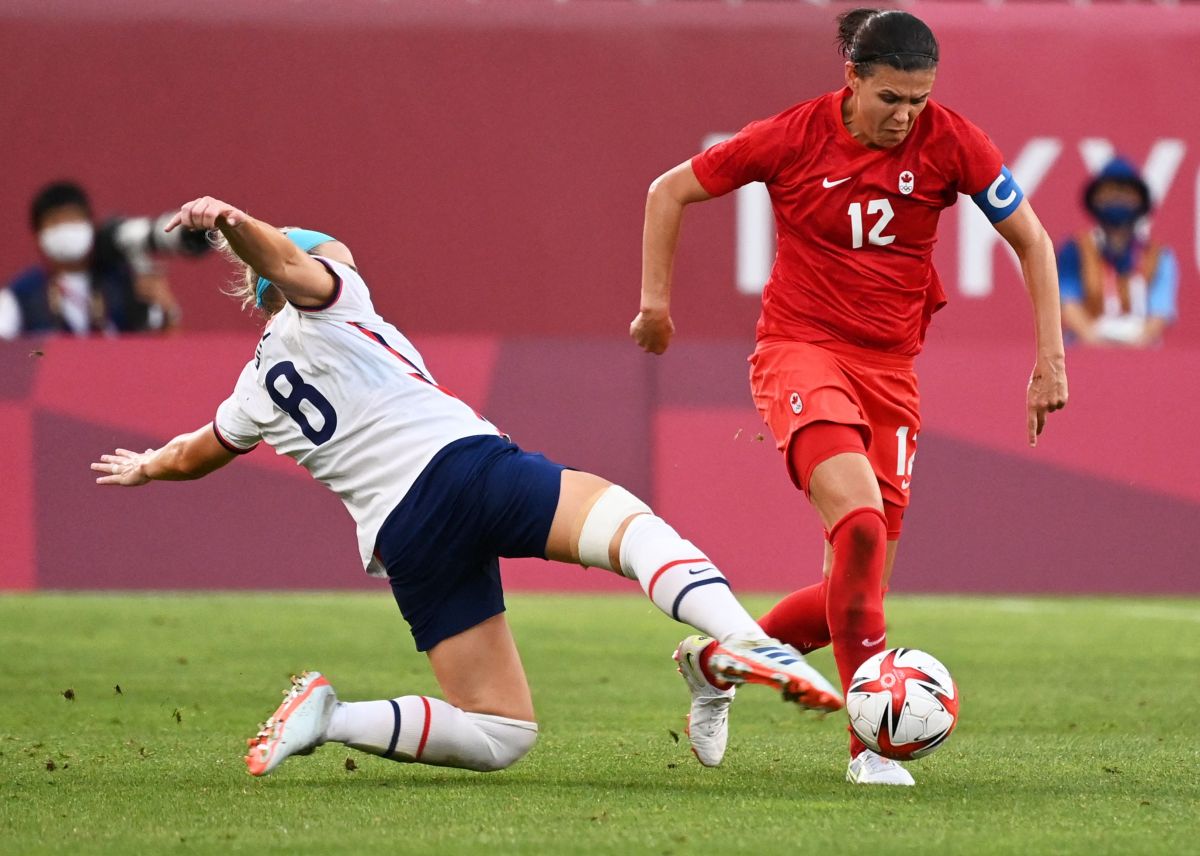
Both De Rosario and fellow panelist Christine Sinclair—whose resume includes 190 international goals in 331 appearances for Canada, plus three Olympic medals (one gold and two bronze)—are uniquely positioned to reflect on how far the game has come in the country, and where it may be heading next.
The View From the Top
If you were asked to name the top international goal scorer in soccer history, most people would probably default to names like Pelé, Eusébio, Cristiano Ronaldo or Lionel Messi.
But all of those guesses would be wrong. That record belongs to Christine Sinclair, who scored 190 international goals for Canada—a milestone she says still feels surreal.
“It is a cool number. Now that I’m done playing, it’s pretty remarkable to think back on the journey that I had on the national team and it’s pretty special that some random Canadian kid holds the record for the most international goals,” she said at the ROM.
“But I think as a story, it represents my evolution as a human, as an athlete, being able to adapt to a changing game. And then I think it also goes hand-in-hand with the evolution of women’s sports and soccer here in Canada and the growth of the game worldwide. And yeah, it shows what’s possible, when a kid with a passion and some hard work and a crazy dream.
“I was given [a chance]. I was the lucky one. I was given that from a young age with supporting parents that signed me up for sports.”
But, for all that success, Sinclair also wishes that someone had told her that it was OK to take a moment and enjoy the journey that her talents in front of goal took her on.
“I wish someone had…just [told] me that you’re gonna make mistakes and you’re not gonna be perfect. I’m a perfectionist at heart. I think it helped me reach levels in the sport that maybe I shouldn’t have, but I was never satisfied. But yeah, I wish someone would have told me just chill out a little bit…”
“…the sport that we played took us all over the world, allowed me to go to some of the most amazing places. I don’t know where that was. I don’t have a picture. I don’t have a souvenir. I wish someone would have told me, ‘Collect shot glasses,'” she explained.
“But I think most importantly, just it’s OK to take a breath and like kind of soak it all in and enjoy the moment. And then you get back to work. I think I could have enjoyed it a little bit more instead of it being such a high pressure, high stakes, like experience all the time. I could have gone to the airport gift shop.”
Remembering the 2000 Gold Cup
While Canada didn’t reach a World Cup during De Rosario’s time in red and white, he was part of one of the most memorable months in the men’s national team’s history: an improbable run to the 2000 Gold Cup.
So, what does he remember of that tournament?
He described a team that entered the tournament as heavy underdogs and was widely expected to exit at the group stage. In fact, qualification hinged on one of the most unusual tiebreakers in the sport.
“First, we went there, we’re about huge underdogs,” the Ontario native said. He explained that Canada finished level on points, goals scored and goals against, meaning progression came down to a coin toss—which they won.
He said that moment “changed our destiny,” but stressed the deeper issue was preparation. Canada, he said, arrived with minimal time together compared with other nations who had a full year of friendlies and structured buildup.
That lack of preparation, he said, fueled frustration within the squad and strengthened their unity, as players pushed for greater support and professionalism around the program. It also marked, in his view, the first real sense of cohesion in the national setup.
From there, he said, results began to build.
“Sure enough, after that, we went on to beat Mexico, beat Trinidad, and then beat Colombia, the final, which was which was unbelievable. I mean, it was it was really sweet,” De Rosario continued.
He said the run reinforced a shared belief within the group. When a team commits fully, he suggested, momentum can carry it further than expected—something he believes defined that tournament and delivered a landmark moment for Canadian soccer.
The Meaning of the Maple Leaf
Part of what makes events like the World Cup so powerful, De Rosario suggested, is that they go beyond sport. Each team is not just competing as a squad, but representing an entire country—turning matches into moments of national identity and shared pride.
As the son of Guyanese immigrants, he said that sense of representation carries deep personal meaning.
“Pure passion,” he said when asked about wearing the Maple Leaf. He reflected on his parents’ journey from Guyana to Canada, describing it as one marked by uncertainty but driven by hope and sacrifice.
He spoke about growing up in a crowded one-bedroom apartment with his family, and the everyday struggles that shaped his upbringing. Those experiences, he said, are inseparable from how he views his career: the sacrifices made not only by his parents, but also by community members, teachers, volunteers, and coaches who helped create spaces where he felt safe, supported, and able to belong.
“So every time I wear that jersey, I wear the most amount of pride, most amount of humility, and gratitude,” he said, adding that without his parents’ sacrifices, he would not have had the opportunity to play at that level.
He also credited those who supported him through his development—from family members who drove him to training, to coaches who gave him the freedom to play his own way, even when he resisted structure early on.
Sinclair, who has experienced similar moments on the world stage—including a home World Cup—also spoke about sports’ ability to unite people across divides.
She described playing in front of tens of thousands of fans from different countries and backgrounds, where, for 90 minutes, differences fade and shared experience takes over. Recalling the 2010 Vancouver Olympics, she said those moments of collective emotion stay with people long after the final whistle.
Looking ahead to the World Cup in Canada, she said that while the wider world faces significant challenges, sport has a rare ability to bring people together, even briefly.
“We’ve talked about the World Cup coming to Canada and there is a lot going on in the world right now that isn’t great, but for one month, the world is going to be connected around this particular sporting event. And you don’t see that anywhere else with anything else. Sports, soccer specifically, it’s what we know has the unique ability to transcend countries and cultures and backgrounds and connect people.”
Embracing the World Cup Moment
The discussion took place with anticipation building around the upcoming World Cup in North America. While concerns remain about ticket prices, transport, and accessibility, both Sinclair and De Rosario focused on the importance of engaging with the tournament in whatever way people can.
Sinclair encouraged fans not to be discouraged by costs, suggesting there are still ways to be part of the atmosphere even without attending matches directly.
“For me it has to go to the World Cup this summer and [to] go experience it. I understand the tickets are a little out of people’s price range. So maybe you don’t have to go to the game, but go take it in, go enjoy the summer, go enjoy the best country in the world welcoming the world here,” she said.
“We’ve lived a life of football and go experience these football fans from around the world where this sport is literally life and death for them and just enjoy it.”
De Rosario echoed that sentiment, focusing on the broader cultural experience surrounding the tournament. He spoke about the importance of creating space to enjoy the moment—something he said applies to adults as much as children—and encouraged people to immerse themselves in the atmosphere beyond the stadiums.
“Just embrace the whole culture, embrace everything that the game brings. Walk to the game with the fans [even if you’re not] going to the stadium. Embrace it. There’s so many great things going on for free that you can be involved in. Bring your kids out. [Experience] different cultures. Laughs, smile, have a great time.
“I think it’s a real, it’s gonna be a real special time. We’re a world in a city and we truly reflect that. But again, Canada, make sure you wear your red and white.”
Read the full article here