



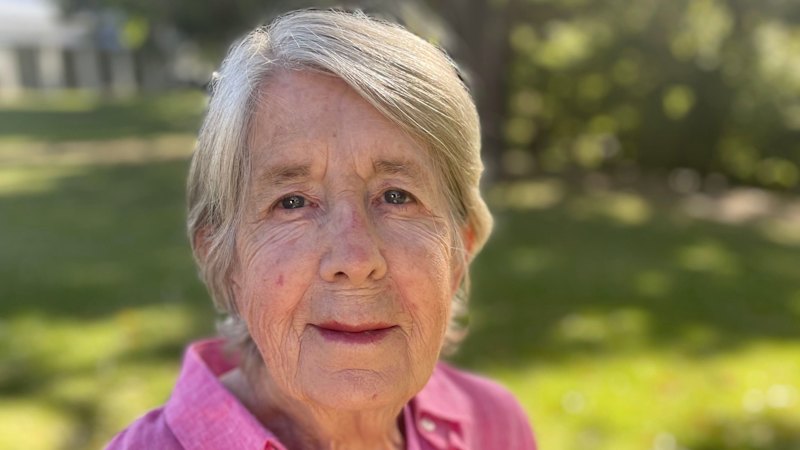
For Pauline Moore, Melbourne’s tram network connected her to the world.
From her home in Hawthorn, the 78-year-old could visit her grandson and buy her own groceries. She could travel to the local library, and make her own way to her regular dialysis appointments at the hospital.
But in September 2022, Pauline broke her pelvis during a fall on the tram.
Protocol required the immediate evacuation of the tram, and she was forced to call her own ambulance from the footpath, so the tram could be returned to the depot. It left the 78-year-old scared to ride public transport.
Then two months later, Pauline passed away from complications sustained in hospital after the fall.
In the four years since her mother’s death, Cath Moore has been asking for greater transparency and accountability from Yarra Trams regarding its safety and first aid policies.
“It’s not good enough … people fall through the cracks, and it’s the most vulnerable members of society who are the ones that should have the most protections afforded them,” Cath said.
Between 2016 and 2025, 812 people were injured due to an incident on a Victorian tram, according to statistics from the Office of the National Rail Safety Regulator. A further eight passengers died.
But deaths like Pauline’s – which happened in the weeks following a fall and included other factors – aren’t necessarily reflected in these statistics.
When the 78-year-old boarded a route 48 tram in Richmond, she didn’t have a chance to sit down or hold on before the tram started to move – then brake – and she fell over.
The driver carried out a welfare check. Pauline indicated she’d hurt her back, but declined an ambulance at first, partly because she was in shock and disoriented from the fall.
As it was a serious incident, Yarra Trams protocol meant that all passengers were unloaded from the tram so it could be sent back to the depot, where it could be inspected for defects and the driver would receive a welfare check.
That left Pauline to call her own ambulance soon after from the footpath. On arrival at the hospital, doctors found she had broken her pelvis.
The grandmother was discharged, before later returning to hospital due to a previously undetected second break. During one of these stays, she contracted a bacterial infection – clostridioides difficile – which ultimately led to her death.
“She kept saying to me in hospital: ‘If only [the driver] waited another few seconds’ … it haunts me to this day,” Cath said.
Tram drivers do not need to undertake any first aid training or have medical supplies on board, according to a report by the Public Transport Ombudsman provided to Cath and seen by The Age. Drivers are required to check whether passengers need medical assistance, but aren’t required to call an ambulance if the passenger declines help.
Cath said this policy is inherently harmful for older passengers like her mother, who are “conditioned to think that they’re a burden”.
“They don’t want to bother. [But] if an old person says ‘No, no, I’m fine,’ you have to use your critical thinking,” she said.
A spokesperson from Yarra Trams said that their thoughts remain with Pauline’s family following the tragic incident.
They said that after a passenger fall, tram drivers are required to stop and check on the passenger, including asking whether they need help calling an ambulance.
All incidents are also reported by the driver at the end of their shift, the spokesperson said. “Safety of our passengers and people is always our number one priority. We’re constantly working to improve network safety for all passengers, particularly for older and more vulnerable members of the community.”
But Cath said Yarra Trams’ protocols remained opaque and not fit-for-purpose.
While the ombudsman report indicated that changes had been made to the operator’s First Aid policies following Pauline’s death, the Yarra Trams spokesperson didn’t say what these changes entailed.
The spokesperson said that the safety practices across the network are regularly reassessed.
Cath would also like to see a more streamlined review process when it comes to victims and their families communicating with organisations like Yarra Trams, the Transport Accident Commission and the ombudsman, which she said are currently siloed.
Cath hopes these changes might assist others who are navigating similar heartbreak following an injury or fatality on Melbourne’s network.
Ben Rogers, chief executive of the Council on the Ageing (COTA) Victoria and Seniors Rights Victoria, said all public transport needs to constantly strive towards improved accessibility, so the network can best support the state’s older population.
“Public transport is a lifeline for many older Victorians. It’s the glue that holds and brings their lives together,” Rogers said.
COTA Victoria supports mechanisms like pre-boarding ticket validation, increased on-board announcements and appropriate pauses when a passenger with accessibility needs is boarding or exiting. Similar measures were also recommended by the Victorian Coroners Court in August, after the death of a 78-year-old following a fall on a tram late last year.
“[That’s] so we don’t have these unintended falls and consequences that can really impact people’s lives, and in the most horrific form, potentially end it,” Rogers said.
Cath Moore said there needs to be tangible changes made, so the process is easier for the family of those involved in incidents to navigate.
“I’ve never given up the fight to get mum’s pain recognised by Yarra Trams,” Cath said.
“My mother was never interviewed. She was never given an opportunity to tell them what had happened to her … hopefully [policy changes will] save somebody else’s family from the heartache that we’ve gone through.”
Start the day with a summary of the day’s most important and interesting stories, analysis and insights. Sign up for our Morning Edition newsletter.
 Gemma Grant is a city reporter at The Age. Contact her securely on Signal @gemmagrant.88Connect via email.
From our partners
Read the full article here