



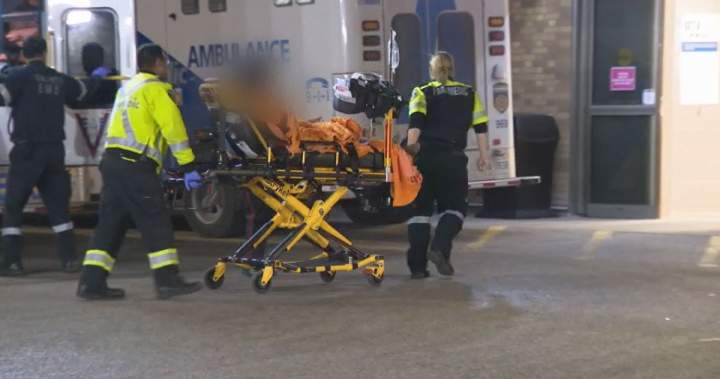
Paramedics in communities across Canada are trained for high-stress situations, often performing life-saving care. But when dealing with these high-stakes scenarios, paramedics are increasingly putting their own lives at risk.
In March, a Windsor, Ont., paramedic was threatened with a gun while attending to a call for service in the city’s west end, according to police.
Situations like this are becoming all the more common, said James Jovanovic, president of CUPE 2974, the union representing paramedics in Windsor-Essex.
“Over the last several years, we certainly noticed that the increasing trend – as the mental health crisis is getting worse and substance abuse cases are worse, particularly in the Windsor area – is violent actions and outbursts towards first responders.”
Paramedics in the region recorded 35 incidents involving verbal threats, 19 incidents of intimidation, 22 physical assaults and one sexual assault in 2025, a spokesperson for Essex-Windsor EMS told Global News.
And Windsor isn’t the only community where first responders are facing these issues.
“There’s specific drug concerns that we’ve seen in certain regions that we know are linked to an increased risk of violence and erratic behaviour,” Ryan Sneath, president of the Paramedic Chiefs of Canada, told Global News. “That is one linkage to it. There are certainly other factors involved that will likely need to be studied.”
Between April 13 and 17, two Ottawa paramedics were assaulted and a third was threatened with a firearm in three separate instances. In each case, Ottawa police laid charges.
Rates of violence have skyrocketed in the Niagara Region, with the union representing paramedics there reporting a 386 per cent increase over the past 12 years.
Ninety-three per cent of paramedics who responded to a 2025 survey from the Manitoba Government and General Employees’ Union said they had experienced violence on the job.
Of those, 24 per cent said they experienced violence daily.
“Winnipeg Fire and Emergency Services filed 109 reports regarding violent incidents or threats of violence in the workforce in 2025,” a spokesperson for the City of Winnipeg told Global News in an email.
While this number is down from 2024, the spokesperson said the number is still “concerning” and that incidents may be under-reported.
“When first responders are under threat, the safety of everyone they serve is at risk,” Winnipeg Mayor Scott Gillingham said at a city council meeting in September 2025.
A report presented to Halton regional council in Ontario last week said paramedics are “frequently subjected” to violence while carrying out their duties.
In 2025, the region’s emergency services reported 274 cases of violence, up from 260 in 2024.
Verbal abuse made up the largest number of complaints (132), but there were also increases in reported cases of intimidation and sexual harassment.
Emergency services in Cochrane, Ont., located just north of Timmins, have reported a stark rise in violence in the first five months of the year.

Get daily National news
Get daily Canada news delivered to your inbox so you’ll never miss the day’s top stories.
Cochrane District Services Board data shows paramedics reported 10 cases of violence throughout 2025. Since the beginning of 2026, 16 violence reports have been filed.
Most of that increase came from physical assaults, with one reported in 2025 and eight reported so far in 2026.
The escalating rates of violence across Canada are already having very real impacts on emergency service workers’ ability to do their jobs.
“Police officers have extensive training and self-defence at their disposal. Firefighters have large teams that go into calls,” Jovanovic told Global News. “Paramedics are fairly isolated where it’s just either you and a partner or sometimes you by yourself.”
A rise in violence has contributed to eroding morale for paramedics on the job, Sneath said.
“There is this consequence of the psychological injury and stress, increased anxiety amongst the individual members, increased incidence of post-traumatic stress,” he said.
In December 2025, IAFF firefighters and paramedics in Saskatchewan reported that first responder mental health-related Workers’ Compensation Board claims in the province had increased 224 per cent since 2019.
Prior to that, the Canadian Institute for Public Safety Research and Treatment found in a 2017 study that 45 per cent of paramedics reported signs of a mental health disorder, four times the national average of the general public.
While violence against paramedics may not always result in physical injuries, Sneath said the mental toll is very pressing.
“It is affecting our retention of our employees, people are seeking employment into other professions and it just is overall compromising the whole quality of care and safety for even our patients in general,” he said.
Sneath said paramedicine schools across the country have seen enrolment numbers dip.
While Sneath said there is no way to say for sure that the number of those choosing to study paramedicine is a direct result of increasing levels of violence, he can’t help but think it might be a contributing factor.
It has also become a source of contention between paramedics and their employers.
In February, Saskatoon paramedics voted in favour of strike action after being without a contract for two years. Members later rejected a proposed contract. Local workers cited a “broken system” and the need for their employers to support retention, mental health, adequate benefits and fair compensation.
The same month, paramedics in Windsor voted in favour of strike action.
“Our members have carried this system as it’s crumbled around us for years,” Jovanovic said in a news release in May. “One quarter of us have depression or PTSD. That is unacceptable and it puts the lives of residents at risk. It’s time our leaders made paramedic services a priority.”
Both Essex-Windsor EMS and Medavie Health Services West, which employs paramedics in Saskatoon, Moose Jaw, Yorkton and Wadena, Sask., told Global News they maintain a “zero tolerance policy” for any kind of violence towards their staff.
“The safety and wellbeing of our paramedics remains a top priority for Medavie Health Services West,” a spokesperson for Medavie told Global News. “We recognize the challenging environments paramedics across the country are increasingly working in and the importance of ensuring they have the supports, resources and protections needed to do their jobs safely.”
The Essex-Windsor EMS spokesperson said the region is working to identify repeat offenders to help address incidents of violence.
Neither employer addressed Global News questions about the ongoing negotiations.
Essex-Windsor EMS said it does support legislative initiatives that would help strengthen the severity of the consequences for those who commit violence against a first responder. Similar support has been shown by municipal representatives in Halton and Winnipeg.
In March 2023, Conservative MP Todd Doherty, who represents the B.C. riding of Cariboo-Prince George, introduced a private member’s bill into the House of Commons that would amend the Criminal Code to consider any sentence for an assault against a first responder as an aggravating circumstance. This typically justifies a harsher sentence.
Doherty told Global News he began speaking with first responders about their experiences about seven years ago after hearing from a paramedic who was thrown down the stairs while responding to a domestic dispute.
“Real heroes walk amongst us and hearing those stories, that’s absolutely horrific,” he said. “How far we’ve fallen that it’s OK to punch and kick and stab or cut and kill somebody. That’s just crazy. In my mind, it’s unfathomable.”
Doherty’s bill, Bill C-321, made it through the House of Commons and to the final reading in the Senate before it died on paper when Parliament was dissolved in early 2025.
Following the election, two senators brought forward Bill S-233, which asks for the same Criminal Code amendments. The bill passed unanimously in the Senate and passed second reading in the House of Commons on Wednesday. Members from all political parties, making up 332 votes, voted in favour of the Bill. No MP voted against it and eight were paired.
But Doherty said the waiting game is frustrating.
“This is a non-partisan issue,” he said. “I remain hopeful that we can still find a way to get it done. It’s just a frustrating thing.”
But Doherty said Criminal Code amendments are a reactive measure that can serve as a deterrent, but on their own are not enough.
“We’re asked all the time, ‘Will this solve the problem?’ And the answer is, it will help it, but it is a complex issue,” he said. “We need to do more along the lines of mental health supports, addiction treatment, prevention efforts. We need to do more to support those who are on the front lines by providing them the tools that are required to do their job.”
Sneath also wants to see work on what he considers the root causes of the issue. He said there have been some positive results from individual programs that help educate paramedics on how to detect a situation that may become violent, so support can be called in ahead of time.
“But those programs cost a lot of money,” he said. “It’s difficult for paramedical services to institute them without financial backing and support.”
Overall, he said more recognition is needed so that all levels of government, as well as employers of first responders, can work together to help keep them safe.
Read the full article here