



The world should end new fossil fuel drilling, EU Climate Action Commissioner Wopke Hoekstra has said, adding that global energy security depends on reducing oil and gas dependency.
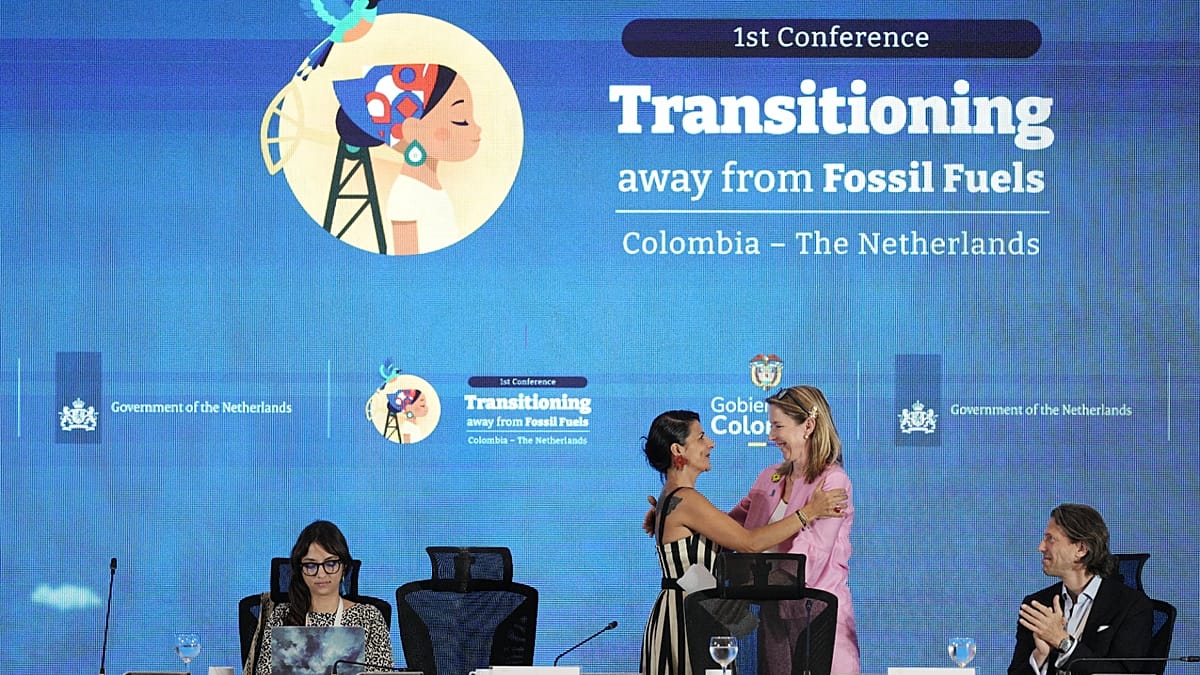
Speaking on Tuesday at an international conference in Santa Marta, Colombia, aimed at quitting oil, gas and coal for good, the EU climate chief said that science-driven, measurable steps should be identified to support the transition from fossil fuels. “Science matters in climate change. And transitioning away from fossil fuels is a very tangible way to follow science,” he said.
The First International Conference on Transitioning Away from Fossil Fuels, gathering 60 countries, including some major oil producers, comes at a timely moment.
Global demand for oil and natural gas has surged in the wake of the US-led war against Iran and the closure of the Strait of Hormuz, a vital trade passage. Nonetheless, the European Union insists that the long-term goal of clean power is more necessary than ever.
But as EU ministers scramble to secure supplies amid soaring energy prices, some countries are considering tapping their fossil fuel reserves for a rescue.
Even before the recent market disruptions, Greece issued its first offshore oil and gas exploration license in over four decades. Italy is also considering reviving offshore oil and gas exploration, which was suspended in 2019.
Rome and Berlin have also suggested a temporary return to coal to remedy soaring electricity prices.
However, Hoekstra said the clean energy transition remained the best long-term response. “We need to reduce our fossil fuel dependence for our energy security. We cannot be at the mercy of regimes holding up our resources,” he said.
“As long as we rely on fossil fuels, we are vulnerable to volatility and external pressure. What is the answer? To double down on affordable, reliable, homegrown clean energy. To move faster towards a clean, electrified energy system. For climate, but also for security, resilience, competitiveness and independence.”
Hoekstra called for a doubling of energy efficiency, a tripling of renewables by 2030 and more electrification to prevent vulnerabilities to price and supply shocks from global markets.
He also said that the annual United Nations COP climate meetings were not moving fast and far enough.
“We all know that the COP process is unfortunately not always delivering what it should. That means we need to improve that. But at the same time, we also need to ensure that we make the most of these plurilateral initiatives,” he said, as he thanked Brazil for tabling the initiative to transition away from fossil fuels at the COP30 last November.
Momentum for COP31
Denmark, Ireland, Portugal, Spain and the United Kingdom are among the European nations represented in Santa Marta, a global conference that was planned long before the conflict in the Middle East.
Rachel Kyte, the UK’s Special Representative for Climate, said the blocking of the Strait of Hormuz had forced countries around the world to pivot to clean energy, adding that the UK is eager to “support those wishing to drive forward their transitions to clean and secure energy.”
“We have the experience of our transition to share and the recent experience of driving to energy security with our clean power mission,” Kyte told Euronews.
Spanish Energy and Environment Minister Sara Aagesen hailed the Santa Marta gathering as a “success” that will generate alliances and consensus to sustain the momentum leading up to COP31 in Turkey.
“Fossil fuel dependency makes us incredibly vulnerable,” Aagesen said. “We need to bet on this clean energy agenda. We have our own success story, which has allowed us to be less dependent and more shielded from energy spike prices.”
Seeking consensus among oil producers
Several major oil-producing nations, including Canada, Norway, Brazil and Nigeria, are taking part in Santa Marta. Others, such as the United States and Russia, were not invited due to what Colombia’s Environment Minister Irene Vélez Torres described as “openly extractivist” positions.
China, the world’s largest consumer of coal and oil, was also barred, as its status as the top global emitter would make commitments to phasing out fossil fuels particularly challenging, Torres noted.
Torres said the countries gathered in Santa Marta were a “coalition of the willing” intended to bypass the gridlock often caused by major fossil-fuel producers in UN climate talks.
Climate researchers at the Santa Marta event presented scientific workshops, including on the potential impact on public health and jobs in a world no longer reliant on fossil fuel production and use.
While no major new initiatives are expected to emerge from the meeting, the goal is to identify collective actions that would be difficult to achieve individually.
“We are opening a new chapter of global political discussion which, naturally, won’t solve all the challenges on a single conference,” Torres told reporters. “What matters here is the declaration of what we’re willing to do to end fossil fuel dependency.”
Read the full article here