


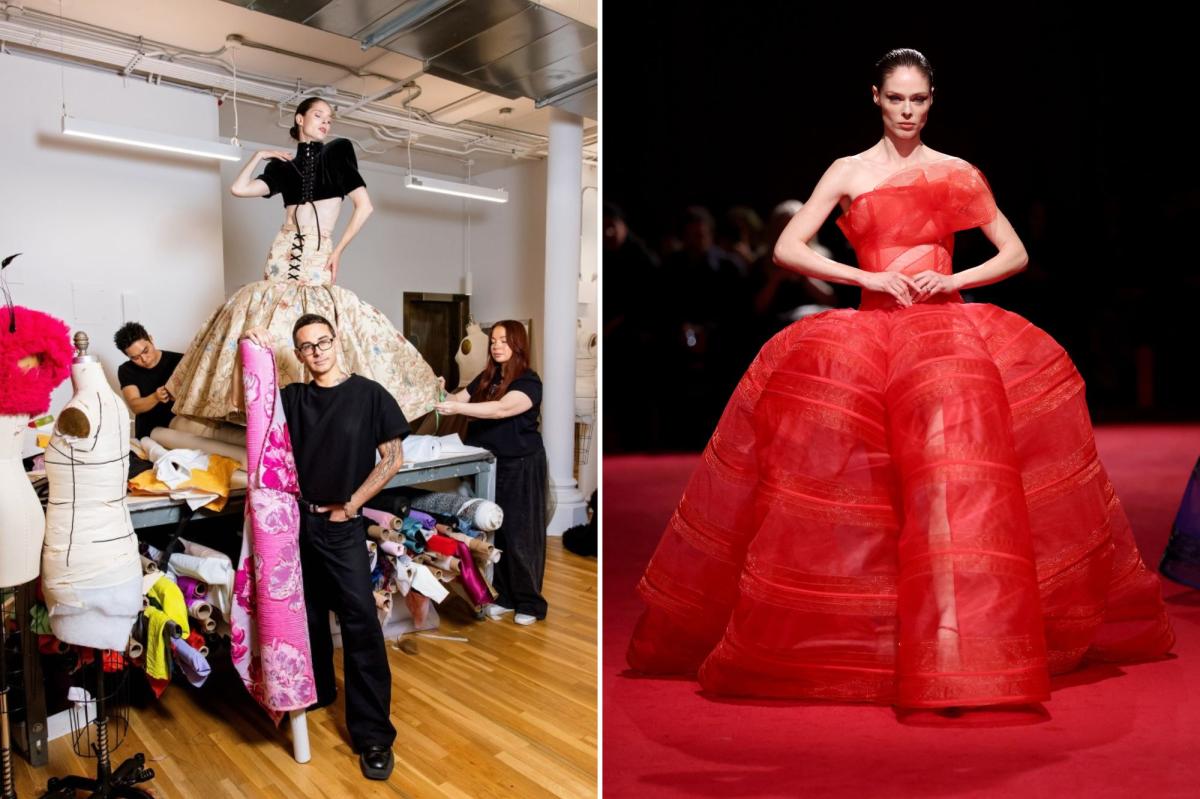
“If you can make it here, you can make it anywhere,” sang Frank Sinatra about New York City. He didn’t realize he was crooning about clothes.
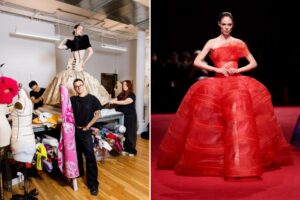
The Big Apple is once again becoming a hub for fashion manufacturing, with red carpet royalty like designer Christian Siriano insisting that their ultra-glam gowns — as seen on celebs like Zendaya, Celine Dion and even Oprah — get made in Manhattan.
That’s a big leap for fashion, which has lost nearly 97% of its American industry to overseas operations, taking millions of jobs with it.
But major designers like Thom Browne and Ralph Lauren are investing back into skilled US style workers, making some — or, in Siriano’s case, all — of their clothes in the Empire State.
“We’ve been doing it right here in the city for almost 20 years,” Siriano told The Post. “If you see a dress on my runway, it didn’t come from a factory overseas. We literally made it back there,” he says, pointing to the satin-crammed workroom of his Mercer Street studio.
“We live in New York. And we live for New York!”
But he’s part of a small but growing group of New York designers who manufacture their pieces in Manhattan, Brooklyn or Queens — even as inflation, tariffs and material costs make it more expensive than ever to make clothes in the city that once defined global style.
“All the customers and the [celebrity] clients, they really love that the dress comes from New York,” said the “Project Runway” host. “They feel like they’re getting such a special, unique thing. Even if it’s a really basic, simple, great dress, when it’s made here, it feels like it’s worth so much more.”
“We’re not outsourcing our style to three other countries, you know? We’re not gonna ship something around the world just to get a zipper sewn on. It’s local, and we’re proud of that,” he added.
“People dream of looking like they have an amazing New York life,” said Siriano. “Well, the way to do that is by buying New York clothes.”
At the peak of New York’s fashion power from the 1920s to the 1960s, the city’s famous midtown Garment District made nearly 95% of America’s clothes, with over 1 million city dwellers employed as seamstresses, pattern cutters and assembly linemen.
As the city teemed with immigrants from Italy, Russia, Germany and recent arrivals from the American South and Puerto Rico, the Garment District fostered teamwork and community among skilled workers, regardless of origin — even if nobody’s co-workers spoke the same language.
And in the 1970s and 1980s, these workers’ expertise helped labels like Ralph Lauren, Donna Karan and Oscar de la Renta become iconic American enterprises.
But soon, cheaper options arose overseas — and fast fashion giants like Temu began making plastic-y dupes of Hailey Bieber’s tightest tank tops, then selling them for $5 each.
Now, even though over 900 fashion brands are based in the Big Apple, 99% of them manufacture overseas, according to the global watchdog publication Sourcing Journal.
Some luxury labels import their leather boots and cashmere crewnecks from tiny artisan workshops in Italy and Mongolia, but most retailers are hauling shipping containers full of cheap-o crap from unregulated factories abroad.
That’s because when it comes down to it, making clothes in New York — anywhere in America, really — costs more, especially now. Nobody making a dress on Seventh Avenue can sell it for $7 like Shein… or even for $40 like Uniqlo.
But that, too, might be changing — at least a little.
In January, the Council of American Fashion Designers (CFDA) and Ralph Lauren launched the U.S. Fashion Manufacturing Fund, which promises real cash infusions for designers wanting to create an American-made collection.
There’s also the CFDA x NY Forward Grant Fund for Garment District factories that need equipment upgrades.
But even without those cash infusions, a small, stubborn cluster of Gotham glamour junkies is doing it the hard way: sketching and sewing their designs between subway rides.
“Everyone used to know someone — an uncle, a family friend, an older neighbor — who had worked in the Garment District,” said Batsheva Hay, a native of Kew Gardens who started her namesake line in 2016, after ditching life as a corporate lawyer.
“Now, I tell people I make my clothes in town… They look at me like I’m high.”
Hay’s prairie-punk vibe has been embraced by worldwide fashion babes like Natalie Portman, Celine Dion and Chloe Fineman. But her connection to New York’s “fashion history” keeps her making looks on 28th Street — that and the fact that, as a mother of two, she wants to work close to home.
“People are like, ‘You can go to India for a month and get everything made so much easier,’” she said. “But my kids are here. My life is here. And I want to support other people whose lives are here, too.”
Hay’s swishy dresses cost about $300 retail. (Not terrible, but not Zara’s $60 staples, either.) She keeps costs down by using “deadstock” fabric — reams of cool prints from the 1970s, ’80s and ’90s that she buys from discount warehouses or shutting-down factories. She’s also won small awards like the Fashion Trust US prize to help her along.
“I don’t just want to make something on a Pinterest board and send it out for other people in another country to make my dreams come true,” she added. “There’s no romance in that. New York has the heart.”
When Brooklyn-based knitwear designer Aisling Camps launched her own line after graduating from Columbia University, she schlepped three looms into her DUMBO studio. “Everyone in Italy and France goes on vacation for two months in the summer,” Camps told The Post.
“If I didn’t make these clothes myself, I’d have to wait six months. And by then, people would want something different!” This summer, Camps was nominated for her first CFDA Vogue Fashion Fund Award, which recognizes extraordinary talents in the city. “I knit the clothes I showed Vogue myself,” she said.
For those without looming deadlines, designers say there are still tiny but mighty Garment District hubs like Joanna Design Source, Steinlauf and Stoller, International Pleating and the New York Embroidery Studio — all within a few blocks of each other in midtown.
Ariana Grande, Elle Fanning, Bad Bunny and “Heated Rivalry” star Hudson Williams have all worn pieces from The Creatory, a manufacturing hub on West 39th Street that’s used by Gen Z fashion brand Tanner Fletcher.
“When we had a week to make five Met Gala outfits, we did it with them,” says designer Fletcher Kassell, who runs the label with co-creator Tanner Richie.
“New York gets it done.”
Trust is also a big factor when it comes to making New York clothes, Kassell told The Post.
“We can go into the factory ourselves and stay involved because they’re just down the street.
If you’re buying something from us, we want it to be from us, not someone we’ve never met!”
Read the full article here