




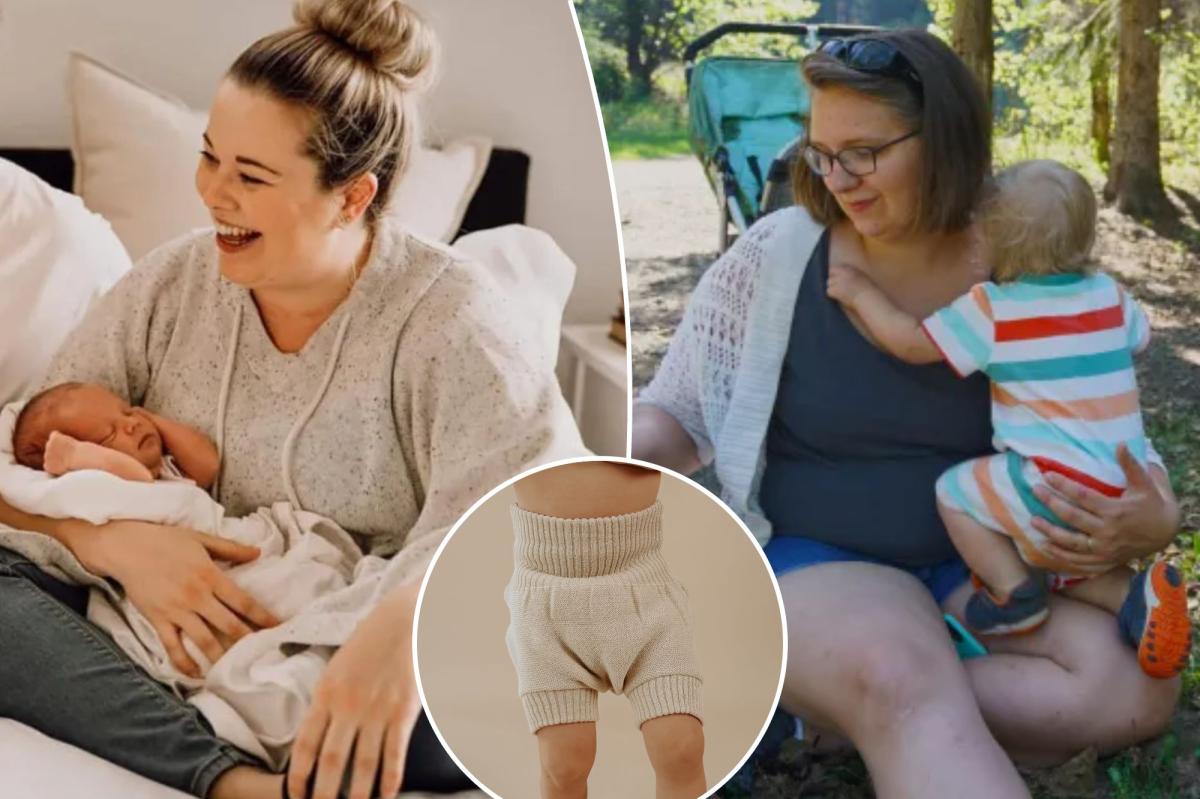
When Bailey Bouwman’s first child was born, he was a heavy wetter, and getting the perfect diaper fit to prevent leakage was impossible. There’s little as demoralizing as being the parent with the wet baby in public.
Bouwman also lives in Prince George, British Columbia, so it’s cold. If she didn’t change her son immediately every time he was wet, he’d inevitably get uncomfortable, fast.
But wool diaper covers changed the game. Overnight, leaks became a nonissue. The soft wool covers were absorbent and kept her baby dry with no odor. Plus, they weren’t so finicky with fit to simply work.
Aami Mills turned to wool for a different reason. Her second child had severe eczema, and disposable and cloth diapers weren’t doing much to help. But wool diaper covers cracked the code because of their lanolin content, which is the natural fat that sheep emit into the fiber.
“The product worked for [my baby] because he needed something soothing for his skin,” she says. “For a baby with eczema, lanolin is so moisturizing.”
Wool diapers may sound odd at first glance, but they solved tangible, everyday problems for these moms.
They also offer a potentially less risky option amid growing concerns about toxins in disposable diapers.
Last year, a study published in Toxics found that babies who used diapers made with phthalates (synthetic chemicals used as plasticizers) actually had traces of them in their urine. The concerns down the line, researchers wrote, are that such chemicals could cause DNA damage that predisposes a baby to chronic diseases.
Cloth diapers are not for the faint of heart, so for decades, the assumption has been that granola-eating, alternative parents with a cabinet full of essential oils are the only ones who actually use these products.
Not anymore. Wool diapers have eclipsed crunch status and captured the interest of a cross-section of parents across the political spectrum, from MAHA moms to semicloseted Marxists. Here’s what to know about how they work.
Tackling the wooly mammoth
Wool diapers require a two-part system. There is an insert, typically cotton, that looks like a sanitary pad and catches all of a baby’s waste. From there, a wool diaper cover holds the cotton insert in place.
Dr. Sabat Ameen, a senior staff pediatrician at Henry Ford Health in Michigan, says that
wool is having a moment because it’s so hygienic: When urine comes into contact with lanolin, it breaks down into water and salt. When a parent goes to change the baby in the morning, they can remove the wool diaper cover, flip it inside out, and let it air dry. Once dry, it’s ready to use again.
“It’s one of those weird things … Used underwear are taboo, but used cloth diapers? Go at it.”
Bailey Bouwman
Mills says that the big benefit of a wool diaper cover is that if only urine leaks out from the cotton insert, parents can go up to four weeks without washing a wool diaper cover because it’s self-cleaning.
“Wool fibers are antibacterial and antimicrobial,” Mills says. “You lanolize it, or put wax over the top, so any wee will evaporate straight off.”
However, if baby has a poop blowout that leaks out of the cotton insert and onto the wool diaper cover, it’s game over. The cover needs to be washed, and meticulousness in knowing how to do so matters.
There are a handful of different wool knits used on the diaper market that have varying washing instructions. Some blends can be tossed into the washer, and others must be hand-washed. If a parent accidentally tosses an item into the washer and the wool yarns shrink, that premium product may no longer fit the baby — and it takes prayers and a conditioner soak to even have a chance of restoring the original shape.
As for the insert, there are both disposable and reusable options, the latter of which needs to be washed after every use.
Diaper dollars
A central reason why so many parents have quietly opted for wool diapers is also economic. Wool diapers by the piece aren’t cheap — a single diaper cover can cost $40 to $100 — but you don’t need many of them.
For example, Lunapaca, which Bouwman calls the Holy Grail of the wool diapering vendors, sells a birth-to-potty training set of alpaca diapers for $750 all-in. Some estimates find that parents spend about $900 per year on disposable diapers, and nearly half of American families can’t afford the expense.
Wool diapers require more cash upfront, but for parents with the time and gusto to put in the elbow grease, it’s a financially sound choice.
Plus, they sell on the secondhand market like hotcakes.
“When wool diapers come in second-hand, they get snatched up quick,” Bouwman says. “It’s one of those weird things … Used underwear are taboo, but used cloth diapers? Go at it.”
In fact, both Bouwman and Mills say that their personal experiences using wool diapers landed so significantly with their local mom communities that it had a part in helping them launch their own businesses and become cloth diapering influencers.
In 2020, Mills founded Mimi & Co., a reusable diaper and period care company, which was featured on Shark Tank just three years later. Mills says that over the past year and a half, the demand for wool diapers has skyrocketed.
Bouwman’s passion for wool diapers led to producing the Cloth Diaper Podcast, where she interviewed vendors across the world on the rationale behind their cloth diapering products, as well as opening a baby boutique called Nest & Sprout.
Bouwman notices that the main clientele for wool diaper products tends to be well-off, educated moms, but the trends have shifted over the years. When post-COVID inflation was high, the conversation shifted to embracing wool diapers as a means to save money. Now, parents are into it due to worries about plastic exposure.
Snags in the fluff
From Ameen’s point of view as a pediatrician, all kinds of parents across ethnic and religious backgrounds ask about cloth and wool diaper options, but most inquire to see if wool diapers are the solution to diaper rash.
“Diaper rash can happen due to prolonged exposure to urine and stool,” she says. “If you’re not changing a wool diaper frequently, you can still get a contact rash.”
This gets at the fact that parents, especially mothers, need to have enough support in time and money to learn about, clean and treat wool diapers.
As for daycares, they vary greatly in their policies to utilize reusable diaper products. And if they do accept them, parents have to invest in plenty of product — and be prepared to pick up their baby at the end of the day in one arm, with a leaky bag of used cloth diapers in the other.
Read the full article here