


Mayor Zohran Mamdani’s socialist utopia is now blocking his sidewalk.
A brazen vagrant has seized a patch of prime Manhattan real estate, setting up a sprawling encampment right in Hizzoner’s daily path — steps from City Hall.
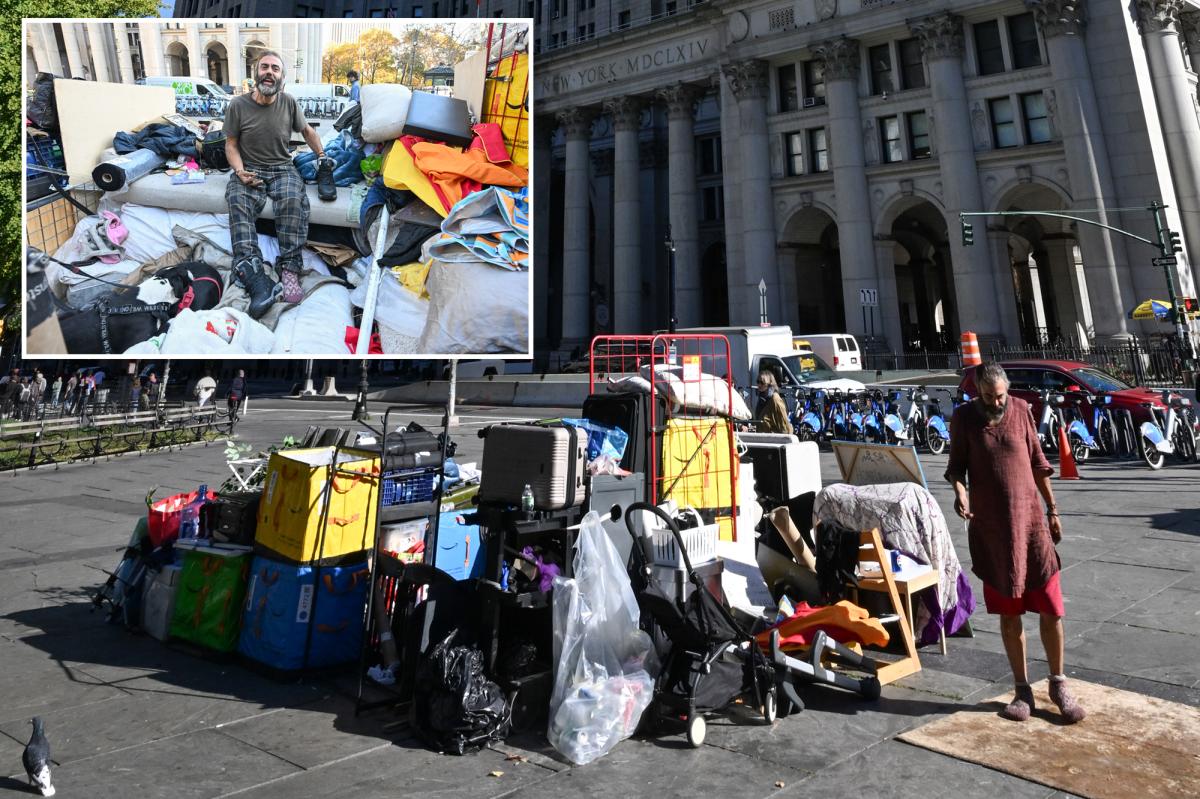
Mark Roggemann commandeered roughly 200 square feet of busy Centre Street walkway across from the Brooklyn Bridge entrance about six weeks ago — and has wasted no time making himself at home as he exploits loopholes in the city’s lax new homeless-sweep rules.
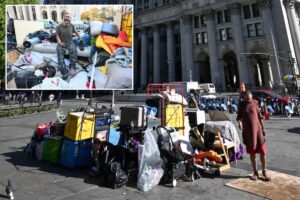
He’s plopped down a plywood-box bed and built a makeshift fortress around it, complete with aluminum clothing rack, potted fake plants, a rolling bin he says stores hot and cold water, and Amazon delivery totes for storage. When it rains, he covers his home with a cream-colored plastic tarp.
Not only does he have easy access to Mamdani at City Hall, but his camp is at the epicenter of civic life in NYC, across the street from the David N. Dinkins Municipal Building, which houses government agencies and offices of other lefty pols, such as City Comptroller Mark Levine and Public Advocate Jumaane Williams.
Roggemann didn’t choose Centre Street in the hopes of getting Mamdani’s attention, but admitted to The Post he’s shocked someone from Hizzoner’s camp hasn’t “come out” to visit — at least out of curiosity.
“I guess there’s concern [that] if they have any interaction with me at all, then it sets a precedent,” Roggemann, 50, rambled to The Post Wednesday. “If you want to speak to the mayor — come camp out in front of City Hall, which, like, sounds like a horrible plan, but with a mayor like Mamdani, that may not be the worst idea.”
“I’m just sitting here waiting to see who stops by,” he added.
Thanks to Mamdani, Roggemann won’t be getting the bum’s rush anytime soon.
Under the mayor’s relaxed homeless policies, the city does not forcibly remove people from sidewalks. Instead, social workers conduct an agonizingly slow seven-day “engagement process” before performing a “clean-up” or attempting relocation efforts.
The Department of Homeless Services slapped Roggemann with a “Notice of New York City Clean Up” on Nov. 6, ordering him to vacate the area by Friday.
So the tenacious tramp simply wheeled his belongings 35 yards north on Centre Street on Thursday, still within view of City Hall and now closer to the NYC Department of Education’s headquarters at the Tweed Courthouse.
Roggemann said he knew city workers would be powerless to move him if he relocated a short distance — which proved true on Friday.
If the city slaps a cleanup order on his new pad, starting another seven-day clock, he’ll simply return to his original concrete plot, he said. But he plans to return before then, Roggemann added.
“This is the idiocracy we live in right now,” said Councilwoman Joann Ariola (R-Queens), whose district includes several neighborhoods inundated with homeless encampments.
“A 35-yard move is all it takes to reset the city’s clock. He could just keep going in a circle, moving a few feet every week, and the city won’t do a thing about it thanks to the current rules. This is lunacy.”
She also said there’s nothing funny about Roggemann’s makeshift mansion greeting drivers, cyclists and pedestrians as they cross the famed bridge into Manhattan.
“This camp is basically a billboard saying, ‘Welcome to Mamdani’s Manhattan, where every street is becoming skid row,’” Ariola said.
Tourists checking out scenic views from the Brooklyn Bridge were stunned by the city’s hands-off approach to the homeless.
“We have our own homeless problem in Seattle . . . but even our politicians wouldn’t let people stay so long next to our City Hall,” said Robert Lawrence, 30, who was visiting from the Emerald City.
“Considering he’s right in their faces, you’d think that someone associated with the mayor would do a better job trying to get this guy help and convince him to leave.”
Unlike most of the nearly 5,000 people estimated to be living on NYC streets, Roggemann said he has access to his own taxpayer-funded apartment in Brooklyn provided by the Department of Homeless Services.
However, he claimed the pad was so horrific and “hot” that he packed up most of his belongings in July to take his chances on the streets of Manhattan with his two beloved dogs, Sir and Mage.
He said they moved because he believed the building’s lack of air conditioning caused the deaths of two other pooches belonging to an upstairs neighbor.
At first, Roggemann, a self-described artist, camped two miles north in Union Square Park — where over the years he’s sold his abstract finger paintings to passersby and highlighted them on social media. But living in city parks is illegal, so authorities ultimately booted him, sources said.
When he arrived at Manhattan’s Civic Center by City Hall six weeks ago, he initially set up in the heart of the Centre Street pedestrian pathway, not far from where a bunch of popular food trucks operate.
But the food vendors quickly convinced him to relocate 30 yards north because it was best for business.
“He was scaring away customers, but he’s a good guy and needs help,” said one vendor. “We’re the only ones feeding and taking care of this guy. He sweeps for us, and we give him cigarettes, ice cream and food.”
Puffing a Newport cigarette during Wednesday’s 15-minute sit-down with The Post, Roggemann said his beef isn’t with Mamdani but rather the DHS, claiming the department is corrupt and “harassing” him.
“I’m just some random dude living near a park . . . This is not an encampment,” Roggemann insisted. “There is no structural integrity. There is no roof. Everything basically goes on wheels and is moveable. They call it an encampment to try and do some cleanups.”
The Mayor’s Office did not return messages.
The DHS declined to discuss Roggemann living near City Hall, instead saying in a statement, “This administration is focused on connecting homeless New Yorkers to shelter, medical care and the services they need to move into permanent, stable housing.”
Marie Colon, a Bronx resident who works at a nearby grocery store and routinely walks by Roggemann, said his situation shows “just how flawed the system is.”
“I feel bad for this guy,” she said. “You can offer him help, but if he’s not accepting, [city workers] need to get him to safety and help him. Having him move for a cleanup and then return doesn’t help.”
Read the full article here