



Dozens of families are anxiously searching for alternative childcare after multiple Melbourne centres announced closures amid falling enrolments and growing volatility in the sector.
About 355,300 children were enrolled in Victorian childcare centres in June, down 2.06 per cent on the same time last year, as operators grapple with the fallout from child sexual abuse allegations, declining fertility rates and cost-of-living pressures pushing families out of inner suburbs.
Reservoir mother Lisa Nguyen said she was baffled when the not-for-profit centre her children attended announced it was no longer viable to continue offering long day care, while three for-profit centres had just opened in the area.
Nguyen said she now has to find another provider she trusts, forcing her to look beyond her neighbourhood for care.
“It’s really daunting,” she said.
Long day care centres provide at least eight hours a day of childcare, and families are able to access means-tested subsidies. The state government provides subsidies for kindergarten programs for three-year-olds and four-year-olds.
A recent Victoria University report found for-profit centres were opening and closing services in response to fluctuating demand at a rate almost four times higher than not-for-profit centres, with few barriers to prevent them doing so.
An earlier report from the university found for-profit providers were more likely to operate in affluent areas, leaving some parts of Australia in what it termed childcare deserts.
Fiona Balsillie, executive director of Early Learning Uniting Vic Tas, which operates the Merrilands Uniting Early Learning centre in Reservoir, said it would close its long day care service in December but continue to offer sessional kindergarten.
Balsillie said the decision was made in response to ongoing low enrolments and a “significant increase in new childcare centres opening in the area”.
“We have trialled multiple service models to improve viability. Unfortunately, we can no longer continue operating at a loss,” she said.
Australia’s largest private childcare operator, G8 Education, announced plans to close 40 centres across five states in April this year. Affinity Education, Australia’s third-largest provider, closed 11 locations in 2025.The two centres’ financial fortunes fell after it was revealed a Victorian childcare worker charged with child sexual abuse, Joshua Brown, had been employed at their centres.
G8 Education chief executive Pejman Okhovat said the sector was undergoing “unprecedented change and uncertainty” driven by socioeconomic and macroeconomic factors, including cost-of-living pressures and declining birth rates.
The federal government’s 2026 Intergenerational Report projects Australia’s fertility rate will fall to 1.34 children per woman in 2065-66, below the long-term assumption of 1.62.
In August, families with children at Affinity-owned Papilio Early Learning Murrumbeena were notified that they had less than one month to find alternative care, as the centre would shut down on September 25.
“Over time, demand patterns in the area have not developed as expected,” Affinity operations director Michelle Baldwin wrote in a letter to parents.
“For an extended period, the number of families choosing to access care here has remained low, and we have reached a point where continuing to operate would not allow us to deliver the standard of care your family deserves.”
An Affinity spokesperson said the company responded to shifting demands and invested in locations where families need it.
Smaller operators across Victoria are also closing. In Melbourne’s north-west, liquidators took control of Avondale Heights Child Care and Early Learning Centre in August, leaving families without care.
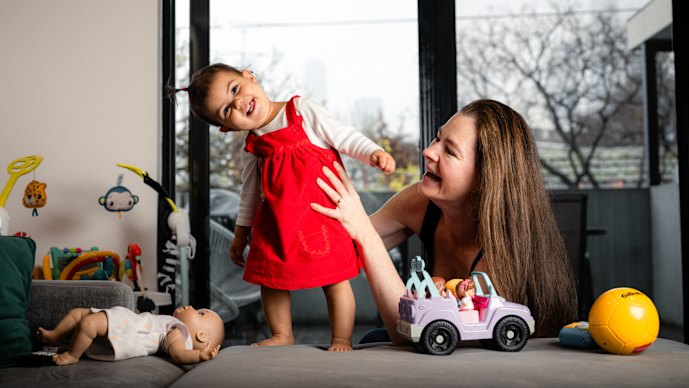
In South Melbourne, mother Melanie Swieconek is searching for a new childcare centre for her 14-month-old daughter, Valentina, just months after Valentina began attending the council-run Coventry Children’s Centre.
While Port Phillip council upgrades six early childhood education centres, Coventry is being used to provide care for children affected by the redevelopments. As a result, some children already attending Coventry, including Swieconek’s daughter, have been displaced.
“Handing over my child to someone to care for was not a decision I made lightly,” Swieconek said.
She is now fighting for families at Coventry to either remain or be rehoused as a group, but she is unsure where she will be able to place her daughter.
City of Port Phillip acting chief executive Brian Tee acknowledged some families would have to find alternative centres.
Tee said the council had added extra support to help ease the transition, including a 15 per cent discount for those moving to other council-owned centres.
The Front Project, an independent childhood education think tank, estimates 66 per cent of long day care services that closed in the 12 months to March 2026 were for-profit providers. Another 28 per cent were not-for-profit providers including 14 per cent that were community managed, and 3 per cent that were run by local and state governments.
Front Project chief executive Caroline Croser-Barlow said the sector had been raising the alarm for a while.
“What we are seeing now is uncontrolled exits, not necessarily market correction. Poor-quality providers are closing, but so are well-established, not-for-profit and community-embedded services,” Croser-Barlow said.
Croser-Barlow is among those advocating for an early childhood and care commission to help tackle the many issues facing the embattled sector.
Federal Minister for Early Childhood Education Jess Walsh said the government acknowledged some parts of the country were oversupplied while others were undersupplied.
“That’s why we’re exploring the development of an early education and care commission, which could help with long-term planning and supply,” she said.
Start the day with a summary of the day’s most important and interesting stories, analysis and insights. Sign up for our Morning Edition newsletter.
 Nicole Precel is an education reporter at The Age. She was previously an audio video producer. She is also a documentary maker. Get in touch at nicole.precel@theage.com.auConnect via X, Facebook or email.
From our partners
Read the full article here