


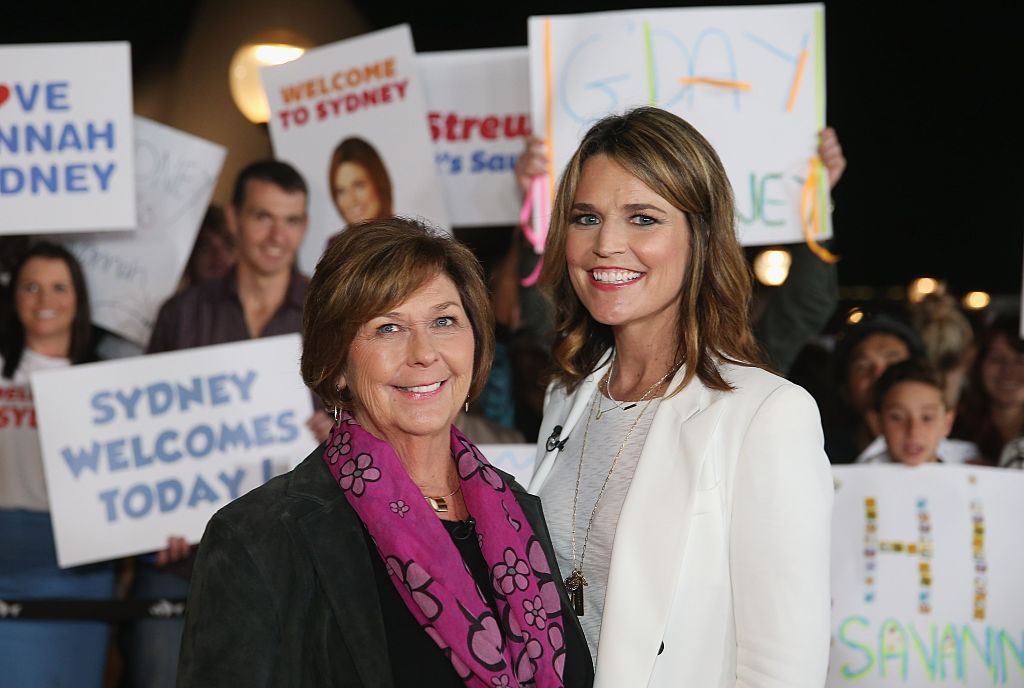
A former detective’s new assessment of evidence in the disappearance of Nancy Guthrie, the mother of NBC’s Today co-host Savannah Guthrie, has intensified concerns about the 84‑year‑old’s fate.
The warning comes more than four months into an investigation that has yielded no suspect, no arrests, and no confirmed breakthroughs. The development affects Guthrie’s family, investigators, and the Tucson, Arizona, community as they brace for what stalled forensic testing and limited searches may mean for the case’s next phase.
The Pima County Sheriff’s Department confirmed to Newsweek the investigation remains active, with DNA and video analysis still underway. “If and when there is a significant development in this case, it will be shared publicly,” the department said in an email.
Savannah Guthrie Shares Emotional New Message: “Bring Her Home”
Savannah Guthrie shared a new message on Instagram Stories alongside a painting of Christ’s ascension. “Oh my, my soul it cries out…Bring her home,” she wrote. The Today co‑host has been a steady public voice throughout the investigation, previously posting the same biblical artwork with the words “I believe, I believe.”
Her family—siblings Annie and Camron, along with their spouses—recently thanked the people of Tucson for their support, saying the community “holds the key to finding resolution in this case.”
Former Detective Says Early Evidence Points to a Troubling Outcome
Former detective Jon Buehler told NewsNation’s Brian Entin that several early indicators have led him to fear Guthrie “didn’t survive the abduction.” He pointed to the complete absence of communication from any potential kidnapper, noting that the lack of a ransom demand or proof of life is “a pretty big stretch” for anyone hoping she survived.
Buehler also highlighted the blood found outside the home, describing it as significant enough to suggest a serious wound, even if not arterial. Combined with Guthrie’s age, medical issues, and pacemaker, the former detective said the circumstances point to a situation in which fear, stress, and force used to gain compliance could have been overwhelming.
Buehler emphasized that his assessment is based on professional interpretation rather than inside knowledge, but his comments reflect the growing unease surrounding the case.
Sparse Searches Could Complicate Any Future Prosecution
Federal prosecutor and no‑body homicide expert Tad DiBiase told Entin that the limited searches for remains could create major challenges if the case ever goes to trial. He explained that thorough searches serve two purposes: they increase the chance of finding remains, and they allow prosecutors to eliminate alternative explanations such as wandering off, suicide, or a medical collapse. Without that foundation, he said, defense attorneys can argue Guthrie may not be dead or may have left the home on her own.
DiBiase noted stranger‑on‑stranger no‑body homicides are extremely rare, making this case even more unusual. He said while a prosecution is still possible without remains, it becomes far stronger if investigators can show they exhausted every reasonable search area and ruled out competing theories.
DNA Delays Stem From Rootless Hair and Multi‑Lab Testing
Pima County Sheriff Chris Nanos recently highlighted that multiple forensic labs are involved in processing DNA, including a rootless hair recovered from the home. Rootless hairs are among the most difficult samples from which to extract DNA, requiring specialized facilities and extended processing times. Investigative genetic genealogy is also underway, adding another layer of complexity.
Nanos said the slow pace reflects caution rather than stagnation. He noted DNA analysis not only identifies suspects but also clears innocent people, a point emphasized by two early raids—one in Rio Rico and another near Guthrie’s home—where individuals were detained but ultimately released. Both now have legal representation and have expressed frustration at being swept into the investigation.
Civil Attorney Warns That Early Missteps Could Affect Wrongful‑Death Claims
Litigation attorney Brian C. Stewart, speaking exclusively to Newsweek, said the early investigative pattern raises concerns for any future civil action. He pointed to the confirmed blood at the scene, the limited searches for remains, and the two raids that produced no arrests as a “troubling pattern.” Stewart said while blood and silence from an abductor strongly indicate a crime, civil cases still require a viable defendant with resources to pursue. Lost evidence, he added, makes wrongful‑death claims exponentially harder to win.
Stewart also warned that investigative missteps—such as detaining innocent people without probable cause—could expose agencies to liability. He urged families not to wait for an arrest before exploring civil options, noting civil cases require a lower burden of proof and can run parallel to criminal investigations.
Video Shows Guthrie Was Targeted in Violent Abduction: Expert
In comments to Newsweek, former federal prosecutor and Director of Emerging Litigation at McNicholas & McNicholas, Joseph McNally, said the doorbell‑camera footage that was released by the FBI in February is one of the most decisive elements of the case.
“The video at her residence showing a masked, armed individual supports that she was likely the victim of a crime of violence, and given the passage of time, is likely deceased,” he said, adding the investigation has effectively become “an identity case” focused on proving who the masked figure is.
McNally noted the footage eliminates any possibility that Guthrie left on her own.
“We know because of the video that she did not wander from her house. This is not a case of an accidental disappearance,” he said. McNally also pointed to the roughly 10‑hour gap between the abduction and the 911 call, a window that would have allowed an abductor to take Guthrie far from her home. Given the surrounding desert terrain, he said large‑scale searches “can only do so much.”
He pushed back on the idea that forensic delays are slowing the case, saying state and federal labs prioritize investigations like this. “If there is usable DNA and other forensic evidence, I would expect that the results of that analysis will be in the hands of prosecutors very quickly,” McNally said. But he cautioned that DNA science is far more complex than the public assumes, noting that degradation, mixed samples, or the absence of a database match can all limit its usefulness.
McNally added that investigators have almost certainly been pursuing digital evidence from the beginning, given that “we leave digital footprints everywhere we go.” Despite the challenges, he believes the case is solvable, saying, “Someone out there, beyond the perpetrator, likely knows who did this. If they tipped off law enforcement, that would help break the case.”
Read the full article here