



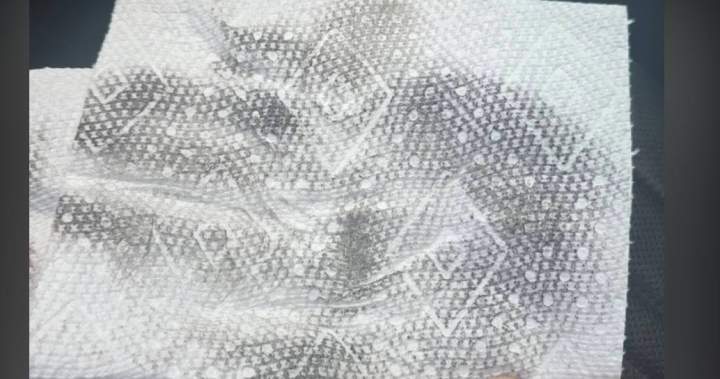
Hamilton Public Health (HPH) officials say a black particulate that fell across parts of the city last month is not expected to pose a long-term health risk.
In a news release on Thursday, the agency said its assessment of the early July event found exposure levels were likely low, based on air quality data, environmental samples and the limited duration of the incident.
Some residents may have experienced mild symptoms, including itchy eyes, coughing or a sore throat. However, a review of local hospital data found no increase in emergency department visits for more severe symptoms.
“The health and safety of residents remains Hamilton Public Health’s top priority,” said Dr. Elizabeth Richardson, the city’s medical officer of health in a news release from HPH.
“The emissions in early July were a short-term worsening of those Hamiltonians experience on a daily basis. This short-term event isn’t expected to have long-term health risks on its own. However, the event contributes to the existing burden on the airshed, particularly the disproportionate impacts experienced in the north end of Hamilton.”
The findings come amid longstanding concerns about black soot in neighbourhoods near Hamilton’s industrial area.
McMaster University researchers recently studied the mysterious black grime that residents reported finding on homes and yards for years.

Get weekly health news
Receive the latest medical news and health information delivered to you every Sunday.
Researchers said coal combustion was a likely source of the dust, but found its composition was complex and pointed to multiple sources.
Ontario NDP Leader Marit Stiles has also raised concerns about the soot, saying in a video posted to social media that Hamilton residents filed 475 complaints with the province’s environment ministry over a nine-day period.
She said parents have been wiping the soot from shoes, slides and parks, questioning, “What is in the air we are breathing?”
The NDP leader directed residents to CleanupTheSoot.ca, which includes information about the issue and a petition calling for action.
The latest public health assessment focuses specifically on the black particulate reported in early July.
Ontario’s Ministry of the Environment, Conservation and Parks determined emissions from Birla Carbon on Parkdale Avenue North were the primary source of that event.
Environmental samples collected by the ministry mainly contained carbon, along with small amounts o2f sulphur and very small amounts of mineral particles.
While the materials can be toxic at high concentrations over prolonged periods, public health said air quality data, environmental samples and rainfall that helped reduce the amount of soot indicate exposure levels during the July event were low.
The assessment also found several instances where levels of PM10 (particulate matter measuring 10 micrometres or smaller) exceeded Ontario’s ambient air quality criteria.
On July 1, PM10 levels exceeded the province’s reference level at five monitoring stations. Further exceedances were recorded on July 2, 13 and 14.
The highest recorded level was at the Beach monitoring station on July 14, when PM10 reached 109 micrograms per cubic metre. Ontario’s 24-hour reference level for PM10 is 50 micrograms per cubic metre.
Despite the findings about the July event, public health said air pollution remains a concern for people living near Hamilton’s industrial areas.
“We recognize that residents across Hamilton have different exposures to air pollution depending on where they live and work,” said Dr. Bart Harvey, associate medical officer of health said in the release. “Residents living near industry have higher exposures.
“Although there has been a decrease in emissions, air pollution levels and health impacts over the past decades, air quality and its health impacts within industrial settings remains a challenge and more needs to be done.”
Public health said black particulate may settle on the ground or transfer to skin, outdoor surfaces and vegetation.
Residents concerned about the material are advised to clean skin and surfaces with soap and water or a mild detergent and wash produce under running water.
Officials also recommend avoiding dry sweeping or using leaf blowers on affected surfaces because doing so could stir particles back into the air.
“Clean air is not a luxury, it’s a right,” Stiles said.
© 2026 Global News, a division of Corus Entertainment Inc.
Read the full article here