



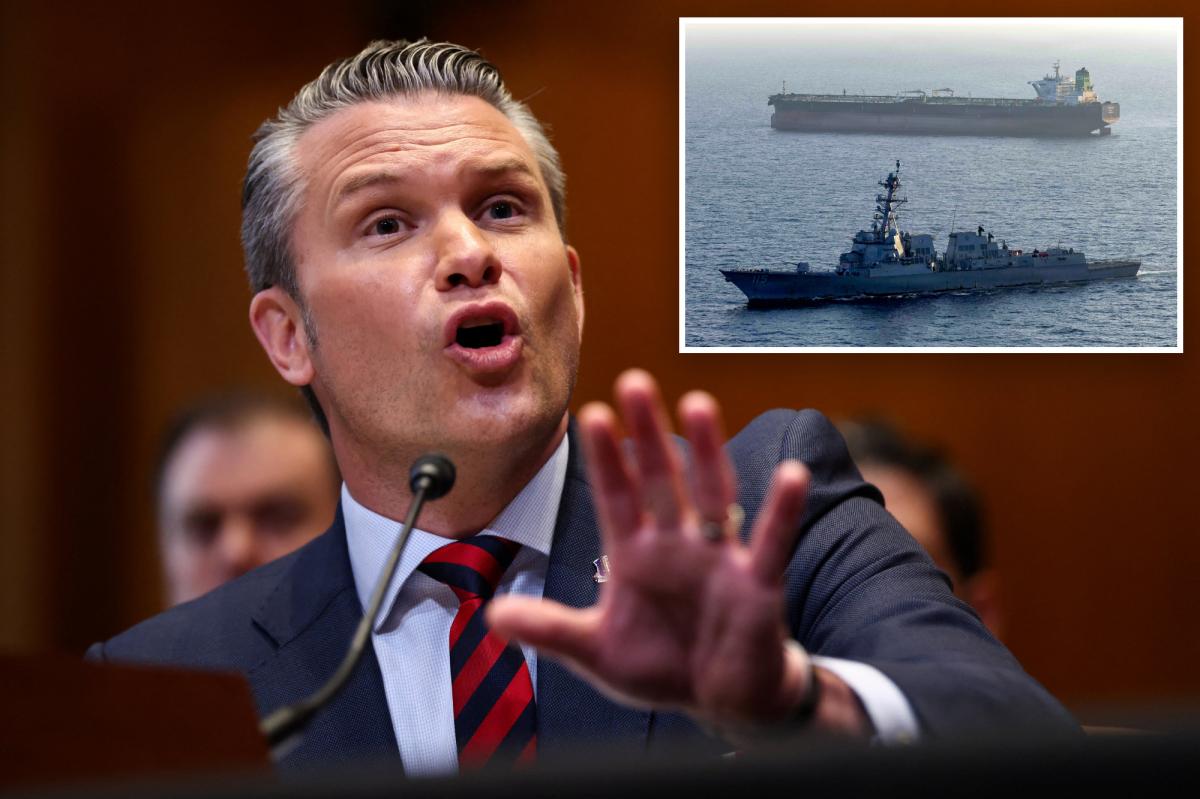
WASHINGTON — Secretary of War Pete Hegseth insisted the US has “control” of the Strait of Hormuz during surprisingly civil testimony before House and Senate appropriators on the Pentagon’s wallet-busting $1.5 trillion budget plans.
The Pentagon honcho fended off tough questions about the war in Iran and bipartisan skepticism that the Department of War hasn’t been sufficiently transparent with the public on key details of the conflict.
“I don’t think enough has been stated about the blockade and the power of the blockade and the dilemma that our blockade creates for them,” Hegseth told the Senate Appropriations Subcommittee on Defense.
“They can’t move anything out of Iranian ports, and over, I think it’s 65 ships at this point have been turned around or disabled,” he went on. “But ultimately we control the strait, because nothing’s going in that we don’t allow to go in.”
Democrats, in particular, didn’t buy that narrative and underscored how traffic through the chokepoint, where over a fifth of the world’s seaborne oil supplies once flowed through annually, has largely ground to a halt.
Sen. Chris Coons (D-Del.) repeatedly grilled Hegseth about why the US doesn’t reopen the Strait of Hormuz if Washington has control of it, chiding that the US appears to be on “the verge of a strategic loss.”
“So foolish,” Hegseth erupted. “We have more leverage than we’ve ever had. We’ve had incredible battlefield successes. And you’re talking about a strategic loss.”
Hours earlier, President Trump told radio host Sid Rosenberg that the US doesn’t “have to rush anything” and argued that the blockade is tightening the screws on Iran. Trump was also resolute that the US would get Iran’s “nuclear dust.”
“They’ll either do the right thing, or we’ll finish the job,” he later told reporters.
During the back-to-back hearings, Hegseth refused to confirm or deny reporting that only 30% of Iran’s missile capacity was destroyed in the war, arguing a public setting wasn’t the place to do that. The secretary of war also downplayed concerns about America’s munitions stockpile.
“I take issue with the characterization that munitions are depleted in a public forum. That’s not true,” Hegseth countered to Rep. Pete Aguilar (D-Calif.) “We have all the munitions needed to execute what we need to execute, and we’re going to ensure that we supercharge that going into the future.”
The testimony came hours before Hegseth was set to jet off to China with Trump for his high-stakes meeting with leader Xi Jinping in the first such summit in Beijing in nearly a decade.
At the top of the agenda for lawmakers was President Trump’s $1.5 trillion defense budget. The Pentagon has divvied that up into two main pieces: a $1.15 trillion discretionary spending baseline paired with a $350 billion reconciliation package of mandatory spending.
The $1.15 trillion baseline is what appropriators would oversee, and the other $350 billion is intended to come on a party-line basis from the Senate budget reconciliation process, where Republicans can bypass a 60-vote filibuster from Democrats.
“I would characterize that as a one-time plus-up for catch-up,” Jules Hurst, the acting Under Secretary of Defense, who serves as the de facto chief financial officer at the Pentagon, told lawmakers. “To fix all of our poor and failing barracks and other facilities of the department, and also some catch-up investments in AI and autonomy.”
“We think we can sustain these investments over [time] with discretionary dollars after this,” he added. “[In our] budget request for ’28, we expect to request … discretionary only … and I believe the top line for that is $1.23 [trillion].”
This approach drew unease from Republicans and Democrats alike. Democrats groused that the plan was aimed at circumventing their input.
Republicans raised concerns about the difficulties of the reconciliation process and that the funding plus-up won’t be long-lasting. Rep. Mitch McConnell (R-Ky.), who chairs the Senate subcommittee, for example, pressed Hegseth about whether some of the Pentagon’s top priorities were put in reconciliation.
“The need for significant defense investments is as urgent and obvious as it is overdue,” McConnell argued. “This is not a $1.5 trillion defense appropriation request. It’s a request for $1.1 trillion in base appropriations.”
“If the department’s top priorities aren’t built into annual appropriations, we’re actually taking a big risk,” he stressed.
The Pentagon has not yet released its $350 billion reconciliation plan.
Despite the pointed questions and, at times, testy exchanges with Democrats, Hegseth’s Tuesday appearance before lawmakers was considerably more tame than his combative ones before the House and Senate Armed Services Committees nearly two weeks ago, where he got into much nastier spats.
“We watched some of the other hearings,” Rep. Betty McCollum (D-Minn.), the top Democrat on the House subcommittee, remarked. “This is the way … hearings should be conducted, especially when it’s dealing with national defense, when we ask people to put their lives on the line.”
“I thank everyone for a respectful hearing.”
Read the full article here