



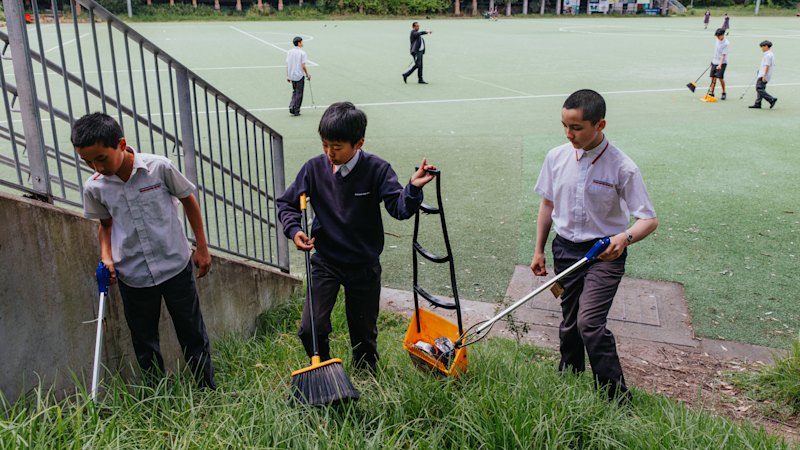
It’s just past noon on a Friday and a small army of students clutching bottles of spray and wipe, buckets and brooms spreads across the playground at Chatswood High, led by a man in a black suit with a commanding voice. Meet Robin Chand, the public school principal not afraid to make students clean.
Other students operate mechanical claws to pick up litter. They have a few minutes to clean an area before Chand leads them, like a benevolent Pied Piper, to their next spot. Their 45-minute cleaning shift began with a small speech.
“I give them a talk about the importance of looking out for our environment, and that the responsibility is on each of us,” he says.
There have been no complaints from the school’s 2287 students since the cleaning regime was introduced about three months ago. Teachers sign up their classes to clean with two sessions a week.
Word has spread quickly on the north shore. Prospective parents are now less interested in NAPLAN or HSC results than they are in cleaning.
“When we go to parent information sessions at primary schools and in the community, when we show a slide of kids cleaning – it is a huge attraction point,” he says.
The origins of the cleaning policy at Chatswood High can be traced back two years, when Chand visited a Japanese high school where students mopped the floors.
“I just thought it was just beautiful. It was just amazing. There was no discussion about why. It was just understood that the school is here for all of us,” he says.
That stuck in his mind. But it was not until the Bondi massacre last December spurred him on to adopt the unconventional cleaning regime.
A contingent of Chatswood High students, parents and teachers visited Bondi Pavilion in the aftermath and Rabbi Dovid Slavin spoke to them.
“He always talks about light beating darkness, and I thought to myself: ‘What’s something that we can do, that I can do as a principal, that will have some sort of effect of planting a seed of kindness and respect?’”
They created a curriculum called Just Be Kind – which explicitly teaches manners, respect, gratitude and resilience, out of which the unconventional cleaning roster was born.
After a shift with the dustpan and brush, year 9 student Hillary Zhu, 14, says the exercise had opened her eyes.
“Only after you start cleaning the school, you realise how much rubbish there is,” she says.
“I told my parents about it, and they were like, ‘These children are so disciplined, they follow their principal. Very good, very good.’”
When Supreme Joshi, 14, heard about the cleaning plan, he was happy because he could see the school was dirty. He estimates he has picked up between 10 and 15 scraps, explaining that finding litter has become trickier since the initiative was launched.
“I’ve tried hard … There’s not much rubbish around here,” he says.
Rachel Benny, 14, says it helps her feel more part of a community. “It’s also pretty calming.”
Adriana Figueroa Gonzalez, 15, pulls a sparkly gold-backed playing card from her pocket. “I mean, it was on the ground,” she says as she places it back into her pocket.
She says the mechanical claw tools (which a local Bunnings donated) alleviated the ickiness she felt about touching other students’ rubbish. But she thinks the cleaning regime helps everyone appreciate the work of others.
“I feel like a lot of times, people forget about the people who actually clean the school, like the janitors. I really want people to notice and appreciate these people,” she says.
Not everyone was initially impressed, says computer science teacher Imogen Harding, who signed one of her classes up for a cleaning session this year. “There was a repeat of grumblings around ‘Why are we doing this? Shouldn’t the younger students be picking up the rubbish?’ ” But students’ attitudes changed, saying at the end it was enjoyable and satisfying.
An email from a parent this month thanked Chand: “Growing up in Asia, cleaning activities were a normal part of our school life. We learnt that keeping our school clean was not just about personal hygiene, but also about respecting and taking care of the environment around us.”
Student Luke McDermott, 15, notes there were good reasons students did not simply pick up rubbish of their own volition.
“I think there’s more stigma around it that if you do it without being told, you’re viewed as more of a goody-two-shoes,” he says.
But that might change too. “Respect is cool,” Chand says. “Respect is courageous.”
Start the day with a summary of the day’s most important and interesting stories, analysis and insights. Sign up for our Morning Edition newsletter.
From our partners
Read the full article here