



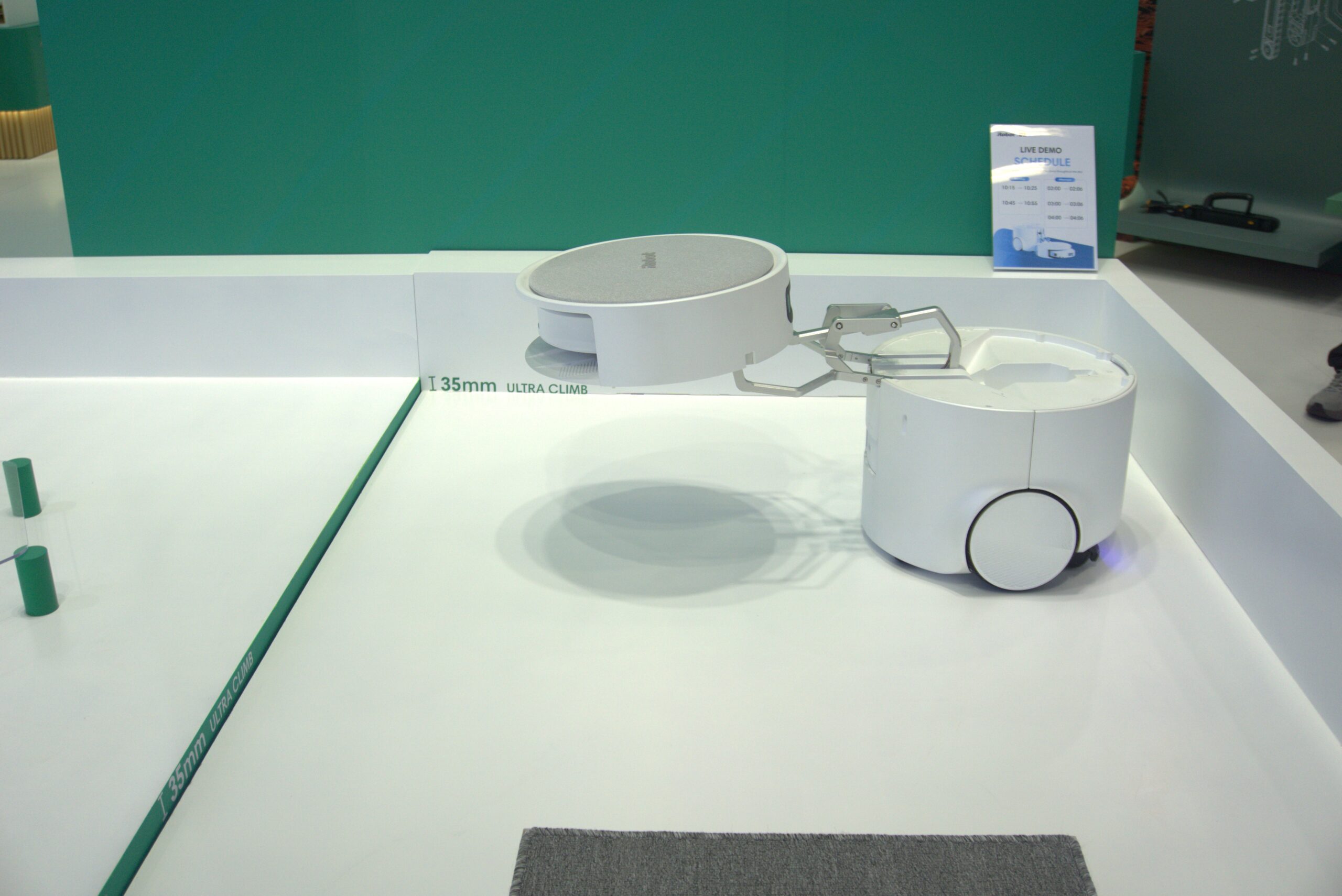
There’s not much the robot vacuum industry can do to surprise me these days. I’ve seen robots that have mechanical arms to pick up objects, robot vacuums with legs and tread systems to climb stairs, and even wilder humanoid concepts. But iRobot genuinely surprised me with its Roomba Duo, a floor-washing robot module that carries a little baby Roomba on top. I saw this contraption in action at iRobot’s booth at IFA Berlin, and I honestly don’t know what to make of it.
I briefly spoke to Adam Pope, iRobot’s chief engineer at the booth, who explained that the Roomba Duo is currently just a concept, but it’s an example of the kinds of things iRobot is considering to address consumer pain points. In the case of the Duo, the main egg-like mothership module includes a powerful floor washer and steamer that’s more capable than the type of hardware you can put. iRobot tells me that the main unit’s power is equivalent to that of a traditional wet-and-dry vacuum, offering powerful cleaning but lacking the autonomy of a robot vacuum.
The Duo solves this problem by also incorporating a slim Roomba that can be deployed. I watched it do so after the main unit sucked up some spilled spaghetti from the carpet for the demo and sanitized the spill area. It then used a top-mounted mechanical arm and what I can best describe as a landing craft to lower the Roomba onto the floor, where it started cleaning in the narrow spots of iRobot’s obstacle course. The movement reminded me of a bulldozer or a forklift because the mechanical arm itself looks quite industrial and sturdy, which iRobot says is necessary to ensure stability under the additional weight.
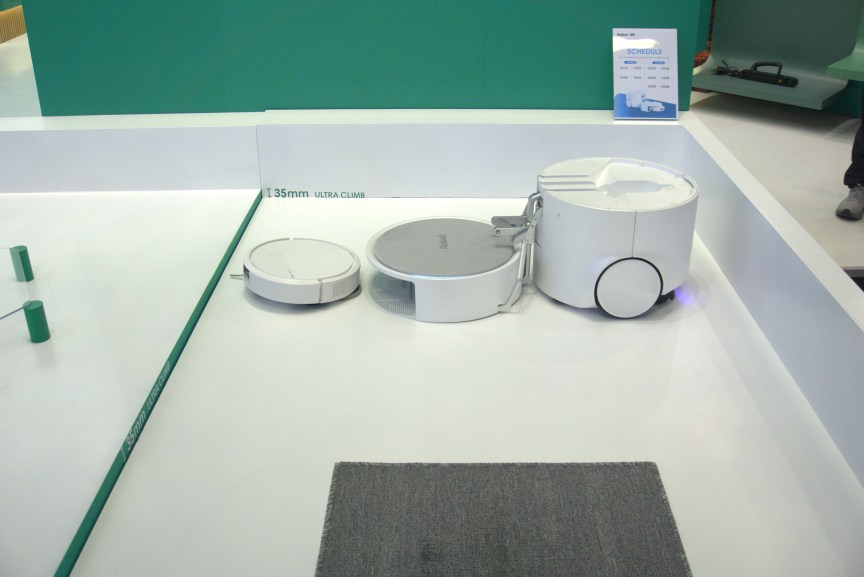
After the main unit finished its heavier cleaning job, it moved closer to its docking area while the smaller Roomba puttered around, cleaning corners and navigating iRobot’s barriers.
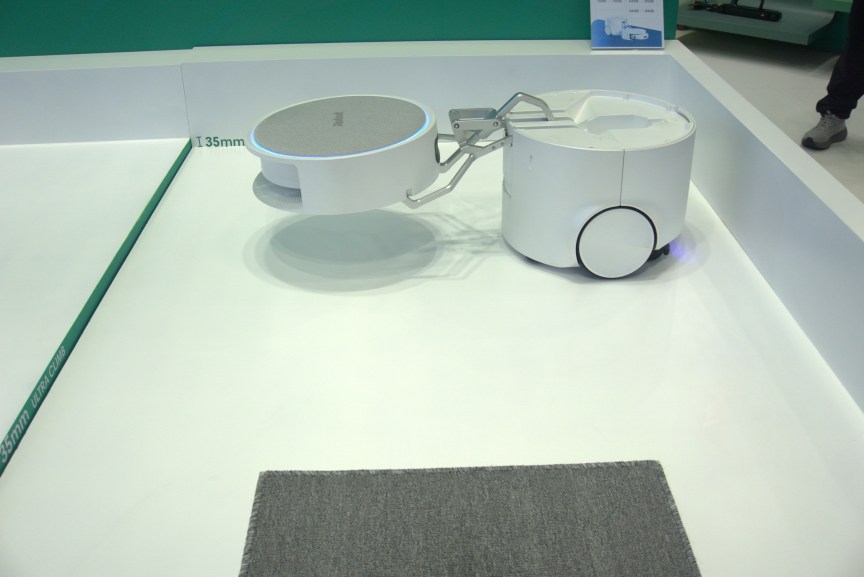
Both units operate autonomously, but they share a home map and an autonomous mobile dock, so they won’t duplicate efforts. They communicate in real time and are connected via the Rooma Home app, which uses AI to coordinate cleaning tasks. iRobot says the main unit vacuums and mops the large, open floor areas, while the slim baby Roomba goes under furniture and into narrow spaces the bulky main module can’t reach.
While this is just a concept product with no indication it’ll come to market, iRobot did share some specs with us. The main mothership has a wet-and-dry floor-washing module, a high-performance motor, and a high-capacity battery. It also uses the company’s PowerSpin Max Roller map, applying 46 newtons of downward pressure, which is a huge jump from the 12 to 14 newtons you typically get from a robot vacuum. iRobot says it scrubs the floor as thoroughly as if you were cleaning by hand.
It also has an internal heater that generates steam to loosen tougher, dried-on grime and stains. The roller is self-cleaning, as we’ve come to expect and iRobot says it can handle everything from dirt to pasta sauce and cooking grease. There’s also a hot-air dryer behind the roller that dries the floor after the roller is done mopping, so the wood flooring doesn’t get damaged by moisture.
The companion robot used for the demo is the Roomba Plus 575 Combo, which we covered after it launched earlier this year. It’s just 8.35 centimeters tall and 29.8 centimeters wide, making it one of the slimmest models we’ve seen, which is why it was selected as the companion unit. Right now, it’s not clear whether the mothership can accommodate other robot vacuum models, but I would guess it’s only compatible with this one for now.
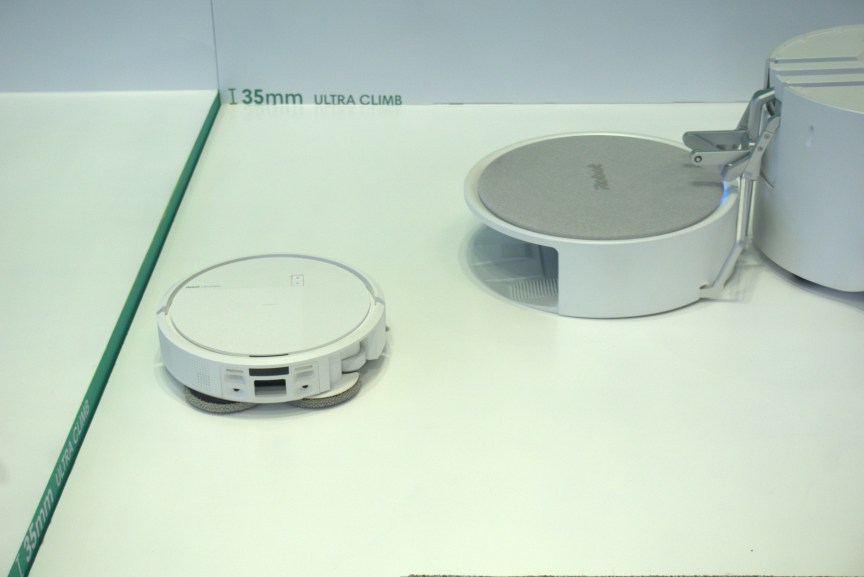
The main Duo unit is equipped with the company’s ClearView Pro dual-line lidar and AI to detect and navigate household objects. It also has a top-mounted AI camera, giving it a better, higher view of rooms and floor layouts, and creating more detailed maps than a standard robot vacuum. It should also be able to better identify stains.
To move this fairly bulky unit, it uses 17-centimeter wheels powered by hub motors. There’s a shared AutoWash dock (the self-emptying and cleaning docking station that most newer Roomba models use). It has a centralized clean water supply, a waste water tank, and like a standard stationary dock, it automatically washes and dries the mop and collects dust in a dustbag, letting you go months before it needs to be emptied.

See full bio
Read the full article here