



I could see the whole room in front of me in surprisingly crisp color video detail, while looking at a grid of apps in front of me. Selecting an app with my eyes and a pinch of my fingers, I launched a 3D Billie Eilish concert video. Then I watched an immersive NBA game that stretched all around me. Was I on the Apple Vision Pro? No, I was wearing a pair of Meta VR Glasses, Meta’s $1,299 reimagining of its VR ecosystem coming next spring that feels like one part Apple, one part Meta Quest and one part AR glasses that haven’t been built yet.
Despite releasing waves of smart glasses over the last few years and ditching games studios, software initiatives and fitness apps, including Supernatural earlier this year, Meta’s not done with VR. But the Meta VR Glasses are a very different proposition than the Quest: in price, in design, in portability and in ambition. They’re not AR glasses, like Meta’s Orion prototype I tried two years ago. But they are a VR headset in glasses form, and share a lot in common with the Orion.
I felt echoes of other products as I slipped Meta’s new visor-like pair of VR glasses over my head. An Apple Vision Pro that’s been put onto folding glasses. No: a Meta Quest Pro shrunken down. Or, the Xreal Aura I tried earlier this year. The Meta VR Glasses – yes, that’s their real name – feel like they’re straddling gadget categories. And they’re pushing a price Meta hasn’t tried for in years.
Ultraportable VR
The best point of comparison for the Meta VR Glasses might be the now-discontinued Quest Pro, from their small size to their vivid displays and eye- and hand-tracking controls. But they’re also oddly evolutionary, like many other recent VR/AR products I’ve tried.
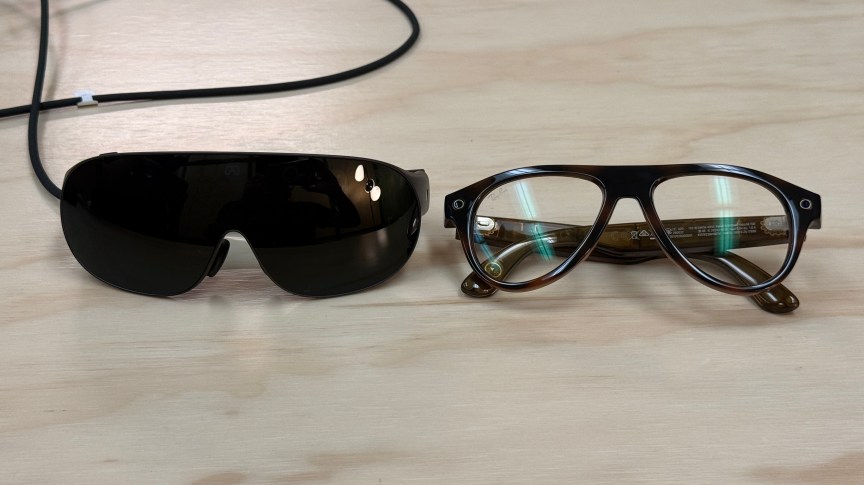
The magnesium frame glasses-like visor looks minimal compared to any other VR headset, but I’ve seen this form before. I wore another “VR glasses” device called the URXR One back in June.
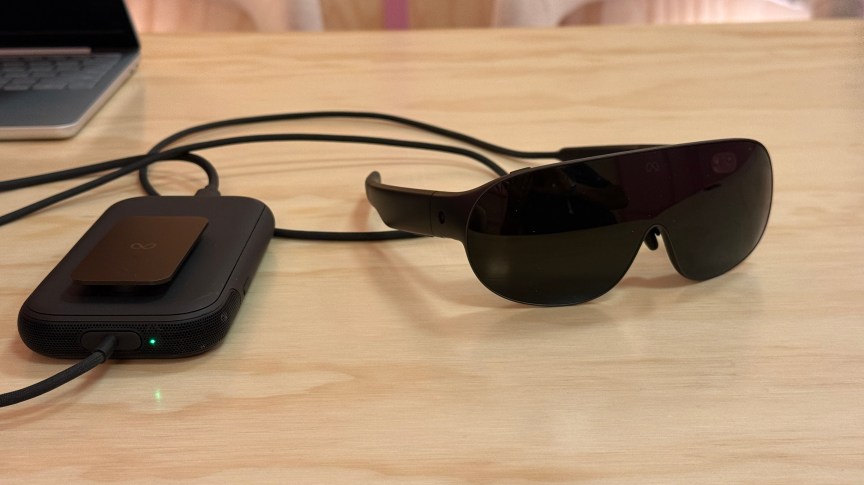
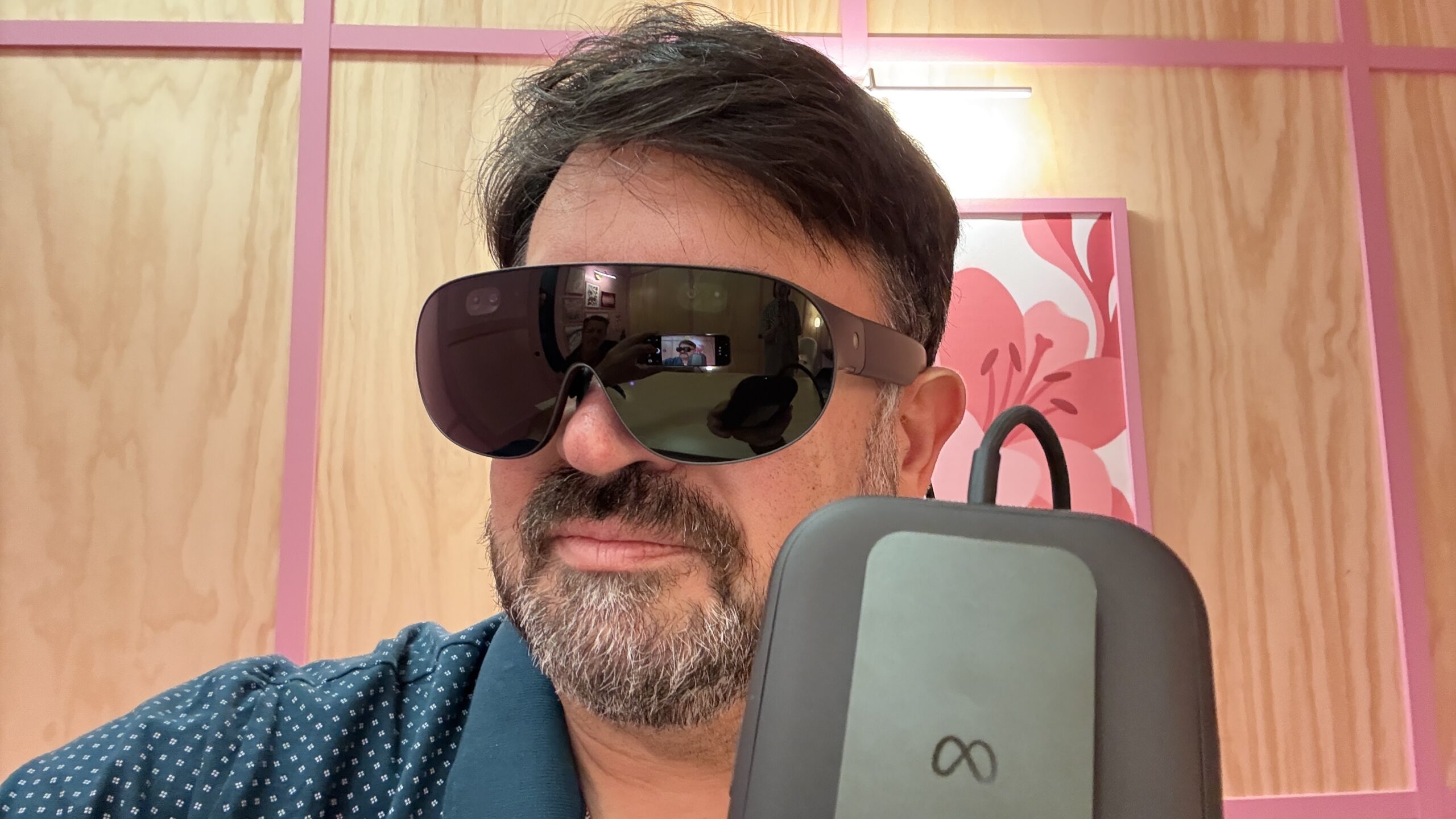
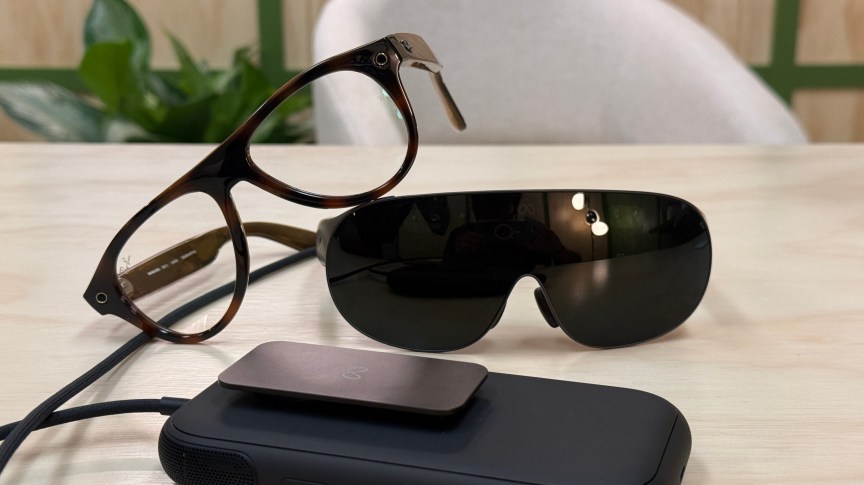
I felt like I was wearing a smaller, like a sliced-off front end of an Apple Vision Pro, bonded to a pair of glasses’ arms. The curved front visor is studded with cameras and sensors that can sense movement in front of and well below my field of view: I could gently pinch my fingers while resting them on the table, the sort of lazy interactions I can do on the Vision Pro. Volume buttons and another control button are embedded in the arms.
The processor puck is where the one USB-C passthrough port is located, and devices that input through it can stream that device into the VR environment, something I didn’t get to try. The puck comes with 128GB of storage, but also has a MicroSD card slot for expandable storage, which requires higher-speed cards. Still, it’s a first for Meta’s VR headsets.
The color passthrough video quality, which makes virtual experiences look projected into the room like augmented reality, was a big notch up from the Quest 3. It felt close to where Samsung and Apple are with their more expensive headsets.
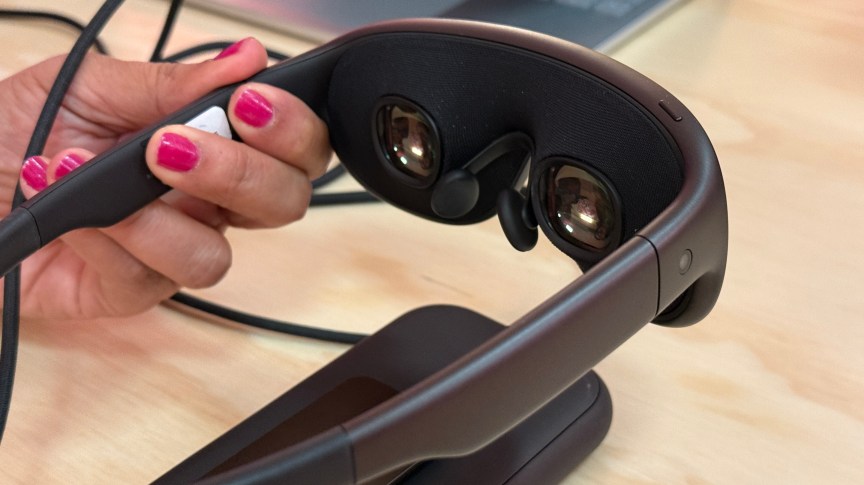
Meta scanned my eyeglasses to provide prescription lens inserts that matched my vision. The inserts fit into the clear pancake lenses in the visor, which were covered in a soft mesh much like the inside of the Vision Pro headset. The Meta VR glasses fit well on my face, too, and they’re far lighter than wearing a Quest 3. They’re 100 grams, which is heavy for glasses but very, very light for a VR headset. They come in two different sizes, but I’m not sure which one I tried.
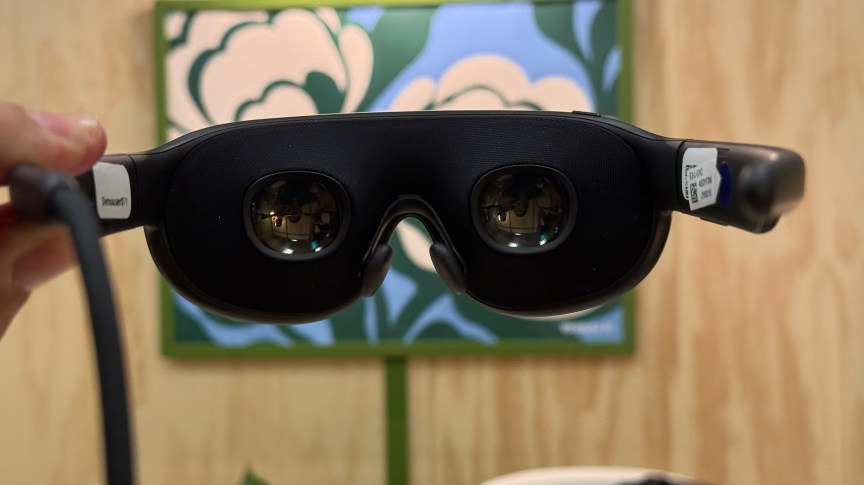
My hands-on time with the Meta VR Glasses
I controlled everything with my hands and eyes, because the Meta VR Glasses don’t come with any controllers at all. They’ll work with Meta Quest controllers, and new controllers will be sold separately, but the whole device is designed to work controller-free. Meta’s promising a series of new optimized games for the headset that will be eye and hand-tracking controlled, too.
I played one of them: a new version of Meta’s classic VR-lightsaber fitness game Beat Saber called Beat Saber Flux, which is arriving next year to time with the glasses. Flux has no sabers at all, actually. Instead, the game tracked my hands as I formed energy fields to punch and slice through oncoming waves of targets. It reminded me more of rhythm games like Synth Riders and Supernatural, but also was a good demo of the headset’s hand tracking chops.

I also tried casting multiple virtual monitors in front of me from a wirelessly connected laptop, something you can already do on the Quest and headsets like the Vision Pro and Samsung’s Galaxy XR. But it’s the smaller size of the Meta VR Glasses that makes this achievement seem particularly impressive.
I typed on a virtual keyboard projected directly onto the table in front of me, a trick Quest headsets can already do but which looked more impressive on Meta’s VR Glasses, particularly since the keyboard really looked as though it had been projected onto the table. It was properly positioned over my hands with realistic occlusion effects. But I don’t know how well it would work beyond my rapid hunt and pecking.
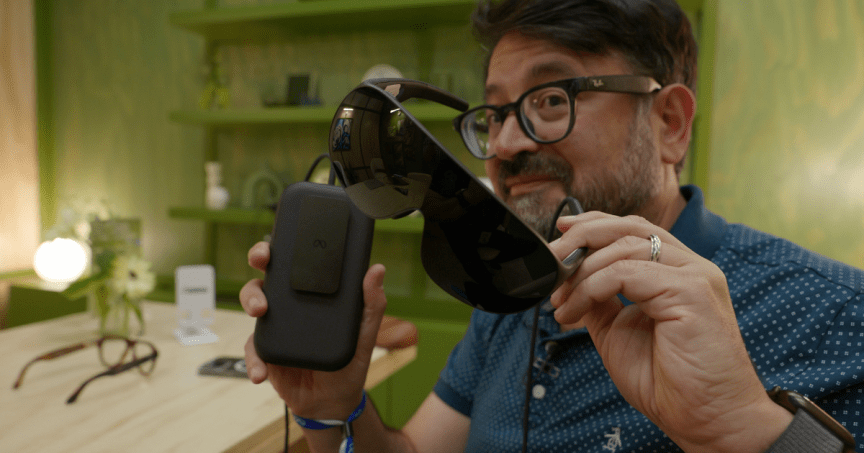
Navigating Meta’s hand and eye tracking interfaces felt fine, and again, very Apple Vision-esque. But also like Meta’s neural band hand gestures for its Ray-Ban Display glasses. Taps and thumb-swipes on my closed fist handled scrolling around, but I found that pinch-and-pull gestures in the air worked for scrolling too. It wasn’t always that easy to make out on-screen indicators of where my eyes were looking, though: Sometimes icons got a little bigger or wiggled, but not always.
Meta promises a 3-hour battery life with the included processor puck, which can fast recharge at 45W. It runs off a Qualcomm Snapdragon Reality Elite chipset, the same one that’s in Xreal’s upcoming processor puck-tethered, VR-like pair of Android XR glasses, Xreal Aura.
A clear display upgrade
In a half-hour demo session at Meta’s Connect developer conference, I watched a series of movie clips and videos meant to show off the quality of the headset as a portable cinema. The twin micro OLED displays with a combined effective 5K resolution felt as vivid as that of a Vision Pro, to my memory, but with a smaller 84-degree field of view. They’re 2,412×2,288 pixels per eye.
Watching a few movies on the Meta VR Glasses looked better than anything I’ve seen on Quest headsets, and clearly offers a step-up to approach the good-enough-for-home-cinema feel I get in the Vision Pro.

Meta’s promising lots of streaming video app support. I viewed a series of brief Disney interactive environments for some of its streaming movies, which tried to give me a taste of something more immersive than what’s already on the Vision Pro and Quest’s Disney Plus app. As I watched Avengers: Infinity War, my room was engulfed by parts of the stellar forge Nidavellir while a scene between Thor and Peter Dinklage’s dwarf king Eitri played on a big virtual movie screen. At one point, Groot also popped out in 3D beyond the screen’s dimensions.
The displays and spatial audio are Dolby Atmos and Dolby Vision capable, and Meta’s touting that the headset is certified for Imax film viewing in the proper aspect ratio. Meta’s launching its own movie store with these VR glasses, and it’ll also be available on Quest headsets.
In a sense, the Meta VR Glasses almost remind me of smaller micro OLED-equipped display glasses like the ones made by Viture and Xreal. They especially resemble Xreal’s upcoming Aura glasses, which I’ve tried several times and run Google’s Android XR operating system and connect to a processing puck. Aura’s field of view is even smaller at 70 degrees, but it’s more like a pair of display glasses that are remarkably VR-like. Meta’s headset feels like a VR headset that’s remarkably glasses-like. The two sort of meet in the middle.

Holograms for chat, at last
A demo I tried in a separate session showed me something Meta’s been promising for years: realistic 3D avatars for video chat, much like what Apple already has in its Vision Pro Personas. Meta showed me early prototypes of its “Codec Avatar” vision for hyper-real avatar embodiment back in 2022 at its research labs, but the new Holograms feel like a slice of that, aimed at working on both VR Glasses, Quest headsets, and even Meta’s Ray-Ban Displays in its smaller 2D screen.
I was actually blown away by my Holograms demo, because what I saw didn’t look like uncannily real people: they looked exactly like real people, as if appearing in a video chat in front of me. A quick head scan and recording of my voice and expressions (mostly with smiling or positive emotions expressed) on a phone app led to a 3D scan of myself that then appeared inside VR Glasses when I made a WhatsApp call to a Meta team member. I couldn’t see myself, but I did see them appear in front of me, first as a 3D torso in a window, then opening out to stand in the room with me, legs and all, when I tapped an icon in my chat window.
It looked like a volumetric video capture of someone, not an artificial scan. And while Holograms currently animate body movement using AI to interpret voice tone, they’ll eventually have body tracking using the VR Glasses’ downward-facing cameras, which track both face and body movements. It seemed like they were in the room, right by a table in front of me…but turning in a ghostly manner to keep facing me no matter which way I turned.
Holograms are going to launch alongside Meta VR Glasses, but also get tested as a Met Ray-Ban Display feature in beta later this year for WhatsApp calling. The technology leans heavily on cloud compute, using stable diffusion versus Gaussian splatting like Apple’s Personas uses. I’ve never seen a more realistic deepfaked version of myself before.
The start of a new phase for VR and AR?
My time with the Meta VR Glasses impressed me, especially compared to other recent VR devices and display glasses I’ve tried, and I immediately thought about what it would be like to travel with them. But their unusual design and higher price, clearly aimed at making a premium experience for movie-watching, immersive HD video and wearable displays, is a risk. It’s a play that Meta hasn’t made since the Quest Pro was released back in 2022.
Would I use the Meta VR Glasses for work? Maybe. I like that they can also connect directly to a laptop, phone or any other UBS-C device with video out to turn them into a portable display, but Xreal Aura will do that too. I also like that they’ll run all the Quest apps I already use, but Meta’s still facing an uphill battle over all the Android and iOS apps Google and Apple’s XR devices can tap into.
I feel more comfortable with Meta as a wear-sometimes device maker in the VR space. I’m much less happy with Meta as a broker of some sort of always-on glasses-based personal assistant (which is where all the AI glasses are headed). But, clearly, those categories are merging, slowly. The VR Glasses feel like an early herald of the attempted merge.
Which raises my final question: Are the Meta VR Glasses a premium upgrade for Quest owners, a portable upsell or a pitch to reach people who’ve never tried VR or AR before? I definitely found them more wearable than any Quest headset, with no pressure on my face and a more casual comfort.
I kept thinking about Valve’s recently released Steam Frame, a headset that costs a similar amount but has a more traditional but modular VR headset design. Valve’s Frame wants to push Steam into new forms. Meta’s VR Glasses are aiming to push the Quest library into new forms, too. And then there are Xreal’s similar Aura glasses coming this fall, and even Snap Specs, which are full augmented reality glasses with clear lenses but have no processor puck tether at all.
They all want to come with me on a trip. Which would I actually take? Or afford? Meta VR Glasses aren’t even on sale until next spring, but I’m already wondering if they’ll be something I’d pick over alternatives, or whether Meta’s VR glasses flex is more of a stepping stone to AR glasses the company can’t quite make happen yet. But I want another go in them, for sure. And I’d love to travel with them next year.

See full bio
Read the full article here