

Robyn Wuth
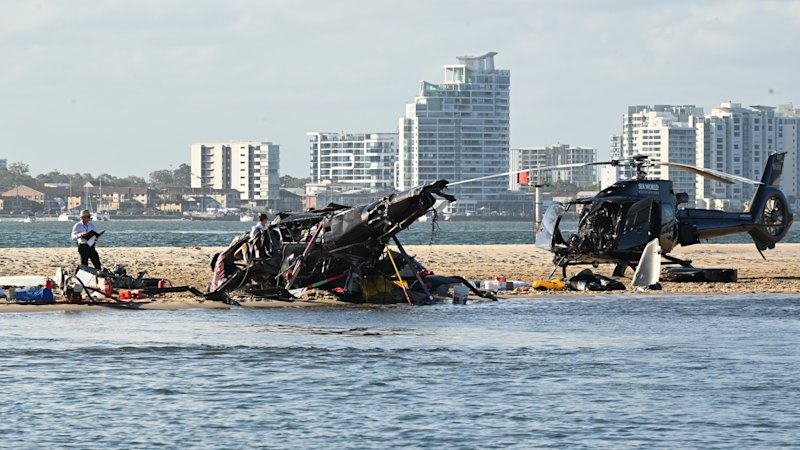
Tourist helicopter joyrides outside one of Australia’s biggest theme parks have undergone a safety overhaul since a mid‑air crash killed four people.
Three tourists and Sea World Helicopters pilot Ashley Jenkinson were killed in a mid-air collision between two helicopters near the Gold Coast theme park on January 2, 2023.
Current chief pilot and head of operations Ben Hall – a long‑time colleague and friend of Jenkinson – said the company now operating as Surfers Paradise Helicopters had brought in a suite of new controls aimed at preventing another collision in the busy Broadwater airspace.
The firm now records radio calls from its operations to ensure pilots are broadcasting at the right times and positions, Hall told the Queensland Coroners Court on Wednesday.
The real-life recordings were used as a training and surveillance tool during flight reviews or proficiency checks with pilots, he said.
The company had also adopted “sterile cockpit” procedures, requiring passengers to remain quiet during take‑off and landing so flight crews can focus on checklists and radio calls.
Pilots must now ensure sterile cockpit conditions below 500 feet (150 metres) on departure and approach to reduce potential distractions.
The inquest heard the joyflight company also formalised and expanded the role of a “pad boss” on the helipad, with specially trained staff using two radios – a UHF set to speak directly with pilots and a VHF handheld to monitor calls across the general aviation frequency.
Pad bosses are trained to listen for key taxi and airborne broadcasts and to radio pilots if expected calls are missed, while scanning for other hazards such as boats, birds and other aircraft near the pads.
Sea World Helicopters was running about 7500 flights a year at the time of the crash, but that number had since fallen, the inquest heard.
“It’s a demand‑based business,” Hall said.
“If tourism increased on the Gold Coast, then our flight numbers would increase.”
Hall, who had known Jenkinson since about 2008, said the pair worked together as line pilots in central Australia and later crossed paths in Melbourne and on the Gold Coast, socialising at parties and dinners over many years.
He described Jenkinson as “a very likeable fella” who was kind, polite and professional, saying nothing in their friendship had suggested an interest in illicit drugs.
Hall told the court he was shocked to learn of evidence that Jenkinson had taken cocaine in the lead‑up to the fatal flight.
“We spent a lot of time socialising and attending parties, social events together, restaurant dinners,” he said.
“Throughout that whole time, there was never any discussion or talk about any drugs.”
Hall became chief pilot in August 2023, months after the crash, in his first chief pilot role.
The inquest previously heard pilots describe the Gold Coast Broadwater as a busy, unforgiving environment where they had to “keep their head on a swivel” and rely on looking out the window to avoid conflict, with multiple helicopters operating from closely spaced pads near the theme park.
But the aviation safety authority’s air navigation boss, Adrian Slootjes, told the inquest a formal, data‑driven review found the Gold Coast airspace was appropriately controlled and operating safely, with no present need for a manned control tower.
“Nothing eliminates risk – nothing that we do here eliminates risk,” Mr Slootjes said.
Sea World owner Village Roadshow Theme Parks sold its joy flights operation to Sea World Helicopters in 2019. The firm dumped the Sea World name on July 1.
From our partners
Read the full article here