




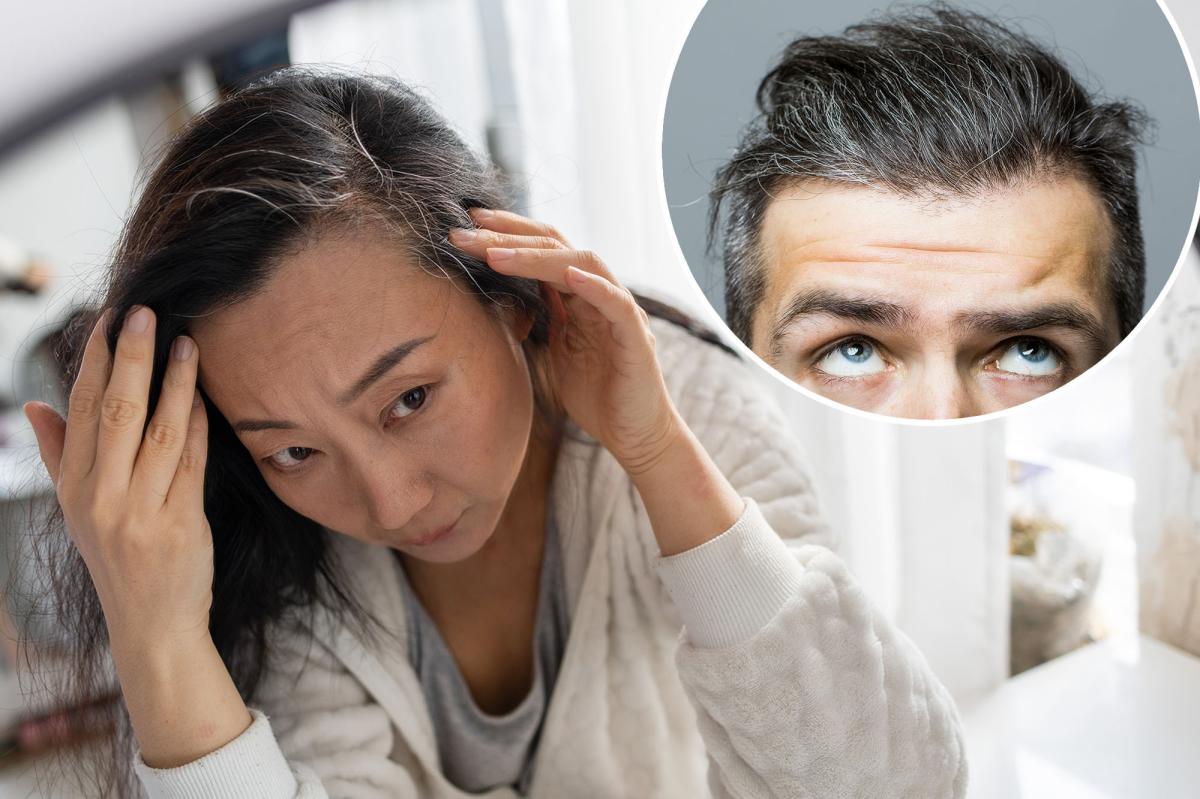
Haircare experts are going for a silver metal.
Emerging research says that it may be possible to reverse the effects of greying hair without dye-ing for a solution. That’s according to Spanish doctors who recently noticed that as their lung cancer patients began to recover thanks to new immunotherapy drugs, their hair began gaining pigment, too.
At first, the scientists thought it was a fluke — until they realized that even patients outside their care were getting their hair color back after taking new treatment drugs like Keytruda, Opdivo and Tecentriq. That led University of Alabama scientist Melissa Harris to start digging into ways to help anyone with an automated Clairol refill on Amazon.
So, when will going grey be passé? Sooner than you think.
For starters, less than 25% of people have a significant amount of grey hair by age 50, according to a 2012 study in the British Journal of Dermatology. But nearly 90% of us do have some pigment loss before hitting the big 5-0.
That’s due to melanocytes, the pigment cells living inside your hair follicles that pump color into every strand as it grows. They’re supposed to keep getting fueled by a backup crew of melanocyte stem cells, but factors like stress, fatigue, and our bodies’ aging repair cycles get in the way. Eventually, the pigment cycle gets depleted beyond repair, and the body doesn’t create new melanin, the colorful cell byproduct that also determines our skin and eye color.
Another big factor is genetics, which means if your grandmother was Cruella de Vil, you’ll inherit more than her spotted fur coat — you’ll also get her signature shock of white hair. (Speaking of dogs, they, too, can go grey, getting a “sugar face” around the muzzle or, in the case of some huskies and hounds, a white streak along their back.)
Scientists think that immunotherapy drug treatments help with greying hair because they’re designed to reawaken and strengthen the body’s existing stem cells, which act as tiny maintenance men that clear debris, repair damage, and restart natural healing cycles. (Think of it this way: If your body is an apartment building, stem cells are your supers.) While the drugs were created for the crucial work of helping stop cancer, a side effect is rebooting the pigmentation process for hair strands.
At the University of Alabama, Harris and her team are isolating the immunotherapy treatments for hair pigment alone. But they haven’t yet tested their findings on human subjects, which means it’ll be months — at minimum — before we know how this can apply to the average shampoo-er.
Until then, some new supplements have hit the market, promising to reverse our grey matter. In 2021, a supplement called Arey hit the market with claims that it could “repigment” hair beginning to desaturate by reducing oxidative stress, the main cause of early hair greying.
Tech guru and longevity junkie Bryan Johnson told followers in March that he was using a blend of the melanin-stimulating GR-7 serum that claims to be a superfood for melanocytes, along with Mayraki, a peptide serum made from fo-ti root, a key ingredient in herbal Asian medicine that showed some promise in 2015 studies to keep strands in living color.
Of course, some people see grey hair as a sex symbol — and with good reason.
In the 1920s, baseball pitcher Jessee Petty earned the nickname “the silver fox” due to his grey hair and sleek physical form; the term is now an easy descriptor for dudes who get hotter as they age, including actors like George Clooney and Idris Elba.
Meanwhile, Andie MacDowell and Salma Hayek continue to maintain bombshell status even as they become grey ladies. In January, 50-year-old model Stephanie Cavalli opened the Chanel couture show with her natural grey hair on full view. (The upstate New Yorker told Vogue she was “walking on clouds” from the experience.)
Scientists also think grey hair has an evolutionary advantage: Male silverback gorillas are seen as the most powerful in their troop because they have earned the trust of their peers and the lived experience of battle.
And in 1998, a research journal proposed the “grandmother hypothesis” that older-looking women were prioritized in early human tribes because their ancestral knowledge and social adeptness boosted the entire community’s odds of survival.
The silver-tressed fan favorite Queen Charlotte on “Bridgerton” would agree. So would Jennifer Lopez and Sarah Jessica Parker, both of whom have rocked grey hair on recent red carpets.
But if you’re not ready to white-out your roots just yet, know that science will soon have your back. Or rather, your scalp.
Read the full article here