



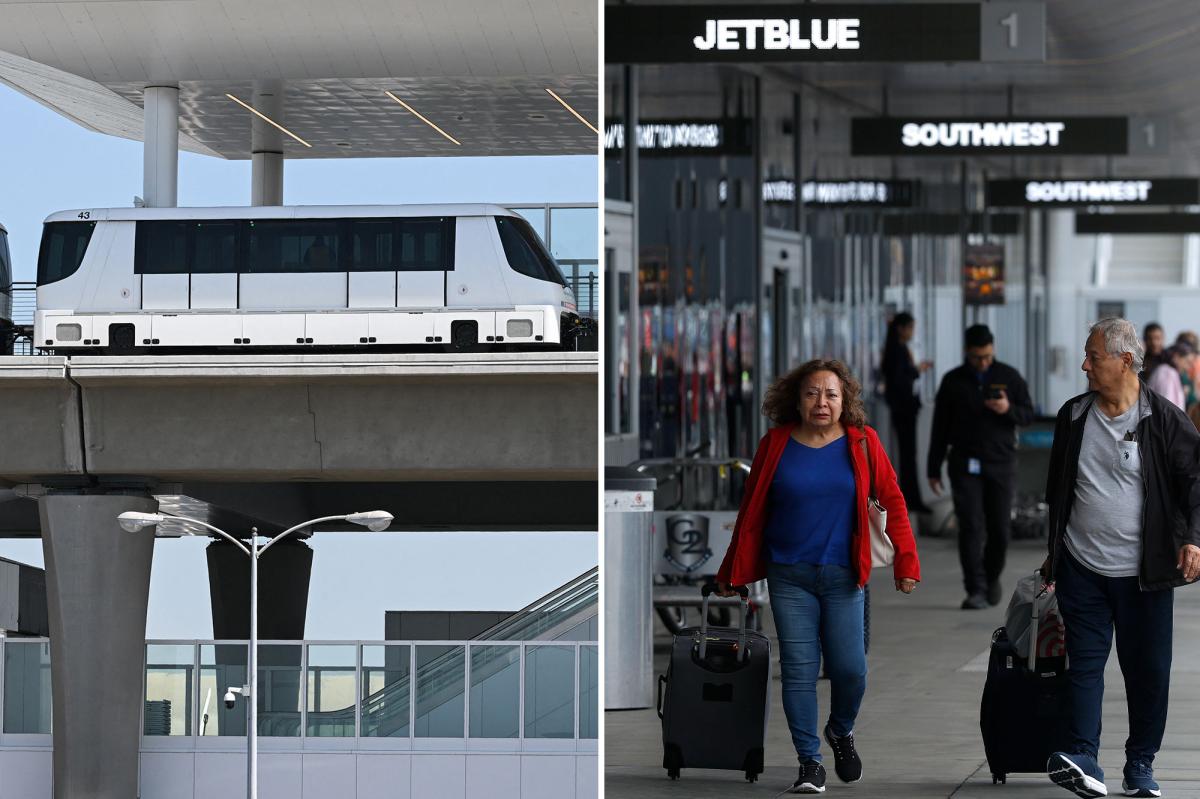
Travelers passing through Los Angeles International Airport may soon spot something unusual: empty trains zipping overhead.
Beginning Monday, the long-delayed Automated People Mover will enter a critical “simulated operations” phase, even as disputes over costs continue on the ground below.
The test will send vacant train cars along the system’s 2.25-mile elevated track around the clock, mirroring the exact 24/7 schedule planned for real passengers, according to a report by LAist.
Airport executive Jake Adams described the upcoming trial to FOX11 as intense, with “tons of trains running up and down the guideway” to replicate real-world conditions.
The high-tech system, designed to connect terminals, parking areas, a rental car hub and the Metro, has been years in the making.
Construction began in 2019, with an original debut slated for 2023.
That deadline came and went.
Now, officials say the testing window will stretch across the next 60 days, during which the system must achieve a flawless 30-day streak of uninterrupted service.
Any significant failure, like a train breakdown, will reset the clock entirely.
Even smaller glitches, such as doors failing to open properly, could count as a “hiccup,” Adams said.
Only after clearing that hurdle can airport leaders move toward announcing a public opening date.
For now, that date remains a mystery, and increasingly unlikely to arrive before the FIFA World Cup this June.
The $3.34 billion transit project, which is roughly 95% complete, has been bogged down by ongoing financial and technical disputes between Los Angeles World Airports and contractor LAX Integrated Express Solutions, part of the LINXS consortium.
The additional work will cost $36 million according to public records obtained by LAist.
When it finally launches, the automated train will be free to use for ticketed passengers, guests and employees.
It will operate a fleet of 44 cars organized into nine four-car trains, each capable of carrying up to 200 riders at speeds reaching 47 mph.
The system will serve six stations, three within the Central Terminal Area and three beyond it.
After the testing phase wraps, officials will review performance data to determine whether the long-awaited system is ready for prime time.
Read the full article here