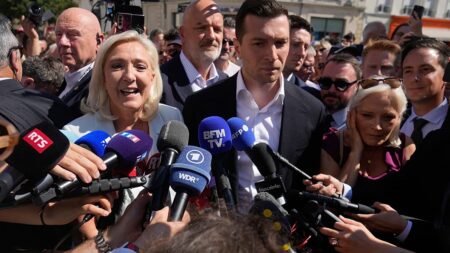




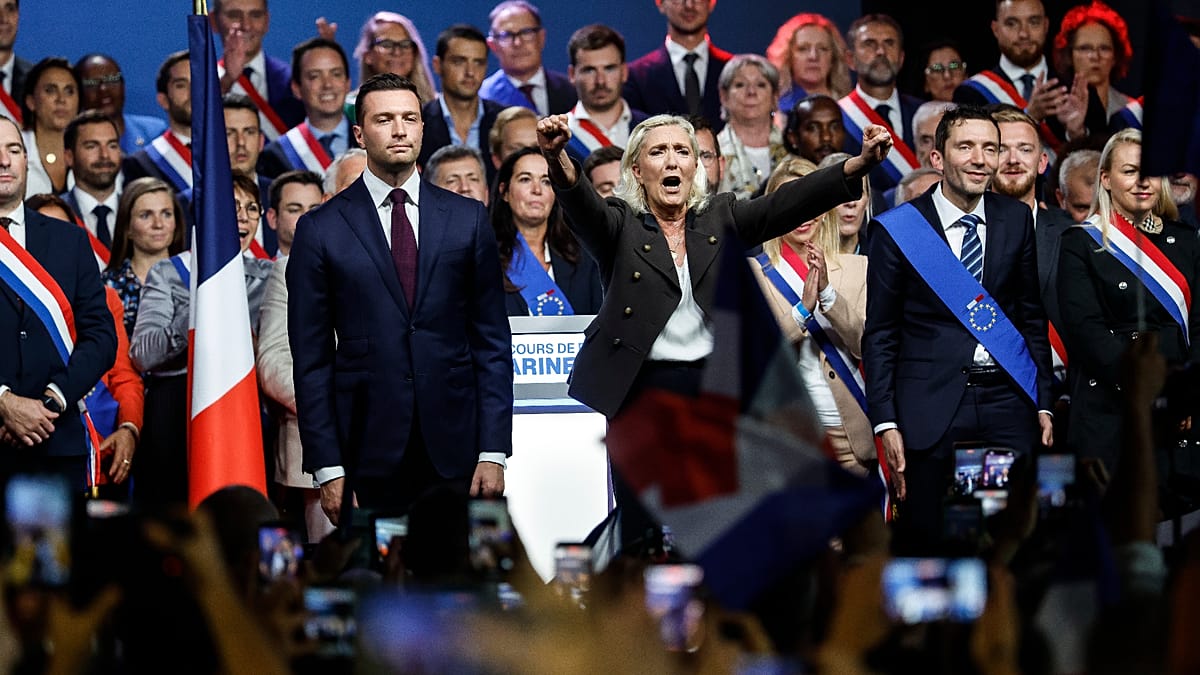
Marine Le Pen put housing and the cost-of-living crisis at the heart of her presidential campaign on Sunday, using her first major speech in the former northern mining town of Hénin-Beaumont to promise French citizens that they would come “first in their own country” — regardless of skin colour, religion or origin.
“We will guarantee all French citizens a natural and fair right, as is done in every country in the world,” said the far-right National Rally party’s figurehead, stating that French nationals would have “more rights in France than others” under her leadership.
Le Pen announced that the policy of “national priority” would apply to housing, notably in terms of access to social housing.
The presidential hopeful also railed against the cost-of-living crisis, pledging to fix issues in the social housing sector, as well as in the private realm — pointing a finger at environmental and administrative restrictions governing planning laws.
She also told her supporters that she promised to cut VAT from 20% to 5.5% for gas, electricity and heating oil, while also chastising taxes: “Where is the money going when taxes and levies are getting heavier while the services delivered to French citizens are crumbling?”
Hénin-Beaumont: The National Rally’s stronghold
Over the years, Hénin-Beaumont, which has an estimated population of 26,000 people, has become a National Rally stronghold. Its mayor, Steeve Briois, has been in power for 14 years, while Le Pen has represented the Pas-de-Calais department — where the town is located — since 2017 in France’s National Assembly.
Almost 20 years prior, she won her first political mandate as a regional councillor for the Nord-Pas-de-Calais region (which has now become Hauts-de-France) in 1998.
“How can I express my gratitude at seeing so many of you this year again, here, on this beautiful patriotic former mining land,” Le Pen told the crowd on Sunday.
National Rally deputy and party spokesperson Laurent Jacobelli told Euronews that in his view, it’s clear why the party has won over locals.
“The Pas-de-Calais region was formerly a mining hub, where people worked hard, paid their taxes, and gave everything to France to support their families and build homes. But they were violently let down by globalisation, by the failure of public services. Here we understood that sovereignty means something, that homeland and the nation are important values,” he told Euronews.
“This is why Marine Le Pen has won over voters: because she is proving that sovereignty and re-industrialisation are achievable.”
Although Jordan Bardella — who is running to become France’s next prime minister — did not address the crowd on Sunday, Le Pen got supporters to sing “Happy Birthday” to him. A show of unity, amid rumours about possible tensions between the two National Rally figureheads .
What do locals think of the National Rally?
Le Pen had a busy weekend: before heading to Hénin-Beaumont on Sunday, she met with MPs from her party for a closed-door political meeting in the coastal town of Le Touquet on Saturday.
But for locals, Le Pen’s visit was not the only item on the agenda: Sunday also marked the town’s annual flea market. Although Le Pen’s parade was cancelled due to “meteorological conditions”, locals and residents from neighbouring towns still turned out in force to sell their second-hand goods, remaining undeterred by the rain.
Local resident Cathy told Euronews that there was a time when the National Rally party’s positions were “harder to defend”, but that this is no longer her view today, describing Marine Le Pen as “very brave”.
Jean-Marie Le Pen, the founder of the National Front (which preceded the National Rally) faced frequent legal challenges for racism, hate speech, and Holocaust denial. Since she took over the party, his daughter, Marine Le Pen, has gone to significant lengths to normalise its image — both at home and abroad — as part of an effort to distance it from her father’s legacy.
Last week, the National Rally party found itself in the crossfire when the French regional newspaper Midi Libre released a video filmed in November 2025, which showed several municipal police officers in Carcassonne making racist, sexist and conspiracy-related comments during a night-time patrol.
Although the emergence of the video made headlines across France, local supporters said they either hadn’t heard of it or didn’t attribute much importance to it.
“I don’t think that just because we vote for Marine Le Pen that we are racists,” responded Antoine, a 19-year-old National Rally activist, who did not comment on the specificities of the video when asked.
Meanwhile, many locals, such as policeman Laurent, said they firmly backed Le Pen. For him, she fits his ideal presidential brief: “someone who prioritises national interests and fights for the people.”
For Catherine, a local who works in Lille, local authorities do a good job keeping the city safe, clean and with plenty of activities for young and old alike.
Multiple residents also praised local tax rates — the local council has repeatedly lowered the municipal property tax rate on buildings.
When questioned about Marine Le Pen’s 2027 presidential bid, lots of locals said they supported her but either refrained from commenting on her specific policy proposals at a national level, or said they weren’t aware of the finer details.
One recent retiree, who has lived in Hénin-Beaumont for the past 25 years and spoke to Euronews on condition of anonymity, said that the National Rally was doing all in its power to “dazzle” locals.”
“Many businesses here are run by Algerians, Moroccans, and Tunisians. Some people think that if the National Rally is voted in, then all the Arabs will leave, but we are French, we have French passports, and many of us are dual nationals.”
“I know that many of my neighbours vote for the National Rally, but I turn a blind eye. We do know how to live together here, as a community,” she said.
For Sana, a Spanish-Moroccan local business owner, Marine Le Pen’s proposal to hold a referendum to ban the hijab in all public spaces is not a measure she can stand by.
“I don’t wear a headscarf, but for the rights of other women, I am against this kind of measure,” she told Euronews.
Meanwhile, activists from the anti-fascist collective of the mining area (Collectif Anti-Fasciste du Bassin Minier) set up a protest banner outside the Hénin-Beaumont train station on Sunday.
Activist Ludivine told Euronews that there are plenty of residents in Marine Le Pen’s constituency who “firmly stand against the far-right.”
“We are in post-industrial abandoned areas, where unemployment is rising, so the narrative that this is all because of the National Rally’s various scapegoats is rising very quickly,” she said.
Fellow activist Laurence stressed, “the fact the National Rally is in power does not remove the fact that plenty of people are unhappy; they may just stay quiet, be scared, or not know how to express their opposition and resistance to the horrible and dangerous ideas espoused by this party.
When asked about his opinion about the National Rally, one local businessman said that he did not want to speak — even on the condition of anonymity — out of fear he would have “issues” with local authorities.
Read the full article here