



Last week, Lethbridge, Alta., city council met during a community issues committee (CIC) to discuss, among other topics, the ongoing integrated fire/EMS funding model.
Earlier this year, the province told the city it will have to make a decision — spend more to keep the current, 114-year-old model, or allow Emergency Health Services Alberta to find cost savings, which could lead to splitting the fire department from ground ambulance services.
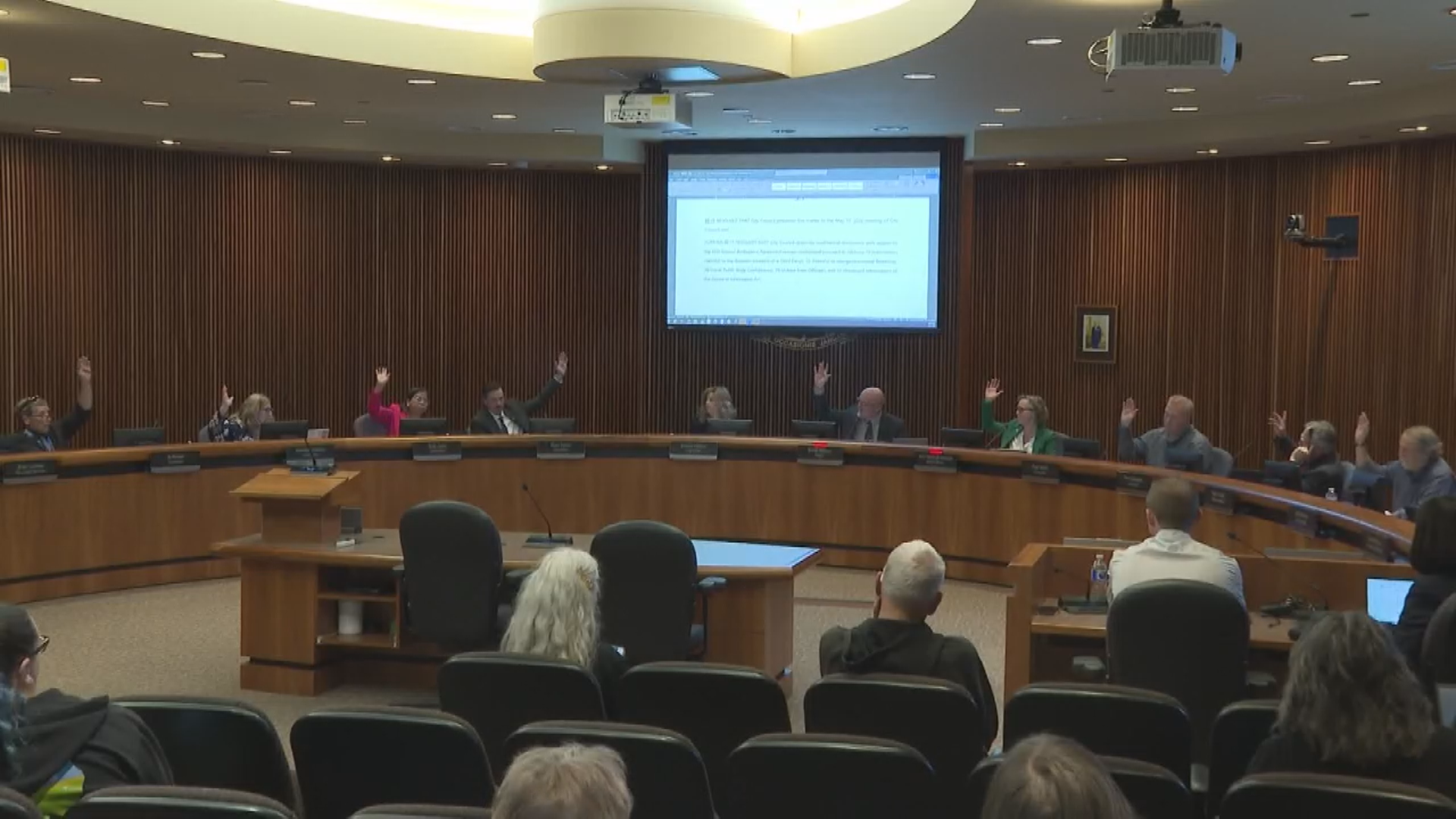
During the April 30 CIC meeting, council voted 5-4 to reject the provinces proposal. This meant Lethbridge’s council was refusing to pay more, which by default would mean it could lose the integrated service.
However, during a special council meeting on May 5, that vote was declared moot.
Council released previously confidential information indicating it had met on March 24, where all nine councillors voted to reject the province’s proposal.
It was the same outcome, effectively voiding the April 30 vote.
“That decision was already made on March 24th, so we reiterated the decision,” said Blaine Hyggen, Lethbridge mayor.
While this in itself doesn’t officially change anything, the fact four councillors changed their minds did give council something to think about.
“Fast forward to April 30th, you saw what happened, we discussed it again. You can see how different thoughts have changed,” said Hyggen.
Council voted on Tuesday to postpone a concrete decision to May 12. Part of the reasoning was that councillor and acting mayor Jenn Schmidt-Rempel announced she will be bringing forward a motion to rescind the March 24th vote.

Get daily National news
Get daily Canada news delivered to your inbox so you’ll never miss the day’s top stories.
It will require a two-thirds majority to pass.
If it does pass, council will be back to square one, with no official stance on the province’s proposal.
“We don’t want to accept what the province is going to give us, but we want to be able to have the opportunity to continue the service we have within the community of Lethbridge,” said Hyggen.
They have until the end of May to give the provincial government an answer.
This slight change in direction has given a bit of hope to firefighter-paramedics in Lethbridge.
“Members of this community now have more chance, more opportunity to let mayor and council know the integrated system that saves the lives of their families is important,” said Brent Nunweiler, president of the Local IAFF 237 firefighters union.
Nunweiler admits the decision is stressful for the 70 or so employees who could have their jobs affected by the decision. However, he promises they won’t stop working in the meantime.
“Our members are still showing up every day, doing what this community expects of us. We’re putting our lives on the line every day for this community and we’re going to continue to do that.”
From the province’s perspective, it’s now in the hands of the city.
“Decisions around local service delivery and taxation ultimately rest with City Council. With the province committing to paying 100% of the equivalent EHS-AB cost, I remain hopeful all parties can work collaboratively to protect frontline services and public safety,” said Lethbridge-East MLA Nathan Neudorf in a public statement on Wednesday.
However, Neudorf says he does fully support the current model remaining in Lethbridge.
“Emergency Health Services remain a key priority for Alberta’s government, and I fully support the integrated Fire and EMS model in Lethbridge. This issue should not be framed as a choice between service quality and inevitable tax increases. Municipalities have options to prioritize essential services, find efficiencies, and explore regional cost sharing, particularly for services relied on by the broader region.”
He says recent spending is proof of this support.
“Alberta’s government has demonstrated a strong commitment to health care in Lethbridge, including significant investments like the cardiac catheterization lab, and an integrated EHS model aligns well with that role as a regional health hub.
“We’ve also taken significant steps to enhance EHS services across the province which include investing $1 billion, an additional $45 million increase over last year, in the Emergency Health Services provincial corporation to support the delivery of ground and air ambulance services, the emergency health services dispatch system, and medical first responder programs province wide.
“Also, we’ve invested $40 million over two years through the Emergency Health Services Vehicle Capital Program to maintain and replace ambulances and other EHS vehicles that have reached the end of their life cycles. This investment improves fleet reliability, reduces response times, and ensures uninterrupted service delivery across the province.”
Lethbridge city council will meet next on May 12 to discuss this issue.
© 2026 Global News, a division of Corus Entertainment Inc.
Read the full article here