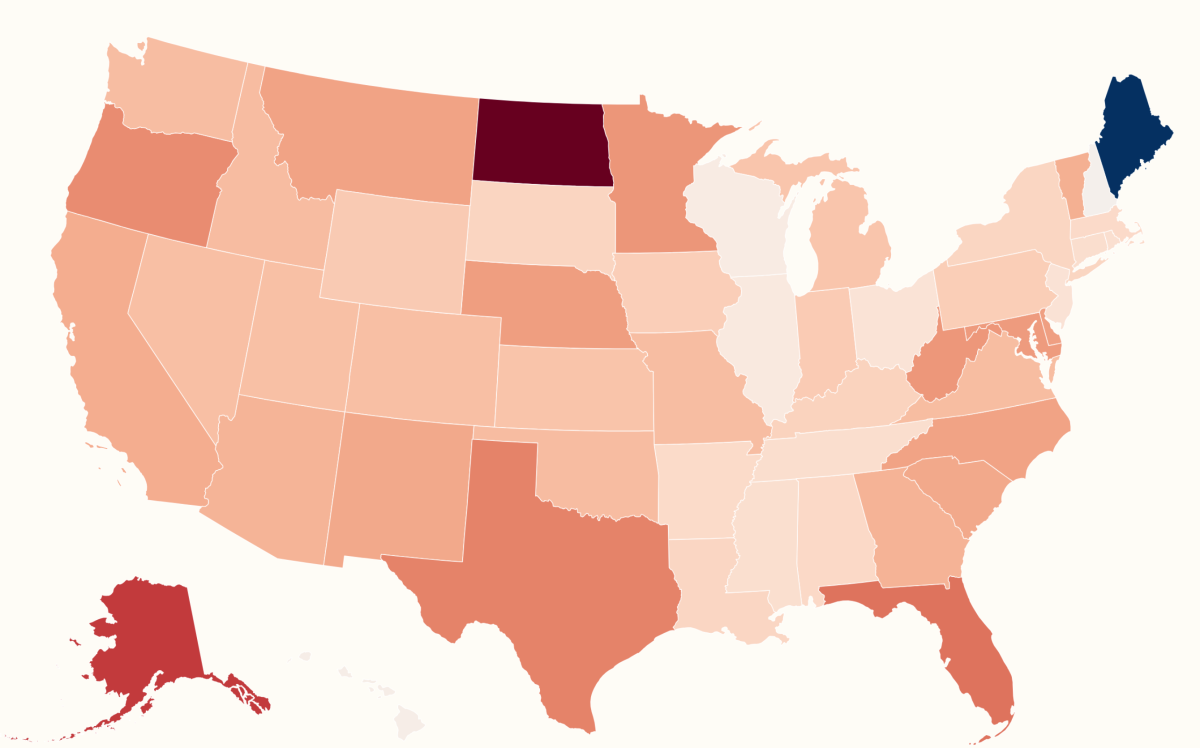
Personal bankruptcies are climbing across nearly every state as more families struggle under the weight of rising debt, high borrowing costs and persistent inflation.
The increase in bankruptcy filings adds to growing signs of financial stress across the U.S. economy, particularly among households already struggling with elevated housing costs, inflation and record levels of debt.
“At some point, rising household debt has to stop, but it may involve a lot of defaults and bankruptcies,” Lucia Dunn, a professor of economics at Ohio State University, told Newsweek.
New research from financial technology company SmartAsset found that personal bankruptcy filings increased year-over-year in 49 states between March 2025 and March 2026.
Separate data released by the American Bankruptcy Institute (ABI) in April showed that bankruptcies of nearly every type rose during the first quarter of 2026 as households and businesses faced mounting “economic pressures.”
Why Are Bankruptcies Rising?
Economists warn that if defaults continue rising, borrowing could become even more expensive as lenders respond to growing risk.
SmartAsset said the findings underscore the “acute financial distress” facing a growing number of Americans in 2026.
In its April analysis, the ABI said the rise in bankruptcies coincided with a “notable uptick” in credit card, mortgage and other forms of debt—offering clues as to why more Americans are turning to court-supervised financial relief.
Earlier this month, the Federal Reserve Bank of New York reported that total U.S. household debt climbed to a record $18.8 trillion in the first quarter, with balances increasing across most major loan categories.
While some economists argue the increase was largely driven by mortgage balances and does not yet signal broad instability, others warn growing debt burdens could place mounting pressure on both households and the wider economy.
Which States Are Seeing Bankruptcies Soar?
To determine which states experienced the biggest increases, SmartAsset analyzed nonbusiness Chapter 7, Chapter 11 and Chapter 13 filings across 84 bankruptcy courts over two 12-month periods ending March 31, 2025, and March 31, 2026.
Researchers found that filings rose in 49 states year-over-year. Maine was the lone exception, recording an 8.1 percent decline.
North Dakota and Alaska saw the sharpest increases, with filings rising 41 percent and 29 percent, respectively. However, both states still rank among the lowest nationally in total filings and filings per capita.
California recorded the highest number of overall filings during the period at 52,973, followed by Florida with 44,496 and Texas with 35,573.
However, population size plays a significant role, and all three states rank closer to the middle nationally when filings are adjusted per capita.
Alabama recorded the highest bankruptcy filing rate per 100,000 residents at 405, followed by Mississippi at 332 and Tennessee at 299.
Together with Georgia, SmartAsset described the region as part of the nation’s “bankruptcy belt.”
Rising Defaults Could Add Pressure to the Economy
Economists warn the rise in bankruptcies could have consequences beyond individual households, particularly if defaults continue accelerating alongside growing debt loads.
Dunn told Newsweek that, if defaults and bankruptcy filings continue rising, “we will probably see interest rates rise for all types of loans, and debt servicing will become more expensive for everybody.”
Pamela Foohey, a professor at the University of Georgia School of Law, previously told Newsweek that the growing number of Americans seeking bankruptcy protection could signal continued financial strain well into 2026 and beyond.
“Their increased filings show that their budgets are tightening, which seems largely due to inflation, which has increased the costs of food, housing, and gas, among other necessities,” Foohey said.
The professor added that the trend “seems likely to continue into the future.”
Read the full article here