



Usually, when a person is charged with criminal offences, they will say nothing to anyone other than their lawyers, and perhaps family and close friends.
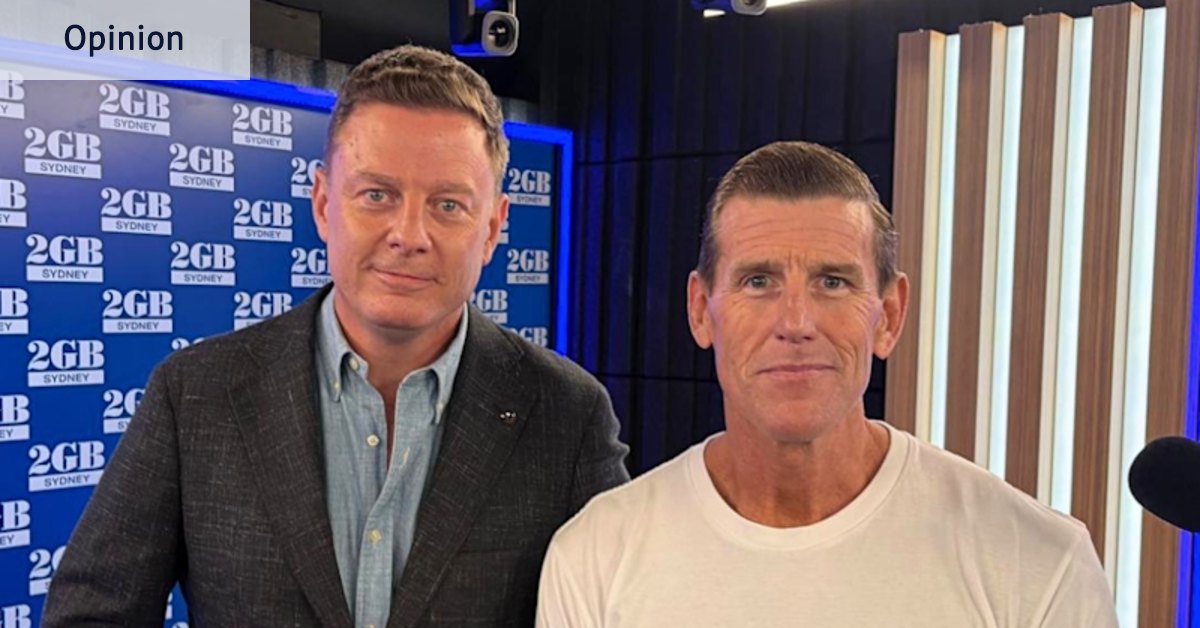
But former SAS soldier Ben Roberts-Smith has taken a radically different approach with his lengthy and sympathetic interview with Sydney radio host Ben Fordham on Thursday. Not only is this strategy different, there are risks attached to doing interviews before a criminal trial.
This is no critique of Roberts-Smith’s legal team. We don’t know what advice he was given or the tactical approach to the case.
Roberts-Smith has been charged with five counts of the war crime of murder alleged to have been committed in Afghanistan between 2009 and 2012.
He adamantly denies the charges, and of course, has the presumption of innocence. Thursday’s interview was wide-ranging and covered his denials about the allegations against him, but also his reflections on his unsuccessful Federal Court defamation case against the then-Fairfax and now-Nine newspapers.
In that case in 2023, Justice Anthony Besanko concluded that, on the balance of probabilities, Roberts-Smith had committed or was complicit in the murder of four Afghan men between 2009 and 2012 who were under the control of Australian forces.
An appeal to the Full Court of the Federal Court was unsuccessful, as was an application to the High Court in 2025 for leave to appeal the Full Court decision.
Some of the statements made by Roberts-Smith about that civil case are problematic, as Michael Bachelard pointed out in a fact check of the interview on Thursday. For example, Roberts-Smith said, “You don’t have to prove that it’s true.”
It was enough “to prove that they believe it, or that it might have happened”.
As Bachelard pointed out: “This gives the impression the defamation judgment was based on thin evidence. That is simply false.”
Roberts-Smith’s interview not only traversed his view of the Federal Court findings but also his view of the justice system. He wants to be given a fair go in the upcoming criminal trial.
“All I’m asking for is a fair shake, mate.” That’s what all defendants expect, and rightly so.
One of the dangers with high-profile criminal proceedings today is that the media, both traditional and social, sometimes advocates for a cause that arguably prejudices the rights of an accused by publishing damning material about them prior to a trial. This Roberts-Smith interview is the opposite. The accused has put himself in the limelight.
And why? Is it to influence the public narrative about Roberts-Smith to sway a potential jury?
Hugh Riminton argued in a piece published in this masthead on Thursday: “Technically, as he faces five counts of the war crime of murder, Roberts-Smith’s opponent is the Crown. But that’s not his target. Ultimately, it is the 12 as-yet unselected members of the jury.”
If that is the motive, then it is unusual to say the least, although it has been done before and regularly happens in the United States.
But there is a risk in it. And the risk is this: anything an accused says to the media can be – subject to it being admissible and relevant in a trial – used by the prosecution for the purposes of shaking the credibility of the accused if they give evidence.
For example, if a person says to a journalist “I didn’t tell the police X”, and in another media interview they have said the opposite, that inconsistency could be used to undermine the accused’s credibility.
The more you say to the media, the more material you potentially give to a prosecutor to sift through and find inconsistencies and false statements.
It is one thing, if the camera is in your face, to deny the charges and say you look forward to being vindicated; it is another to comment on findings from a defamation trial that is dealing with the same subject matters as the forthcoming criminal trial.
Roberts-Smith has powerful advocates in the media and the community.
It is surely in the interests of justice for them, and his critics, to be circumspect from now on so that the criminal trial process plays out. That is the way our justice system should work.
Greg Barns, SC, is a criminal lawyer and spokesman for the Australian Lawyers Alliance.
The Opinion newsletter is a weekly wrap of views that will challenge, champion and inform your own. Sign up here.
From our partners
Read the full article here